Why Unreviewed Code Fails in Production: A Dev’s Guide

Unreviewed code is the leading cause of preventable production failures, introducing hidden defects, security vulnerabilities, and fragile assumptions that conventional testing rarely catches. A large-scale empirical study of 302,600 AI commits across 6,299 GitHub repositories found that 22.7% of AI-introduced problems remain unresolved at the latest revision. That figure means roughly one in four issues shipped by AI assistants like GitHub Copilot quietly persists in your codebase. Modern CI/CD pipelines built on GitHub Actions and DevSecOps practices add another layer of risk: attackers can exploit unreviewed pipeline configuration files just as easily as application code. Understanding why unreviewed code fails in production starts with recognizing that the problem is not just about bugs. It is about hidden trust assumptions that no linter or unit test will surface.
How do unreviewed code changes directly cause production failures?
Unreviewed code fails in production through several distinct mechanisms, each harder to detect than a simple syntax error. The most common are semantic bugs: code that compiles and passes tests but behaves incorrectly under real conditions. An off-by-one error in a pagination query, an authorization check that only fires on the happy path, or a middleware function that silently swallows errors are all examples. None of these trigger a red build. All of them can take down a production service.
Pipeline poisoning is a less obvious but equally dangerous failure mode. Attackers modify repository content to trigger CI/CD systems to inject malicious instructions directly into shipped software artifacts. The attack does not require server access. It only requires that a build script or workflow file goes unreviewed. A single unaudited change to a GitHub Actions YAML file can redirect artifact signing, exfiltrate secrets, or replace a dependency with a malicious version.
Intermediate artifacts and caches introduce a third failure vector. Trusting cached pipeline states without strict validation leads to supply chain compromises even when legitimate credentials and signatures are present. A documented GitHub Actions exploit used poisoned caches restored and signed by legitimate workflows, resulting in 84 versions released with malicious code. The signatures looked valid. The code was not.
Production systems also fail due to wrong assumptions and misunderstood dependencies rather than outright code errors. A function that works perfectly in isolation can break an entire auth flow when it interacts with a stateful session cache it was never designed to touch. These failures are invisible to reviewers who only check whether the code looks correct, not whether it behaves correctly under system-level conditions.
- Semantic bugs: Logic errors that pass syntax checks but fail under real user conditions
- Pipeline poisoning: Unreviewed CI/CD config changes that inject malicious instructions into build artifacts
- Cache and artifact trust failures: Signed but compromised intermediate states that bypass credential checks
- Unhandled edge cases: Missing error paths in auth flows, rate limiting, and external API calls
- Fragile assumptions: Code that works in dev but breaks when concurrency, load, or state differs in production
Pro Tip: Never treat your CI/CD pipeline state as implicitly trusted. Audit every workflow file, cache restore step, and build script with the same rigor you apply to application code. A poisoned pipeline can ship malicious artifacts even when your application code is clean.
What distinguishes unreviewed code from reviewed code in production risk?
The gap between unreviewed and reviewed code is not simply the presence of a pull request approval. Reviewed code that passes a human gate still carries risk if the review process only checks for syntactic correctness. Reviewers regularly approve syntactically polished but semantically fragile code, especially AI-generated code, missing authorization flaws and failure path gaps. The review gate reduces risk. It does not eliminate it.
The real difference lies in the operational controls that surround the code. Well-governed code lives inside a system with architectural guardrails, automated verification, security controls at the release stage, and runtime observability. NIST NCCoE’s DevSecOps project demonstrates that SSDF-aligned processes integrated across build, integrate, release, and operate stages measurably reduce supply chain risk. That is the standard unreviewed code bypasses entirely.
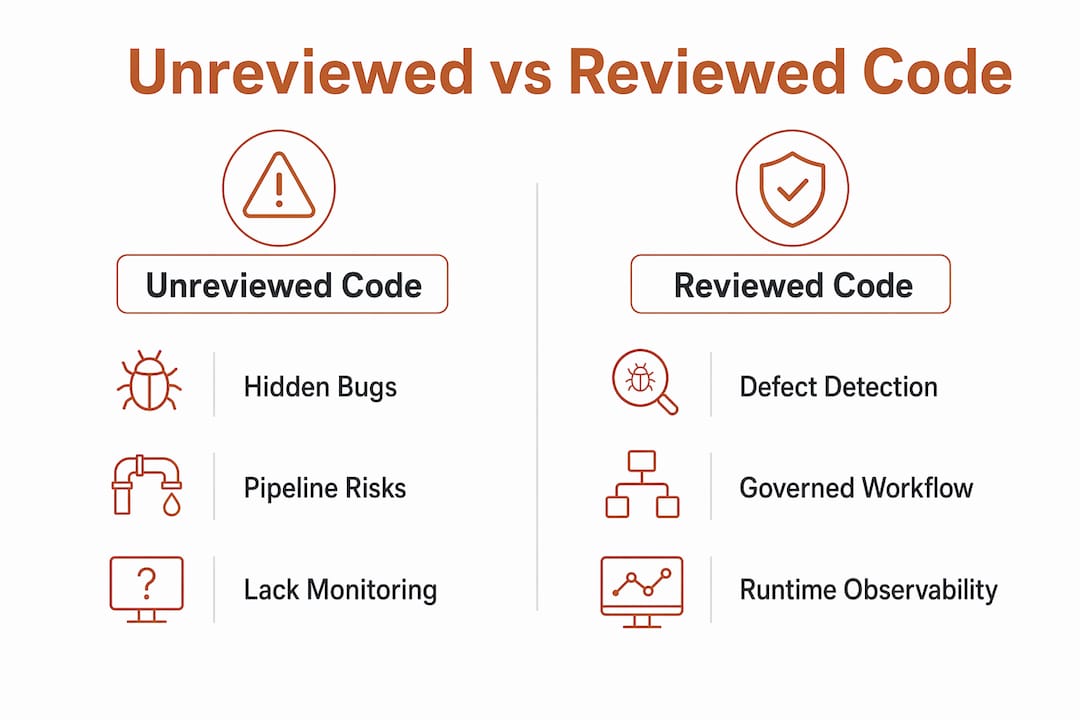
| Characteristic | Unreviewed code | Reviewed and governed code |
|---|---|---|
| Defect detection | Relies on production incidents | Caught at PR, CI, and release gates |
| Security posture | Exposed secrets, auth gaps, CVE risk | Scanned at commit and build stages |
| Pipeline trust | Config files unaudited | Workflow files treated as application code |
| Observability | Failures surface late, post-incident | Runtime monitoring catches latent issues early |
| AI-generated code handling | Treated as trusted output | Treated as untrusted input requiring verification |
The observability row in that table deserves emphasis. Teams that deploy without runtime monitoring discover failures through user complaints or outage alerts. Teams with proper observability detect anomalies in latency, error rates, or auth failures within minutes of deployment. That difference in detection time directly determines how much damage an unreviewed change causes.
How do AI tools affect the prevalence of unreviewed code failures?
AI coding assistants have collapsed the time from idea to working code, but they have also increased the volume of unreviewed changes reaching production. The Pith study of AI-authored commits found that more than 15% of commits introduce at least one issue, with code smells, correctness problems, and security vulnerabilities all represented. The code looks clean. The problems hide in logic, not syntax.
This creates a specific challenge for code review. AI-generated code is often well-formatted, well-commented, and syntactically correct. That surface quality builds false confidence in reviewers. A human reviewer scanning a 200-line AI-generated auth module may approve it quickly because it reads well, missing an authorization check that only fires on the first request in a session. Local tests miss complex system-level interactions that cause failures despite code reviews, and AI-generated code amplifies this problem by producing plausible-looking code at high volume.
Leadership teams that treat AI-generated commits as untrusted input see better outcomes. The practical shift is treating every AI-assisted change the same way you would treat a dependency update: verify it, scan it, and test it against system-level behavior, not just unit tests.
- Off-by-one errors: AI models frequently generate loop boundaries that are correct in isolation but wrong under edge conditions
- Authorization gaps: Auth checks placed on the wrong layer, or only on the primary code path
- Limit abuse: Rate limiting and quota logic that works in tests but fails under concurrent load
- Stale dependency assumptions: AI-generated code that references library versions or APIs that have changed
- Missing error propagation: Functions that catch exceptions silently instead of surfacing them to the caller
Pro Tip: Establish a written policy for AI-assisted commits. Require that every AI-generated change includes a system-level test covering at least one failure path, one concurrency scenario, and one auth boundary. This single policy catches the majority of AI-generated production failures before they ship.
What strategies actually prevent unreviewed code failures?
Preventing production failures from unreviewed code requires a layered approach. No single control is sufficient. The following workflow reflects what DevSecOps practitioners and NIST NCCoE guidance recommend for teams operating modern pipelines.
-
Lock down SCM and CI/CD permissions. Restrict who can modify workflow files, build scripts, and configuration. Treat these files as pipeline attack vectors with the same access controls as production secrets. Require separate approvals for pipeline changes versus application code changes.
-
Enforce automated security scanning at the commit stage. Static analysis, secret detection, and dependency vulnerability scanning should run on every pull request. Tools like GitHub Advanced Security, Semgrep, and Dependabot catch a large class of issues before human review begins.
-
Apply SSDF-aligned verification at the build and release stages. DevSecOps practices integrate security controls continuously across build, integrate, release, and operate stages. This means signing artifacts, validating provenance, and refusing to promote unsigned or unverified builds.
-
Treat AI-generated code as untrusted input. Flag AI-assisted commits in your PR template. Require reviewers to check system-level behavior, not just code correctness. Run integration tests that cover auth flows, concurrency, and failure paths specifically for AI-generated changes.
-
Instrument production for early detection. Deploy with structured logging, error rate dashboards, and latency alerts configured before the first user hits the service. Latent issues in unreviewed code surface fastest when you are watching for them.
-
Audit intermediate artifacts and caches. Never restore a cache in a CI/CD pipeline without validating its integrity. Pin dependency versions and verify checksums. A cache poisoning attack can survive a clean code review if the artifact layer is not audited.
The goal is not to slow down shipping. The goal is to make shipping fast and safe at the same time. Each layer in this model catches a different class of failure, so removing any one layer creates a gap that unreviewed changes will eventually exploit.
Key takeaways
Unreviewed code fails in production because hidden semantic flaws, pipeline trust gaps, and AI-generated fragility combine to bypass every control that only checks surface correctness.
| Point | Details |
|---|---|
| Semantic bugs outlast syntax checks | AI-generated code passes linters but hides auth gaps and logic errors that only appear under real conditions. |
| Pipelines are attack surfaces | Unreviewed CI/CD config files let attackers inject malicious code into signed, legitimate build artifacts. |
| Review gates are necessary but not sufficient | Human approval reduces risk but misses system-level failures; automated scanning and observability are required complements. |
| AI commits need untrusted-input treatment | More than 15% of AI-authored commits introduce at least one issue, so every AI-assisted change needs system-level verification. |
| Observability determines damage scope | Teams with runtime monitoring detect latent failures in minutes; teams without it discover them through user-reported outages. |
The uncomfortable truth about “reviewed” code
At Vibeprod, we see a consistent pattern: teams that believe their code is reviewed are often the most surprised when production fails. The review happened. The approval was genuine. The failure was still real.
The reason is that most code review processes were designed for a world where a human wrote every line and understood the system context. AI assistants have changed that assumption. They produce high volumes of syntactically clean code that reviewers approve quickly because it reads well. The semantic fragility hides underneath. An auth flow that looks correct in isolation can break the moment it touches a stateful session cache or a rate limiter it was never designed to interact with.
The teams that handle this well share one trait: they treat production readiness as a system property, not a code property. They ask not just “is this code correct?” but “does this code behave correctly inside our specific system, under load, with real users?” That shift requires cultural change, not just better tooling. Tooling helps. But a team that does not own the full pipeline, from commit to runtime, will keep finding failures in production that passed every gate before deployment.
The other uncomfortable truth is that pipeline hygiene is still treated as an ops concern rather than a developer concern. Build scripts and workflow files are code. They carry the same risk as application code, and in some cases more, because they have direct access to secrets, signing keys, and artifact registries. Until developers treat every YAML file in .github/workflows with the same scrutiny as a payment processing module, supply chain attacks will keep succeeding through the path of least resistance.
— Vibeprod
Vibeprod scans your repo before production finds the problems
Shipping fast matters. Shipping with hidden defects in your auth flow, exposed secrets in your config, or unreviewed pipeline files matters more. Vibeprod scans your GitHub repository and identifies launch risks in under two minutes, generating reviewable pull requests for each fix without touching your existing features.
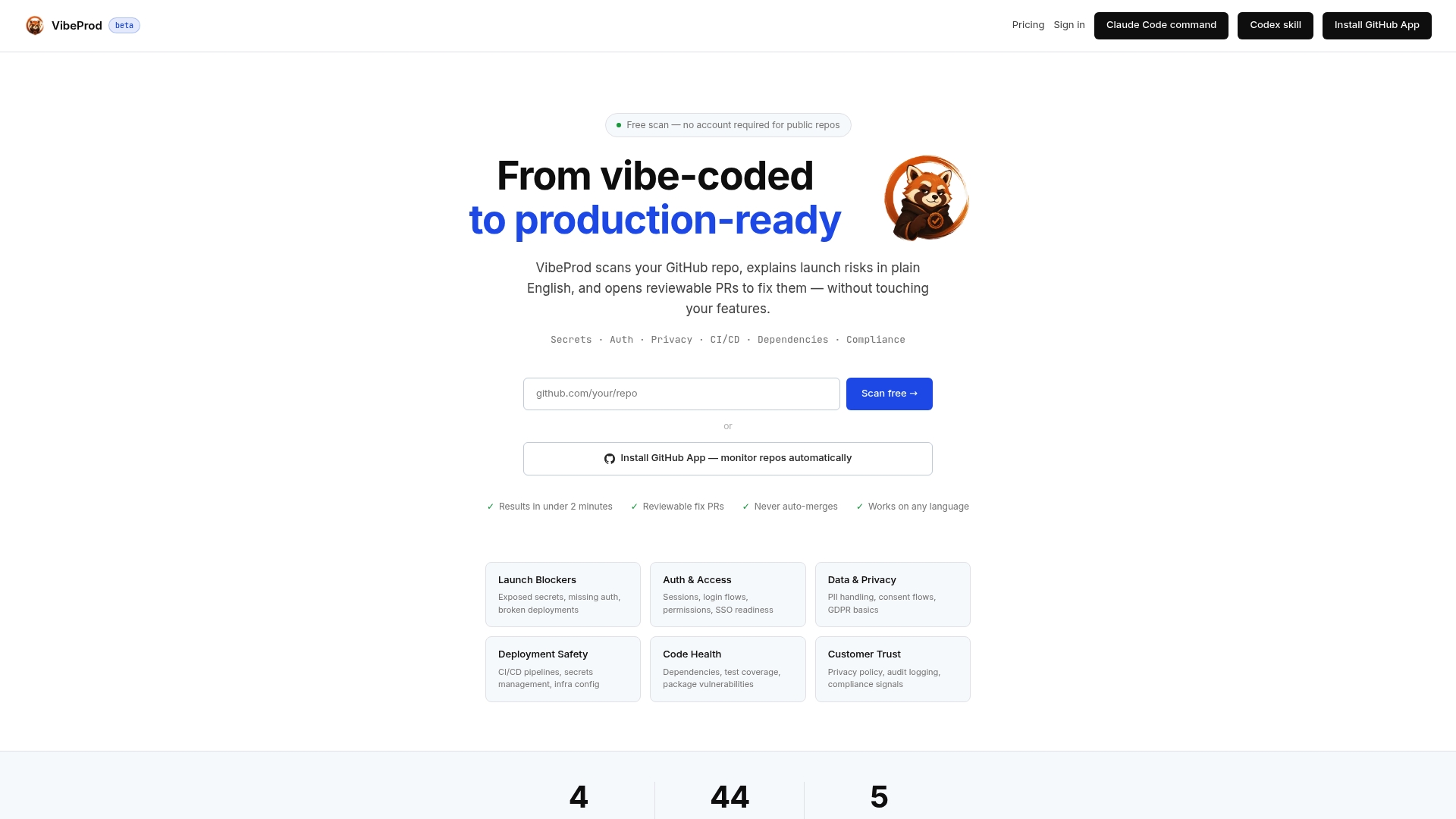
Every issue comes with a plain-English explanation, so you understand what failed and why, not just that something needs to change. For solopreneurs and small teams shipping AI-assisted code, Vibeprod fills the gap between prototype and production-ready code that manual review consistently misses. If your last deployment skipped a security scan or shipped an unreviewed workflow file, your next one does not have to.
FAQ
What is the most common reason unreviewed code fails in production?
Unreviewed code most often fails due to semantic bugs and hidden assumptions rather than syntax errors. These include authorization gaps, unhandled failure paths, and fragile interactions with stateful dependencies that only appear under real production conditions.
Does passing a code review mean code is safe to deploy?
No. Review gates reduce but do not eliminate risk. Reviewers can approve syntactically correct code that contains semantic flaws, especially AI-generated code, so automated scanning and runtime observability are required complements to human review.
How does AI-generated code increase production failure risk?
AI-authored commits introduce issues in more than 15% of cases, with 22.7% of those problems persisting unresolved. The code looks clean, so it passes review quickly, but logic errors, auth gaps, and limit abuse bugs hide beneath the polished surface.
What is a poisoned pipeline attack?
A poisoned pipeline attack occurs when an attacker modifies a repository’s build scripts or CI/CD configuration files to inject malicious instructions into shipped artifacts. The attack does not require direct server access, only an unreviewed change to a workflow or configuration file.
How can teams detect unreviewed code failures faster?
Runtime observability is the fastest detection method. Structured logging, error rate dashboards, and latency alerts configured before deployment allow teams to catch latent issues within minutes rather than discovering them through user-reported outages.