Why AI Dev Tools Skip Compliance: A Dev & Founder Guide
TL;DR:
- AI coding assistants generate plausible code without considering security, compliance, or architectural constraints.
- Automated enforcement, audits, and specification-driven development are essential for maintaining regulatory compliance in AI-generated code.
AI coding assistants optimize for statistically plausible code, not your organization’s security policies, regulatory obligations, or architectural constraints. That single fact explains most of the compliance gaps developers discover at audit time. Better prompts won’t fix this. Developer-owned controls, updated review processes, and automated enforcement layers are what actually make AI output auditable.
The stakes are real. The EU AI Act sets fines for prohibited practices up to €35 million or 7% of global annual turnover, and for high-risk violations up to €15 million or 3% of turnover. The NIST AI Risk Management Framework gives U.S. teams a parallel governance structure. Tools like Vibeprod exist precisely because the gap between “it runs” and “it’s compliant” is wider than most founders realize until a pen test or audit surfaces it.
- AI tools have no access to your ADRs, Confluence docs, or internal security policies
- Models suggest EOL packages because those packages dominated their training data
- Per-developer API keys and local tool setups create audit blind spots
- Compliance responsibility stays with the developer who commits the code
Table of Contents
- Why AI dev tools skip compliance: the technical root causes
- How organizational gaps let non-compliant AI code proliferate
- What are the real risks for U.S. companies?
- How to absorb AI-generated code into a compliant SSDLC
- What tools should you add to your enforcement stack?
- How Vibeprod closes the gap between fast AI output and compliance
- Your 30/90/180-day action plan
- Key Takeaways
- The compliance gap is an engineering problem, not a policy problem
- Scan your repo before your next deploy
- Useful sources
- FAQ
Why AI dev tools skip compliance: the technical root causes
AI coding tools are trained on public repositories. They internalize what was common, not what was correct or current. When a model suggests requests==2.18.0 or an older JWT library, it’s not making a security decision. It’s pattern-matching against historical popularity.
The architectural blindness compounds this. Your model has no access to your internal wiki, your approved dependency list, or your data residency requirements. It cannot enforce site-specific constraints it has never seen. Every suggestion is context-free relative to your stack.

Hallucination adds another layer. Models occasionally invent package names or API signatures that look plausible but don’t exist, or exist in deprecated form. These pass a syntax check and sometimes even a basic test suite, only to surface as a CVE or a failed dependency resolution in CI.
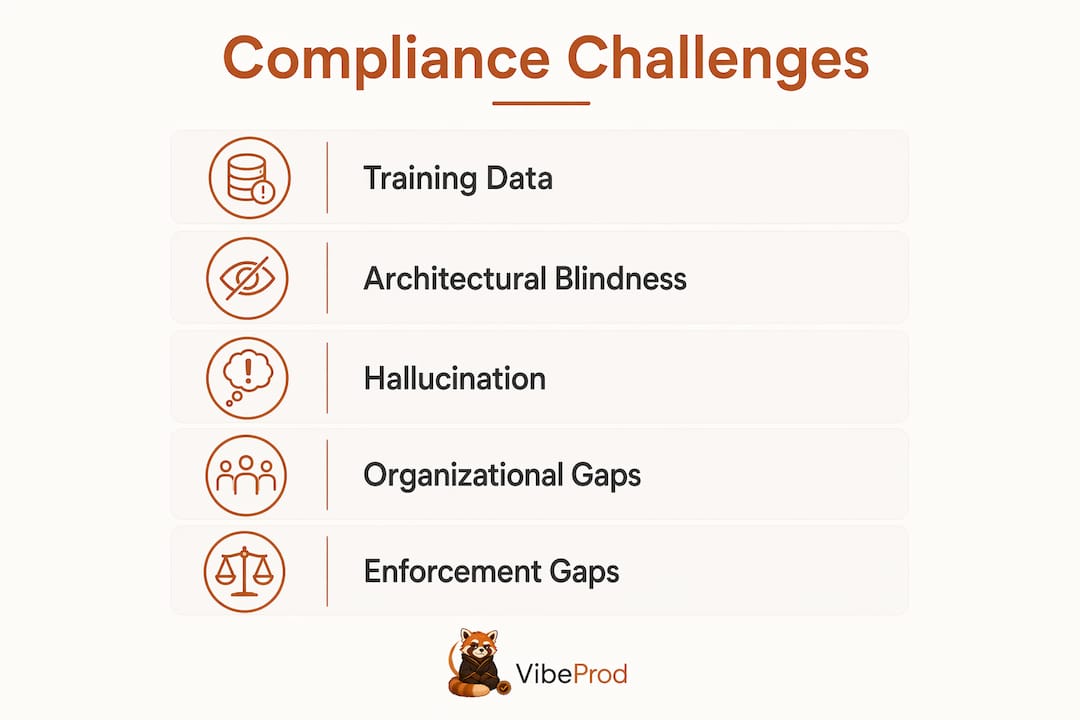
Per-developer tool setups make this worse. When each developer runs their own local API key with no centralized logging, there’s no audit trail. SOC 2 and HIPAA both require demonstrable access controls and logging. A local key with no telemetry is invisible to your compliance posture.
Pro Tip: Don’t try to fix this at generation time with better prompts. Add a centralized enforcement hook at PR-time: a CI gate that blocks merges on policy violations regardless of how the code was generated.
- Training data reflects historical popularity, not current maintenance status
- No internal context: models can’t see your ADRs, approved libraries, or data policies
- Statistical plausibility drives suggestions, not regulatory adherence
- Local API keys and no centralized logging prevent auditability
How organizational gaps let non-compliant AI code proliferate
The technical failures are real, but the organizational failures are what let them reach production. James Wondrasek of SoftwareSeni has described spec-driven development (SDD) as the practical antidote to “vibe coding,” where developers prompt their way through features without formal specifications. SDD produces the compliance artifacts regulators actually look for: versioned specifications, human authorization records, and traceable decision logs.
Governance fragmentation is the other half of the problem. Product, security, and compliance teams often run independent AI initiatives with no shared artifact system. Compliance teams lack the AI technical depth to evaluate model outputs. Engineers lack the regulatory fluency to recognize when a shortcut creates a legal exposure. Neither group has a complete inventory of what AI tools are running or what they’ve produced.
- Vibe coding leaves no specification, no approval record, no audit trail
- SDD shifts compliance from a manual task to a by-product of engineering workflows
- Fragmented ownership means no single team has full visibility into AI-generated code
- Skill mismatch: compliance teams and engineers rarely share a common language or toolset
What are the real risks for U.S. companies?
EOL dependencies dragged in by AI suggestions don’t announce themselves. They pass tests, ship to production, and surface months later as a CVE in a pen test or a finding in a SOC 2 audit. By then, the blast radius is larger and the remediation cost is higher.
On the regulatory side, the EU AI Act is the most concrete benchmark for severity. Violations of prohibited practices can reach €35 million or 7% of global annual turnover; high-risk violations carry fines up to €15 million or 3% of turnover. U.S. companies with EU customers or EU data are directly in scope. Foley & Lardner’s analysis notes the EU Act is the world’s first comprehensive AI regulation, and cross-jurisdiction complexity is growing as U.S. states and the FTC advance their own enforcement frameworks.
Regulatory callout: U.S. enforcement channels include FTC Section 5 unfair practices authority, state-level AI and privacy laws (California, Colorado, Texas), and contractual liability when a vendor’s AI-generated code violates a customer’s data processing agreement.
- EOL dependencies increase breach risk and CVE exposure silently
- Unlogged AI telemetry fails SOC 2, HIPAA, and FedRAMP audit requirements
- Cross-border regulation creates overlapping obligations for any company with EU customers
- Contractual exposure: customer DPAs and vendor agreements often prohibit non-compliant code
How to absorb AI-generated code into a compliant SSDLC
Treating AI output as third-party input is the right mental model. You wouldn’t merge an unreviewed external library without a security check. AI-generated code deserves the same scrutiny.
- Adopt SDD for AI-assisted features. Write a spec before prompting. The spec becomes your compliance artifact.
- Require human authorization at merge. No AI-generated code merges without a named reviewer sign-off logged in your version control system.
- Add PR-time blocking gates. CI checks for EOL dependencies, exposed secrets, and policy violations must block merges, not just warn.
- Generate SBOMs on every build. Software Bill of Materials gives auditors the provenance chain they need.
- Update onboarding docs. New developers need to know which AI tools are approved, how to log usage, and what the review requirements are.
A living system of record that continuously maps assets to obligations beats a static spreadsheet. Models and dependencies drift. Your compliance evidence needs to drift with them.
- Update code review rules to flag AI-generated sections for enhanced scrutiny
- Add audit logging for all AI tool interactions where centralized keys are feasible
- Require SBOMs and provenance documentation for every dependency added by AI suggestion
What tools should you add to your enforcement stack?
Automated controls are what make enforcement consistent. Here’s a prioritized list:
- Centralized API key management and logging — eliminates the audit blind spot created by per-developer local keys
- SCA tuned for EOL detection — tools like OWASP Dependency-Check or Snyk flag packages past their maintenance window, not just known CVEs
- SBOM generation in CI — CycloneDX or SPDX formats give you a machine-readable dependency manifest per build
- Policy-as-code gates — Open Policy Agent (OPA) or similar lets you encode your approved library list and data residency rules as enforceable CI checks
- Secret scanning — GitHub Advanced Security, Gitleaks, or TruffleHog catch exposed credentials before they reach production
- SAST/DAST integration — static and dynamic analysis on AI-generated code catches logic flaws that SCA misses
- Model interaction telemetry — log which prompts produced which code blocks for traceability in regulated environments
Medium-priority additions include prompt scanning for sensitive data leakage and drift detection for dependency lifecycle changes. For teams using AI automation in business operations, centralized visibility into which agents are running and what code they’re producing is equally critical.
Pro Tip: Make enforcement synchronous. An advisory warning that a developer can click past is not a control. A merge block is.
How Vibeprod closes the gap between fast AI output and compliance
Vibeprod scans your GitHub repository and surfaces the exact issues that AI-generated code tends to introduce: exposed secrets, EOL dependencies, authentication gaps, CI/CD misconfigurations, and privacy issues. It generates plain-English explanations for each finding and opens a reviewable fix pull request without auto-merging or touching your existing features.
The workflow maps directly to the SSDLC gates described above:
- Detect on push: Vibeprod scans the repository and identifies launch risks
- Open fix PR: A reviewable pull request is created with the proposed remediation
- Developer reviews and merges: You stay in control; nothing merges without your sign-off
- CI re-scan and SBOM update: The pipeline re-validates after merge
Vibeprod provides compliance insights rapidly, enabling quick identification of AI-generated code risks. For a solo founder or small team without a dedicated security engineer, that’s the difference between shipping with known gaps and shipping with a documented, reviewable remediation record. Vibeprod operationalizes the enforcement layer without slowing your velocity.
Your 30/90/180-day action plan
Within the first month, engineering leads should inventory all AI tools in use and centralize API key management to enable effective oversight. Within the first month, engineering leads should enable software composition analysis tuned for end-of-life datasets in continuous integration to flag outdated dependencies before merge.
Within the first month, engineering leads should add pull request blocking gates for critical compliance issues to prevent merging problematic code. Within three months, engineering and compliance teams should integrate Software Bill of Materials generation into every build to improve dependency visibility. Within three months, engineering leads should adopt spec-driven development gating to require specifications before prompting AI for feature development. Within three months, all developers should complete AI compliance training and implement approval workflows with logged sign-offs. Within six months, engineering and legal teams should deploy a living AI system-of-record with automated continuous drift monitoring and reporting. Within six months, legal teams should ensure vendor contracts include clauses covering AI code provenance and compliance documentation.
-
Start with the inventory. You can’t govern what you can’t see.
-
Add blocking gates before training. Controls that run automatically don’t depend on developer memory.
-
Build the living record last. It requires the earlier layers to have data to track.
Key Takeaways
AI dev tools skip compliance because they optimize for plausibility, not policy, and because organizational controls have not caught up to the speed of AI-assisted development.
| Point | Details |
|---|---|
| Root cause is architectural | Models trained on public repos have no access to your internal policies, ADRs, or approved dependency lists. |
| EOL dependencies are a silent risk | AI suggestions reflect historical popularity; SCA tuned for EOL detection is the direct countermeasure. |
| Blocking gates beat advisory warnings | Synchronous PR-time enforcement is the only control that doesn’t depend on developer discipline. |
| SDD produces compliance artifacts automatically | Spec-driven development generates the approval records and versioned docs auditors require, as a by-product of building. |
| Vibeprod scans and fixes in under two minutes | Vibeprod opens reviewable fix PRs for exposed secrets, EOL dependencies, and compliance gaps without auto-merging. |
The compliance gap is an engineering problem, not a policy problem
The conventional framing treats AI compliance as a governance issue to be solved with better policies and training. That’s half right. Policies without automated enforcement are just documents. The teams that close the gap fastest are the ones that treat compliance as an engineering constraint and wire it into the build pipeline the same way they wire in tests.
The real risk isn’t that developers are careless. It’s that AI tools collapsed the time from idea to working code so dramatically that the review steps that used to happen naturally, during longer development cycles, now have to be explicitly engineered back in. That’s not a criticism of AI-assisted development. It’s a design requirement for anyone shipping production software.
Scan your repo before your next deploy
Most compliance gaps in AI-generated code are fixable in hours once you know where they are. The problem is visibility. Vibeprod scans your GitHub repository, surfaces exposed secrets, EOL dependencies, authentication gaps, and CI/CD misconfigurations, and opens a plain-English fix PR you can review and merge on your own terms.
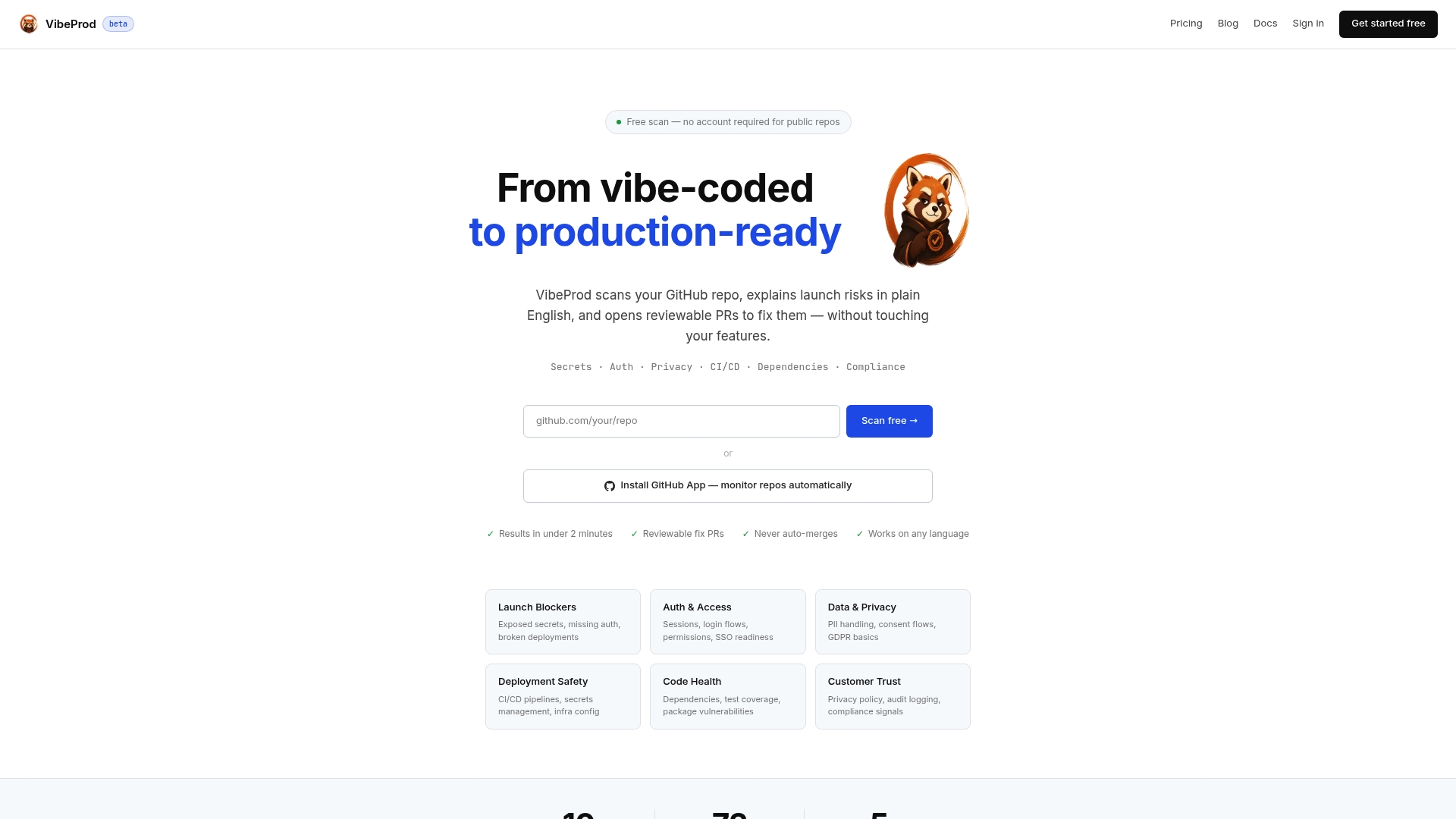
No auto-merging. No black-box changes. Just a clear picture of your launch risks in under two minutes, with a reviewable remediation path attached. If you’re shipping AI-assisted code and haven’t run a compliance scan, that’s the next step. Run your first scan free.
Useful sources
- EU AI Act, Article 99 — the primary text on penalties for prohibited practices and high-risk violations; essential reading before any cross-border deployment
- Foley & Lardner: Compliance and enforcement in global AI regulation — legal analysis of cross-jurisdiction complexity and what U.S. companies must prepare for
- Tenable: Security for AI guide — practitioner guidance on treating AI-generated code as third-party input and updating SSDLC
- HeroDevs: AI coding assistants and compliance posture — detailed breakdown of how EOL dependencies propagate through AI suggestions
- Proofpoint: What Is AI Compliance? — overview of governance fragmentation and the need for centralized AI asset inventory
- Alation: EU AI Act compliance guide — explains why static registries fail and how to build a living system of record
- Medium: Why AI code never follows your standards — accessible deep-dive on model training limitations and why prompt engineering alone is insufficient
This article is general information, not legal or compliance advice. Confirm current regulatory requirements with a qualified attorney or compliance professional for your specific situation.
FAQ
Why do AI coding tools produce non-compliant code?
AI tools are trained on public repositories and optimize for statistically plausible output, not your organization’s internal policies, approved dependency lists, or regulatory obligations. They have no access to your ADRs, security standards, or data residency requirements.
Do AI dev tools need compliance controls?
Yes. The developer who reviews and commits AI-generated code remains legally and operationally responsible for it. Treat AI output as third-party input and apply the same SCA, secret scanning, and review gates you would to any external dependency.
What is the biggest compliance risk from AI-generated code?
EOL dependencies are the most common silent risk: AI suggestions reflect historical package popularity, not current maintenance status, so outdated libraries ship to production and surface as CVEs during audits or pen tests.
How does Vibeprod help with AI code compliance?
Vibeprod scans your GitHub repository and opens reviewable fix pull requests for exposed secrets, EOL dependencies, authentication gaps, and CI/CD misconfigurations, with plain-English explanations and no auto-merging, delivering results in under two minutes.
What U.S. regulations apply to AI-generated code?
FTC Section 5 authority, state-level AI and privacy laws (California, Colorado, Texas), and contractual obligations in customer data processing agreements all create exposure. Companies with EU customers are also directly in scope for the EU AI Act: prohibited practice violations can result in fines up to €35 million or 7% of global turnover, and high-risk violations up to €15 million or 3% of global annual turnover.