What Is Production Readiness? A Developer’s Guide

Production readiness is the state where an application meets all operational, reliability, and security requirements to perform safely in a live environment. It goes far beyond passing tests. A production-ready service has defined service level agreements (SLAs), working incident response playbooks, continuous monitoring, and security controls embedded throughout the codebase. For developers shipping fast with AI-assisted tools, the gap between a working prototype and a production-ready product is exactly where real risk lives. Understanding production readiness criteria before you deploy is the difference between a smooth launch and a 2 a.m. incident.
What is production readiness in software deployment?
Production readiness is the full set of operational capabilities that allow a service to run reliably, securely, and efficiently once it is live. Atlassian defines operational readiness as pre-development established requirements covering availability, reliability, data loss prevention, and restoration, all tied to service tiers. That definition matters because it frames readiness as something you design before you write a single line of code, not something you bolt on before launch.
The core insight here is that production readiness is not a checklist you complete once. It is a continuous state your application either maintains or loses as it evolves. Teams that treat it as a one-time gate consistently face post-deployment surprises: exposed secrets, missing alerts, or auth flows that break under real traffic. The production readiness criteria you define upfront become the standard your CI/CD pipeline enforces on every merge.

Atlassian, USENIX, and NIST each approach production readiness from different angles. Atlassian focuses on operational tiers and SLAs. USENIX centers on Production Readiness Reviews (PRRs) as a reliability practice. NIST anchors the security dimension through its Secure Software Development Framework (SSDF). Together, these three frameworks cover the full spectrum of what production readiness explained properly looks like.
What components and criteria define production readiness?
Production readiness criteria fall into six core categories. Each one addresses a distinct failure mode that can take your service down or expose your users.
- Service tiers and SLAs. Define your service tier before development starts. A Tier 1 service with a 99.9% uptime SLA demands far more rigor than an internal tool. Defining service tiers before development embeds operational thinking from day one and reduces post-production issues significantly.
- Testing coverage. Unit tests, integration tests, and end-to-end tests each catch different failure types. A service without end-to-end test coverage may pass unit tests and still fail when middleware, auth flows, and database calls interact under production load.
- Monitoring and observability. Metrics, logs, and distributed tracing must be in place before go-live. Observability is not optional. Without it, you are debugging production incidents blind.
- Alerting tied to SLOs. Alerts must connect to SLOs and come with actionable playbooks. Alerts without playbooks cause alert fatigue and delayed incident response. An on-call engineer who sees an alert with no runbook will waste critical minutes figuring out what to do.
- Incident response playbooks. Every critical failure scenario needs a documented response. Playbooks should cover rollback procedures, escalation paths, and communication templates.
- Security controls. Exposed secrets, missing rate limiting, and unpatched CVEs are the most common production-readiness failures in AI-generated code. Security must be embedded in the pipeline, not reviewed manually at the end.
Pro Tip: Run a production readiness checklist against your service tier, not against a generic template. A Tier 3 internal tool does not need the same alerting depth as a customer-facing payment service.
How does the Production Readiness Review process work?
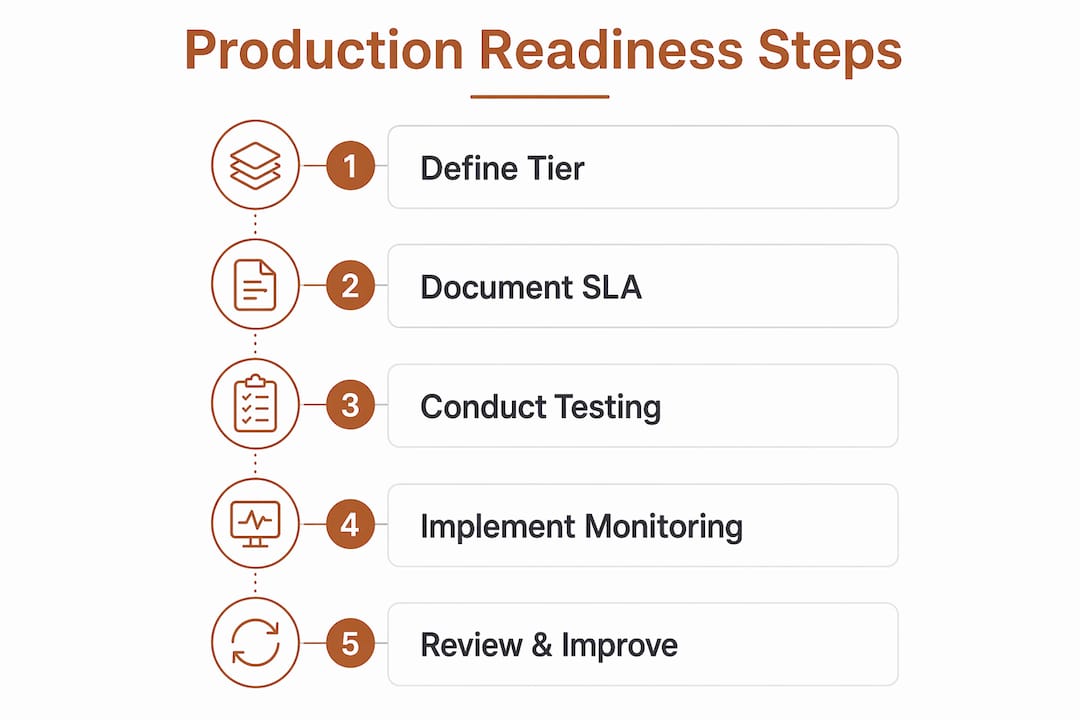
A Production Readiness Review (PRR) is a structured assessment that a development team and a review team conduct together before a service goes live. USENIX describes PRRs as reliability-needs assessments that ask detailed questions about alerting, playbooks, and SLO-linked instrumentation. The goal is to surface readiness gaps before users encounter them.
A typical PRR follows this sequence:
- Scope the service. Define what is being reviewed: a new service, a major feature, or a significant infrastructure change.
- Identify failure scenarios. Starting with known failure scenarios validates whether instrumentation, alerts, and recovery workflows actually address real risks.
- Review observability. Confirm that metrics, logs, and traces are in place and that dashboards reflect the service’s SLOs.
- Audit alerting and playbooks. Check that every alert maps to an SLO and links to a playbook with clear remediation steps.
- Assess scalability and disaster recovery. Verify that the service handles load spikes and that rollback procedures are tested and documented.
- Document gaps and assign owners. Every gap found in the PRR becomes a tracked action item with a deadline and an owner.
“PRRs help scale production expertise when SRE resources are limited, enabling proactive operational improvement and feedback loops between development and infrastructure teams.” — USENIX
The PRR process is most valuable when it feeds a continuous improvement loop. Teams that run PRRs only at launch miss the point. The real benefit comes from running lightweight PRRs after major incidents, after significant feature additions, and on a regular cadence for critical services.
How does production readiness vary by organization size?
Production readiness is a spectrum. Port.io states that readiness checklists and scorecards adapt based on organizational context and risk appetite. A two-person startup shipping an MVP needs a baseline level of readiness. An enterprise running a payment processing service needs a fundamentally different level of rigor.
| Dimension | Startup / Small Team | Enterprise |
|---|---|---|
| Service tiers | Informal or single tier | Formally defined tiers with SLAs |
| Testing | Unit and basic integration tests | Unit, integration, end-to-end, and chaos testing |
| Monitoring | Basic uptime checks | Full observability stack with distributed tracing |
| Alerting | Email or Slack notifications | SLO-linked alerts with on-call rotation and playbooks |
| Security | Manual review before launch | Automated security gates in CI/CD pipeline |
| PRR process | Informal self-review | Structured review with dedicated SRE team |
The table above shows the gap, but the principle is the same at every scale: your readiness process must match your service’s criticality and your users’ expectations. A startup that skips monitoring entirely will eventually face an outage it cannot diagnose. An enterprise that applies startup-level rigor to a Tier 1 service will face regulatory and reliability consequences.
Atlassian uses an automated production readiness indicator that shows green or red based on whether checkable requirements for a service’s assigned tier are fulfilled. That kind of automated signal is achievable at any scale. Developer portals like Backstage can surface readiness status across all services in a single view.
Pro Tip: Assign a service tier to every service you build, even internal tools. The tier forces you to define the minimum readiness bar before you start building.
How do security and compliance fit into production readiness?
Security is not a separate phase. It is a production readiness criterion that must be verified at every stage of development. The NIST Secure Software Development Framework (SSDF) prescribes embedding secure development practices into each SDLC phase to detect and prevent vulnerabilities proactively. That means security tasks belong in your CI/CD pipeline, your code review process, and your PRR checklist.
The most common security failures in production-ready assessments include:
- Exposed secrets. API keys, database credentials, and tokens committed to GitHub repositories are the leading cause of production security incidents in AI-generated codebases.
- Missing authentication controls. Auth flows that work in development often break under edge cases in production. Rate limiting, session expiry, and token validation must be tested explicitly.
- Unpatched dependencies. Known CVEs in third-party packages are a direct production readiness failure. Automated dependency scanning via tools like Dependabot or Snyk catches these before deployment.
- Insufficient logging for compliance. Regulations like SOC 2, GDPR, and HIPAA require specific audit logging. Missing logs are a compliance gap that surfaces during audits, not during testing.
NIST NCCoE emphasizes continuous security monitoring and process improvement within automated pipelines to maintain readiness. The DevSecOps model treats security as a shared responsibility across development, security, and operations teams. Production readiness requires lifecycle-integrated security rather than point-in-time scans at go-live. A single pre-launch scan misses vulnerabilities introduced after that scan. Continuous scanning catches them as they appear.
The complexity challenge is real. Rapid development with AI coding tools like GitHub Copilot or Cursor can produce working code faster than security reviews can keep up. That speed gap is where most production security failures originate.
Key Takeaways
Production readiness is a continuous operational state, not a pre-launch checklist, and it requires defined service tiers, SLO-linked alerting, lifecycle-integrated security, and structured PRRs to sustain reliably.
| Point | Details |
|---|---|
| Define tiers before coding | Assign a service tier and SLA before development starts to set the minimum readiness bar. |
| Alerts need playbooks | Every alert must connect to an SLO and link to a runbook; alerts without playbooks cause alert fatigue. |
| PRRs surface gaps early | Run structured Production Readiness Reviews before launch and after major incidents to catch readiness failures. |
| Security belongs in the pipeline | Embed automated security checks in CI/CD to catch exposed secrets, CVEs, and auth failures continuously. |
| Readiness scales with risk | Match your readiness process to your service’s criticality and your organization’s risk tolerance. |
Production readiness is never really done
The most common mistake I see developers make is treating production readiness as a finish line. You check the boxes, you deploy, and you move on. That model fails the moment your service grows, your team changes, or a new dependency introduces a CVE.
What actually works is treating readiness as a living signal. At Vibeprod, we see this pattern constantly: developers ship fast, the code works, and then three weeks later a secret gets rotated and suddenly the auth flow breaks in production. The code was never the problem. The readiness process was.
The teams that handle production well are the ones who define their service tier on day one, wire their alerts to SLOs before launch, and run a lightweight PRR after every significant change. They do not wait for an incident to ask whether their playbooks are current. They check on a schedule.
The uncomfortable truth about production readiness is that it costs more to skip it than to build it in. A two-hour PRR before launch is cheaper than a four-hour incident response at 2 a.m. Automated security scanning in your CI/CD pipeline is cheaper than a breach disclosure. The math is not complicated. The discipline to act on it before something breaks is the hard part.
Start with your service tier. Define your SLA. Wire your first alert to an SLO. That is not a complete production readiness program, but it is a foundation you can build on. Every additional layer you add reduces the risk of the next incident.
— Vibeprod
Vibeprod helps you close the production readiness gap
Shipping fast is a competitive advantage. Shipping without a production readiness check is a liability.
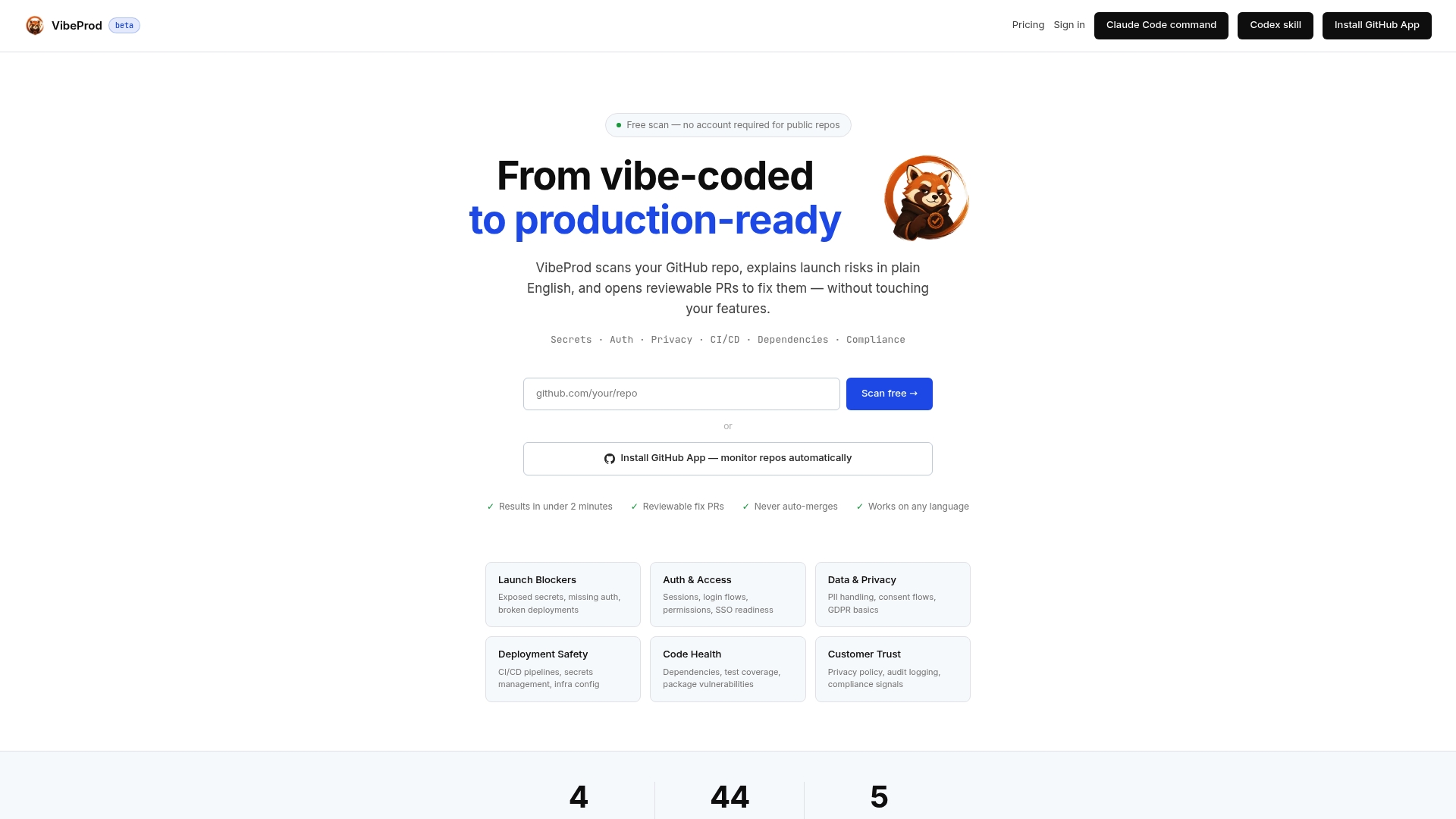
Vibeprod scans your GitHub repository and identifies launch risks including exposed secrets, missing compliance controls, and security gaps in under two minutes. It generates reviewable pull requests for each fix, with plain-English explanations, so you understand what changed and why. You stay focused on your core product logic. Vibeprod handles the production readiness review that AI coding tools skip. If you are building as a solopreneur or a small team and want to ship production-ready code without a dedicated security team, Vibeprod is built for exactly that workflow.
FAQ
What is production readiness in simple terms?
Production readiness is the state where your application is stable, secure, and monitored enough to handle real users without unexpected failures. It covers operational requirements like SLAs, alerting, incident response, and security controls.
What does a production readiness checklist include?
A production readiness checklist covers service tier definition, SLA documentation, testing coverage, monitoring and alerting tied to SLOs, incident response playbooks, security controls, and compliance logging. The specific items vary based on your service’s criticality and organizational risk tolerance.
What is a Production Readiness Review (PRR)?
A PRR is a structured assessment conducted before a service goes live, covering observability, reliability, incident handling, scalability, security, and disaster recovery. USENIX describes PRRs as joint reviews between development and infrastructure teams that surface readiness gaps before users encounter them.
How does security fit into production readiness?
Security is a core production readiness criterion, not a separate phase. The NIST SSDF framework recommends embedding security tasks throughout the SDLC so vulnerabilities are caught continuously rather than only at go-live.
How do I assess production readiness for a small team?
Start by assigning a service tier and defining a minimum SLA. Add basic monitoring, at least one SLO-linked alert with a playbook, and automated dependency scanning. Scale your process up as your service’s criticality and user base grow.