What Does Production-Safe Code Mean? A Dev Guide
TL;DR:
- Production-safe code behaves correctly under real traffic and conditions, prioritizing observable failures and rollback ability. It relies on engineering principles like predictability, containment, observability, and maintainability to ensure reliability in production. Tools like Vibeprod automate critical safety checks, reducing deployment risks and closing the gap between prototypes and high-quality production software.
Production-safe code is code that behaves correctly under real traffic, real data shapes, and real failure conditions — not just code that compiles or passes tests. The goal isn’t to be bug-free. It’s to build predictably failing systems: observable, debuggable, and contained when things go wrong. Before you ship, your code should clear three bars:
- Observability: SLIs and SLOs are defined and instrumented.
- Predictable failure modes: Errors surface visibly and stay contained.
- Rollback ability: Every deploy can be reversed without system-wide disruption.
Tools like Vibeprod and frameworks built around SLOs make these requirements concrete and checkable, not aspirational.
Table of Contents
- What does production-safe code really mean?
- Core engineering principles behind production safety
- Concrete coding practices that support production safety
- How testing and CI/CD gates enforce production readiness
- Observability, SLOs, and runbooks that reduce incident time
- Security and compliance checks that belong in every release
- Your pre-deploy checklist (5–15 minutes)
- Common myths and trade-offs worth knowing
- A 30/60/90-day roadmap for tech leads
- How automation tools help you scale production safety
- Key Takeaways
- The gap between prototype and production is an organizational problem
- Vibeprod makes the pre-deploy checklist automatic
- Useful sources and further reading
- FAQ
What does production-safe code really mean?
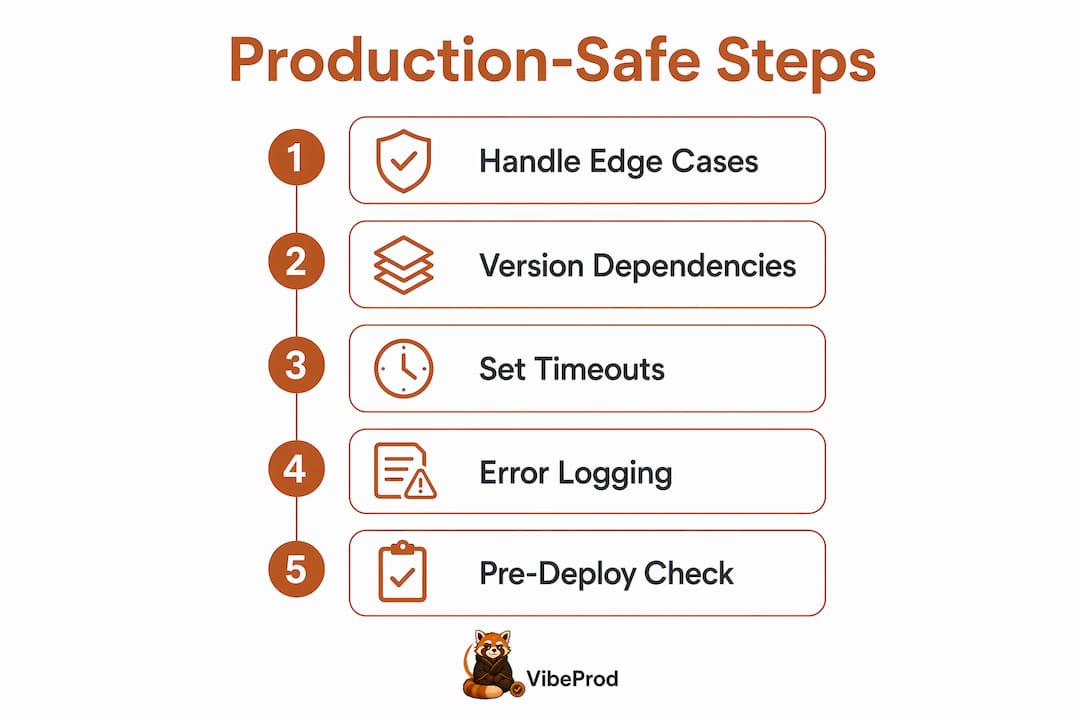
Production-safe code is designed for deployment under real conditions: edge cases handled, dependencies versioned, errors typed, and behavior observable. It’s the gap between a prototype that works on your laptop and a service that holds up at 2 AM under unexpected load.
The distinction matters most when AI-generated code enters the picture. Code can compile and pass tests yet still miss input validation, timeouts, observability hooks, and rollback paths. Passing CI is not the same as being production-ready.
Production-level code also signals an organizational shift: from prototype to professional-grade software that emphasizes maintainability, testability, and handover. Any engineer unfamiliar with the codebase should be able to debug it, extend it, and own it.
Core engineering principles behind production safety
Four principles separate production-safe code from code that merely works in development:
- Predictably failing: Design for observable, debuggable failures. Silent failures that cascade are the real enemy, not bugs themselves.
- Isolation and containment: Minimize coupling between modules. Strict boundaries let you remove or roll back a component without triggering system-wide disruption. This “delete-ability” is a core production-safety requirement.
- Observability and SLO-driven engineering: SLIs and SLOs make runtime risk visible. They turn vague “is it healthy?” questions into measurable, stakeholder-readable signals.
- Maintainability and handover: Code should be readable by engineers who didn’t write it. Structure communicates intent; documentation fills the gaps structure can’t.
Pro Tip: Write your error messages for the on-call engineer who will see them at 3 AM, not for yourself. Specific, actionable error text cuts mean time to recovery faster than any monitoring dashboard.
Concrete coding practices that support production safety
Principles are only useful when they translate into daily coding decisions.
- Defensive programming: Validate at every boundary. Use guard clauses to reject bad input early. Prefer explicit error types over generic exceptions so callers know exactly what failed.
- Idempotency and safe retries: Design operations so a retry produces the same result as the first call. Payment processing and state mutations are the obvious cases, but the rule applies broadly.
- Timeouts, bulkheads, and circuit breakers: Never make a synchronous external call without a timeout. Bulkheads isolate failure domains; circuit breakers stop cascading load when a dependency degrades.
- Separation of concerns: Keep business logic away from infrastructure and side effects. Small, pure functions are easier to test, easier to reason about, and easier to replace.
A quick example: an HTTP client call should set an explicit timeout, catch specific exception types, log the error with context, and return a typed failure result rather than letting the exception bubble up unchecked. That one pattern, applied consistently, prevents a slow third-party API from taking down your entire service.
Pro Tip: For audio software testing and other latency-sensitive systems, instrument every external call with both a timeout and a fallback path. The fallback is what makes the system predictably failing rather than unpredictably broken.

How testing and CI/CD gates enforce production readiness
Testing and pipeline design are where production-safety principles become enforceable policy.
- Test pyramid: Unit tests cover logic; integration and contract tests use production payload shapes; end-to-end tests cover critical user paths. Tests must be independent of the author who wrote the code.
- Automated pipeline gates: Static analysis, dependency and security scans, and contract tests run pre-merge. High-blast-radius changes (auth flows, payments, PII handling) require risk-tiered human review.
- Progressive rollout: Canary and percentage-based deploys compare runtime baselines — error types, latency percentiles — before widening traffic. Automated canary analysis catches regressions that staging environments miss.
Who owns each gate matters as much as the gate itself. The code author owns unit tests and linting. The CI owner owns pipeline configuration and security scans. The release engineer owns canary analysis and rollback triggers. Assigning these explicitly prevents the diffusion of responsibility that lets production incidents slip through.
Independent tests and risk-tiered review are especially critical when agentic or AI-generated code enters the codebase. The code may look correct and still miss concurrency edge cases or data shape assumptions that only surface under real load.
Observability, SLOs, and runbooks that reduce incident time
Observability isn’t a nice-to-have. It’s the mechanism that makes production-safety operational.
- Key metrics: Request success rate, p50/p95 latency, error types and counts, dependency error rates, and saturation signals (CPU, queue depth, connection pool usage).
- SLO-driven alerts: Tie alerts to SLO burn rates and error budgets, not raw thresholds. An alert that fires when your 30-day error budget burns at 5x the expected rate is far more actionable than a generic “error rate above 1%” alert.
- Runbooks: Document the five most likely post-deploy regressions and the exact steps to diagnose and roll back each one. A runbook that lives next to the service definition gets used; one buried in a wiki does not.
Pro Tip: Runtime intelligence — function-level baselines capturing call frequency, latency, and error patterns — gives your canary analysis a real comparison point. Without a baseline, you’re comparing against intuition, not data.
For consumer-facing services, observability and alerting directly affect user retention. A silent error that degrades load times by 400ms won’t trigger a threshold alert but will show up in churn.
Security and compliance checks that belong in every release
Security isn’t a separate phase. It’s part of production readiness.
- Secrets management: Never hardcode credentials, API keys, or tokens. Use a vault (HashiCorp Vault, AWS Secrets Manager) and scan repositories for exposed secrets before every deploy.
- Dependency and supply-chain scanning: Run CVE scans against your dependency tree. Maintain a software bill of materials (SBOM) so you know exactly what’s in your build.
- Input validation and least privilege: Validate and sanitize all inputs at service boundaries. Production services should run with the minimum permissions required, nothing more.
- Audit trails and retention: For U.S.-jurisdiction systems, basic audit logging and data retention controls are part of release readiness, not an afterthought. Regulatory frameworks like SOC 2 and HIPAA treat these as table-stakes requirements.
Your pre-deploy checklist (5–15 minutes)
Run this before every production deploy:
- Code checks (2–5 min, owner: author): Linting passes, unit tests green, no hardcoded secrets, no debug flags left in.
- Pipeline checks (2–5 min, owner: CI owner): Full CI pipeline succeeded, security and dependency scans clean, contract tests green.
- Observability checks (3–5 min, owner: release engineer): New metrics and alerts are present, canary baseline is defined, rollout percentage and promotion criteria are documented.
- Rollback plan (1–2 min, owner: release engineer): Rollback steps verified, feature flags confirmed, on-call owner named and notified.
If any item is red, the deploy waits. The checklist takes less time than a post-incident review.
Common myths and trade-offs worth knowing
The biggest myth: production-safe means bug-free. It doesn’t. Production-readiness is a risk-management decision about making failures predictable and recoverable, not about eliminating every defect.
- Myth: Stricter gates always slow you down. Reality: Risk-tiered gates target effort where blast radius is highest. A low-risk internal tool doesn’t need the same review depth as your auth flow.
- Trade-off: More gates mean more friction. The answer isn’t fewer gates; it’s smarter targeting. Apply the highest rigor to user-facing, high-blast-radius paths: payments, authentication, PII.
- Myth: Passing all tests means you’re production-safe. Reality: Tests validate known behavior. Runtime context — data shapes, concurrency, failure modes — determines whether code is actually safe to run.
A 30/60/90-day roadmap for tech leads
Adoption works best when it’s phased and owned explicitly.
- 30 days: Inventory critical services. Add the pre-deploy checklist. Run dependency and secret scans on all active repositories. Owners: tech leads and SRE.
- 60 days: Add pipeline gates for high-risk paths. Define SLIs and SLOs for core services. Create standard runbooks for the top five failure scenarios. Owners: SRE and service owners.
- 90 days: Automate canary analysis. Integrate runtime intelligence where feasible. Enforce risk-tiered review policies across engineering. Owners: engineering leadership.
Assign four explicit roles: code author, release owner, SRE/observability owner, and security owner. Unassigned responsibilities become nobody’s problem.
How automation tools help you scale production safety
Manual review doesn’t scale. Automation fills the gap.
- Repository scans: Tools that scan for exposed secrets, vulnerable dependencies, and policy violations catch issues in seconds that manual review misses for days.
- Plain-English findings: Automated findings written in plain English reduce review time and make issues accessible to engineers who aren’t security specialists.
- CI gate integration: Surface only high-confidence findings to reviewers. Noisy scanners that flag everything train teams to ignore alerts.
Vibeprod fits here directly. It scans GitHub repositories for exposed secrets, dependency issues, and compliance problems, then generates reviewable pull requests with plain-English explanations for each finding. Small teams get production readiness guidance in under two minutes, without interrupting their core development work. That’s the kind of runtime feedback loop that closes the gap between AI-assisted code generation and code that’s actually safe to ship.
Pro Tip: Treat automated scan findings the same way you treat failing tests: they block the deploy until resolved or explicitly risk-accepted by an owner. A finding that gets silently ignored is worse than no scan at all.
Key Takeaways
Production-safe code requires observable, predictable failure modes and rollback ability — not bug-free perfection — enforced through SLOs, progressive deploys, and automated pre-deploy checks.
| Point | Details |
|---|---|
| Production-safe ≠ bug-free | Design for predictable, contained failures and fast recovery rather than zero defects. |
| SLOs make risk visible | SLIs and SLOs turn runtime risk into measurable signals that guide engineering trade-offs. |
| Pre-deploy checklist | Run code, pipeline, observability, and rollback checks in 5–15 minutes before every deploy. |
| Risk-tiered review | Apply the highest gate rigor to auth, payments, and PII; lighter gates for low-blast-radius changes. |
| Vibeprod automates scans | Vibeprod scans repositories for secrets and compliance issues and delivers plain-English findings in under two minutes. |
The gap between prototype and production is an organizational problem
The move from prototype code to production-level code isn’t just a developer checklist. It’s an engineering and governance decision. Prototype code solves the immediate goal; production-level code makes the operational constraints explicit — who owns it, how it fails, how it recovers, and who gets paged when it doesn’t.
Engineering leadership carries the responsibility of converting tacit knowledge into reusable, automatable context. The runtime expectations, blast-radius decisions, and rollback assumptions that live in one engineer’s head are liabilities until they’re documented, tested, and enforced in the pipeline. The teams that treat production-safety as a shared organizational standard, not a personal coding habit, are the ones that ship fast and stay safe.
Vibeprod makes the pre-deploy checklist automatic
Shipping fast shouldn’t mean skipping the safety checks. Vibeprod gives small teams and solo developers the same pre-deploy rigor that larger engineering orgs build over years. It scans your GitHub repository, surfaces exposed secrets, vulnerable dependencies, and compliance gaps, and explains every finding in plain English — no security expertise required.
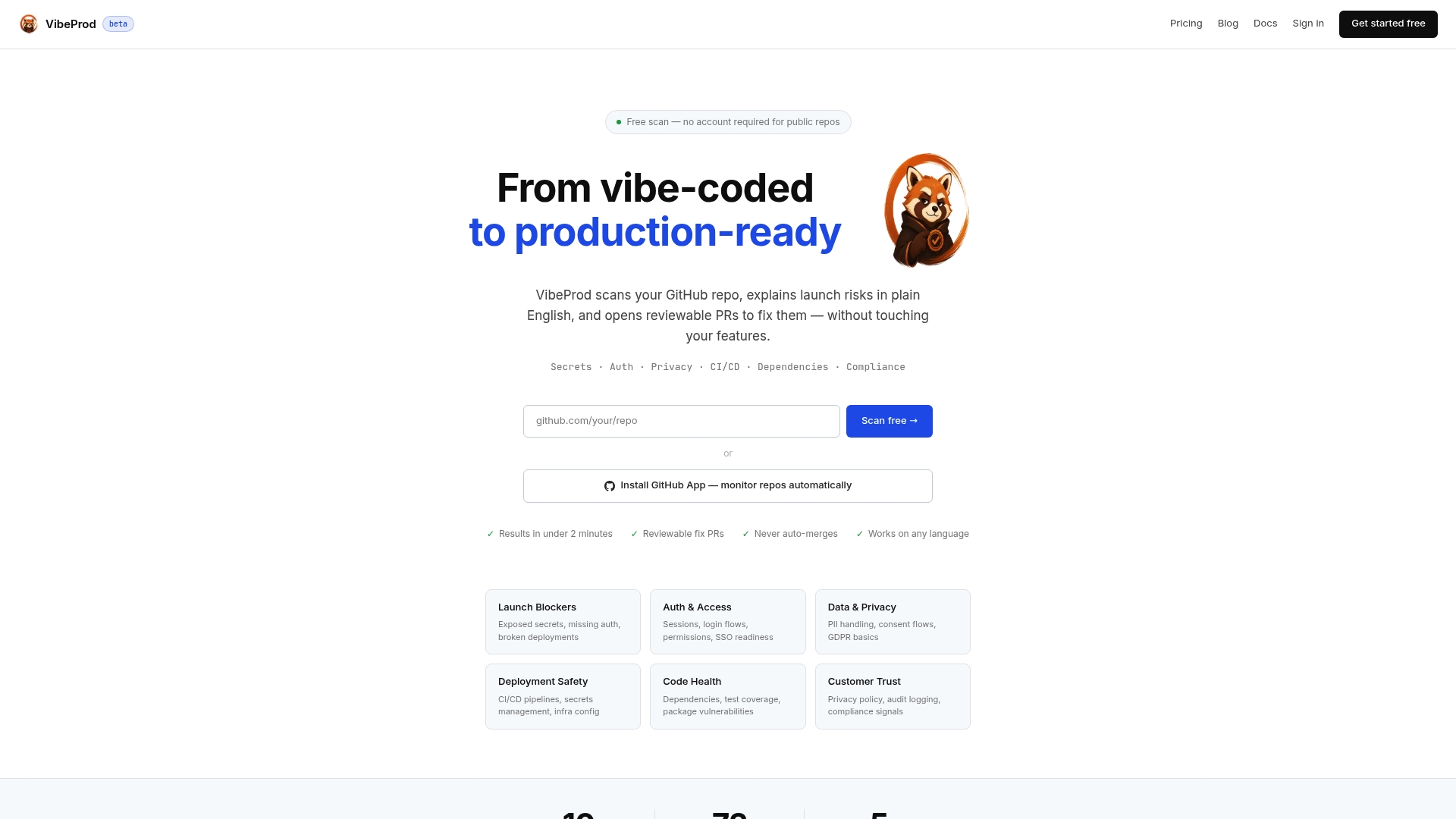
The findings arrive as reviewable pull requests, so your existing features stay untouched while the risks get addressed. It’s not a replacement for engineering judgment or risk-tiered review. It’s the automated first pass that catches what manual review misses, in under two minutes. If you’re ready to close the gap between vibe-coded prototypes and production-ready software, scan your repository with Vibeprod today.
Useful sources and further reading
- How to Write Unbreakable Production Code — Dev.to: principles of predictable failure, isolation, and delete-ability.
- The AI Code-Production Gap — Hicron Software: why AI-generated code misses runtime requirements and how to close the gap.
- Production-Safe AI Code: Why Runtime Context Matters — Snowman Labs: runtime intelligence, canary baselines, and independent test requirements.
- What Is Production-Level Code? — Stack Overflow: community framing of the prototype-to-production shift.
- Production Software Code — GM-RKB: formal definition covering reliability, edge cases, and maintainability attributes.
- Writing Production-Ready Python Code — Dev.to: language-agnostic practices for error handling, logging, and scalable architecture.
FAQ
What does production-safe code mean in practice?
Production-safe code behaves correctly under real traffic, real data shapes, and real failure conditions. It prioritizes observable, contained failures and rollback ability over theoretical bug-free perfection.
How is production-safe code different from code that passes tests?
Passing tests validates known behavior in controlled conditions. Production-safe code also handles runtime edge cases — concurrency, unexpected data shapes, dependency failures — that tests rarely cover.
What are the most important production-safe coding practices?
Idempotent operations, explicit timeouts, circuit breakers, SLO-driven alerting, and a pre-deploy checklist covering secrets, dependency scans, and rollback plans are the highest-leverage practices.
How does Vibeprod help with production readiness?
Vibeprod scans GitHub repositories for exposed secrets, vulnerable dependencies, and compliance issues, then generates reviewable pull requests with plain-English explanations — delivering findings in under two minutes.
When should a team start enforcing production-safety standards?
Start with a basic pre-deploy checklist and dependency scans in the first 30 days, then layer in SLOs, pipeline gates, and canary analysis over the following 60 days as ownership roles become clear.