How to Validate AI Code Security Standards for Devs
Treat every line of AI-generated code as untrusted and enforce it with two gates: author-time steering that shapes output before it’s committed, and blocking build-time scans that stop unsafe code from merging. That’s the operational answer. Here’s how to act on it in the next hour:
- Tag AI-assisted diffs. Add a
gitattribute or PR label (e.g.,ai-assisted) so reviewers and scanners know which changes need elevated scrutiny. - Enable a steering doc and real-time linting in your IDE. A machine-readable security spec consumed at session start steers the model away from insecure patterns before a single line is written.
- Make SAST, SCA, secrets, and IaC scans blocking in CI. Advisory comments don’t stop a merge. Blocking gates do.
- Require human approval for high-blast changes. Auth flows, middleware, and anything touching external APIs need a human sign-off, not just a green pipeline.
That four-step minimum, attribution plus steering plus one blocking scan plus human review on critical paths, is where to start in your repo today.
Key Takeaways
Treating AI-generated code as untrusted and enforcing blocking gates at both author-time and build-time is the minimum viable security posture for any team shipping AI-assisted code to production.
| Point | Details |
|---|---|
| Label AI-assisted diffs | Tag every AI-generated PR so scanners and reviewers apply the right level of scrutiny. |
| Block on SCA and secrets first | SCA and secrets detection are the highest-signal, lowest-cost blocking gates to add this week. |
| Target AISVS Level 2 | Most production systems need Level 2 coverage: supply chain, adversarial robustness, and monitoring. |
| Manual metadata checks matter | Automated SCA misses typosquatting; block packages younger than 30 days as a policy baseline. |
| Vibeprod for repo-level scanning | Vibeprod scans GitHub repos for secrets, dependencies, and auth gaps, returning SARIF and fix PRs in under two minutes. |
Table of Contents
- Why validating AI code security standards matters more than you think
- Primary risks you need to scan for in AI-generated code
- Which standards should you align your validation work against?
- Author-time controls vs. build-time controls: how the two pillars work
- How to make CI/CD scans into real blocking gates
- Testing and verification techniques that prove the code is actually safe
- Runtime monitoring and incident response for AI-origin code
- A practical validation checklist mapped to AISVS levels
- What capabilities should you look for in validation tooling?
- How Vibeprod operationalizes the validation checklist
- Where most teams get the trade-offs wrong
- Vibeprod scans your repo before a vulnerability reaches production
- Sources
- FAQ
Why validating AI code security standards matters more than you think
“AI-generated code” covers more ground than most teams realize: tab completions, multi-file scaffolding, agentic skills that write and execute code autonomously, and infrastructure-as-code generated by assistants. All of it carries the same core problem: the model optimizes for plausibility, not security.
Models reproduce patterns from their training data, including insecure ones. They hallucinate package names that don’t exist, recommend deprecated libraries, and produce string-built SQL queries that look functional until a penetration tester shows up. The risk isn’t that AI writes obviously broken code. The risk is that it writes convincingly correct code with subtle flaws that pass a casual review.
Three standards form the baseline for validation work. The OWASP AISVS provides 191 testable, verifiable security requirements for AI systems across categories including input validation, model lifecycle, supply chain security, and adversarial robustness, with assurance levels 1–3 so teams can calibrate depth to risk. NIST AI RMF gives governance structure: roles, risk assessment, and accountability. ISO/IEC 42001 defines management-system expectations useful for procurement and compliance audits.
What “validated” means in practice: deterministic gates (scanners that pass or fail a build), non-deterministic review (human judgment on context-sensitive decisions), and runtime monitoring (detecting failures that only appear under real traffic).
Primary risks you need to scan for in AI-generated code
AI output doesn’t introduce entirely new vulnerability classes. It amplifies existing ones and adds a few AI-specific wrinkles. Here’s what your validation process must cover:
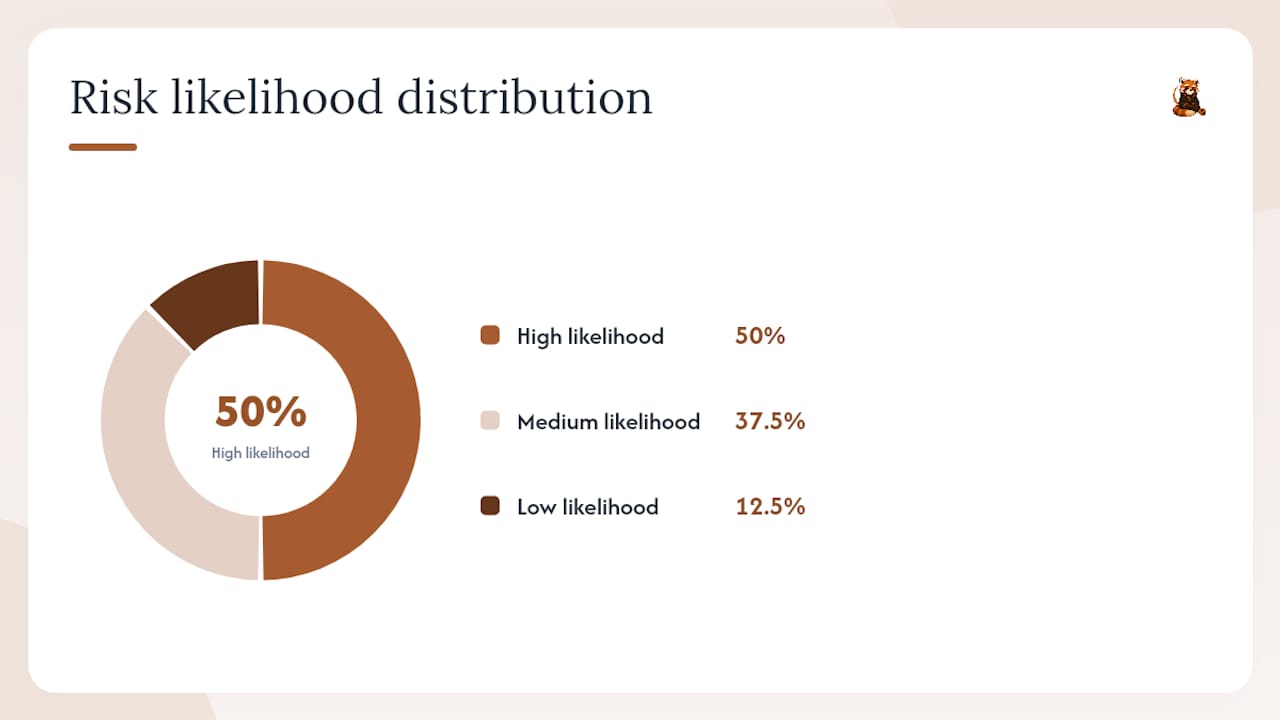
| Risk Category | Example Pattern | Likelihood | Impact |
|---|---|---|---|
| SQL/command injection | String-concatenated queries in ORM bypass code | High | Critical |
| Broken auth/authorization | Missing role checks on generated API endpoints | High | Critical |
| Insecure defaults | TLS verification disabled, debug mode left on | High | High |
| Prompt injection | User input passed unsanitized to an LLM call | Medium | Critical |
| Supply-chain / typosquatting | Hallucinated package name registered by attacker | Medium | High |
| Insecure deserialization | Pickle or YAML load on untrusted data | Medium | High |
| Excessive agentic privileges | Agent skill granted write access to entire filesystem | Low | Critical |
| Secret/embedding leakage | API key hardcoded in generated config or test file | High | High |
A few of these deserve a closer look. Prompt injection is the AI-specific one: when user-controlled input flows into an LLM prompt without sanitization, an attacker can override the model’s instructions. MCP (Model Context Protocol) tool poisoning is a variant where a malicious tool definition hijacks an agent’s action sequence.
Supply-chain risk is more material than most teams assume. A large-scale analysis of AI agent skills found that a significant share contained vulnerabilities and some showed likely malicious intent. That’s not a theoretical edge case.
The reachable vs. theoretical distinction matters for prioritization. A hardcoded secret in a file that’s never deployed is lower priority than a missing auth check on a live endpoint. Static scans surface both; runtime verification tells you which ones are actually exploitable.
Which standards should you align your validation work against?
Not every standard applies equally to every team. Here’s how to pick and map them:
| Standard | Role | When to Use | Example Checks |
|---|---|---|---|
| OWASP AISVS | Technical verification baseline | All production AI systems | Input validation, supply chain, monitoring, adversarial robustness |
| OWASP Secure Coding / LLM Top 10 | Concrete rule library | Web/API and LLM-integrated systems | Injection, broken auth, insecure deserialization |
| NIST AI RMF | Governance and risk accountability | Teams with compliance or procurement requirements | Risk assessment, roles, incident response |
| ISO/IEC 42001 | Management system | Procurement, enterprise audits | Policy, evidence collection, supplier controls |
For most production systems, target AISVS Level 2. Level 1 covers baseline hygiene; Level 2 adds supply chain, adversarial robustness, and monitoring requirements that matter once real users are involved. Level 3 is for high-assurance systems: financial infrastructure, healthcare, or anything where a breach has regulatory consequences.
The NIST AI RMF to ISO/IEC 42001 crosswalk is the practical bridge between governance and technical verification. If your organization needs to satisfy procurement or audit requirements, this document maps governance controls to management-system items so you’re not maintaining two separate evidence trails.
Quick risk-driven selection: if your system handles PII or financial data, start at AISVS Level 2 plus NIST AI RMF. If you’re building an agent with tool-use or external API calls, add agent skill scanning and the OWASP LLM Top 10 to your checklist. If you’re a solo founder shipping a web app, AISVS Level 1 plus secrets detection and SCA is a defensible starting point.
Author-time controls vs. build-time controls: how the two pillars work
The AWS Security Blog’s control framework for AI coding agents organizes validation into two pillars. Understanding the difference tells you which failures each pillar catches and which it misses.
| Dimension | Author-Time Controls | Build-Time Controls |
|---|---|---|
| When it runs | During code generation in the IDE | On commit, PR, or deploy trigger in CI/CD |
| Intent | Shape output before it’s written | Catch what slipped through generation |
| Typical tooling | Steering docs, in-IDE SAST, scoped MCP endpoints | SAST, SCA, IaC scanners, secrets detection |
| Determinism | Non-deterministic (model-dependent) | Deterministic (rule-based, reproducible) |
| Human review required | For spec compliance and context judgment | For critical findings, exception approvals |
Author-time controls reduce the volume of problems that reach CI. A steering doc that says “never disable TLS verification” and “always parameterize queries” catches those patterns before the model writes them. In-IDE real-time linting catches what the steering doc misses.
Build-time controls are your safety net. They’re deterministic, auditable, and they don’t care what the model intended. A secrets scanner either finds a hardcoded API key or it doesn’t.
Pro Tip: Encode your security invariants in a machine-readable steering document (a .cursorrules, .github/copilot-instructions.md, or equivalent) that your IDE assistant loads at session start. Include rules like “no string concatenation in SQL,” “all external HTTP calls must verify TLS,” and “never hardcode credentials.” This shifts left without adding review burden.
The enforcement principle: deterministic checks must be blocking. Non-deterministic checks (LLM-assisted PR pre-screens, model-based code review) are useful for triage and focused human attention, but they should never be the only gate.
How to make CI/CD scans into real blocking gates
Advisory scan results that post a comment on a PR don’t stop unsafe code from merging. Blocking gates do. Here’s how to structure your pipeline:
-
Run secrets detection first, fail fast. Secrets scans are cheap and high-signal. If a hardcoded credential is found, fail the build immediately before running heavier scans. Tools like Gitleaks or TruffleHog run in seconds.
-
Run SCA on every dependency change. Any PR that modifies
package.json,requirements.txt,go.mod, or equivalent should trigger a full SCA scan. Block on critical CVEs. Also check package metadata manually: packages younger than 30 days or with no maintainer history are a typosquatting signal the scanner won’t catch automatically, per OWASP’s secure coding guidance. -
Run SAST with a focused rule set. A broad SAST rule set generates noise. Start with a tight set covering injection, broken auth, and insecure defaults. Tune thresholds so critical and high findings block the merge; medium findings generate a review comment.
-
Run IaC scanning on infrastructure changes. Terraform, CloudFormation, and Kubernetes manifests generated by AI assistants frequently contain insecure defaults (open security groups, public S3 buckets, missing encryption). Tools like Checkov or Trivy’s IaC mode catch these before they reach a cloud environment.
-
Export SARIF artifacts from every scan. SARIF (Static Analysis Results Interchange Format) is the standard output format for security scan results. Store it as a CI artifact so findings are traceable to a specific commit and PR. GitHub’s Security tab, GitLab’s security dashboard, and Jenkins with the Warnings NG plugin all consume SARIF natively.
-
Enforce an exception approval workflow. Not every finding can be fixed immediately. Build a documented exception process: a reviewer must explicitly approve a suppressed finding with a justification comment, and suppressed findings expire after a policy period (30–90 days is common).
KPIs to track: percentage of PRs blocked by critical findings, mean time to fix a critical finding, percentage of AI-tagged PRs that contain at least one critical finding, and number of suppressed findings older than your exception policy window.
For GitHub Actions, the pattern is a job that runs scanners as steps, uses continue-on-error: false for blocking checks, and uploads SARIF with actions/upload-artifact. For GitLab CI, use allow_failure: false on security jobs and the built-in security dashboard for SARIF ingestion. For Jenkins, the Warnings NG plugin handles SARIF and can be configured to fail the build on threshold violations.
Testing and verification techniques that prove the code is actually safe
Static scans tell you a vulnerability exists. Tests tell you whether it’s exploitable and whether your fix actually works. Both are necessary.
| Test Type | What It Catches | When to Run | Maps To |
|---|---|---|---|
| SAST / secrets scan | Known-pattern vulnerabilities, hardcoded credentials | Every commit | AISVS input validation, supply chain |
| Unit / regression tests | Logic errors, auth boundary failures | Every commit | AISVS functional correctness |
| Adversarial / fuzz tests | Unexpected input handling, injection paths | Pre-release, scheduled | AISVS adversarial robustness |
| DAST / runtime exploitability | Reachable vulnerabilities under real HTTP traffic | Staging, pre-deploy | AISVS monitoring, NIST AI RMF |
For AI-touched modules specifically, add these test cases to your suite: malformed and oversized inputs to every public endpoint, authorization boundary tests that verify a low-privilege user can’t access high-privilege resources, and dependency provenance tests that assert no new packages were added without a corresponding SCA approval.
Test harnesses matter here. AI models tend to produce code that handles the happy path well and the edge cases poorly. A harness that generates random, malformed, and boundary-crossing inputs exercises the paths a static scanner can’t reason about. Regression testing for AI-generated outputs in CI catches behavioral drift when a model or prompt changes.
The pairing principle: always follow a static finding with a dynamic test. If SAST flags a potential SQL injection, write a test that sends a payload and confirms the query is parameterized. This reduces false positives and gives you evidence of exploitability (or lack of it) for your audit trail.
Pro Tip: Use AI evaluation metrics to track not just security findings but behavioral correctness across model updates. A model change that fixes one vulnerability class can introduce another.
Runtime monitoring and incident response for AI-origin code
Shipping validated code doesn’t end your responsibility. AI-generated code can behave unexpectedly under real traffic in ways that no static scan predicted.
What to monitor in production:
- Anomalous input/output patterns on AI-generated endpoints (sudden spikes in error rates, unexpected response sizes, or outputs that match known injection payloads)
- Unusual dependency loads at runtime, particularly dynamic imports or plugin loads that weren’t present at build time
- Unexpected outbound network activity from agent skills, especially calls to domains not in your approved list
- Sudden increases in latency or memory usage on endpoints backed by AI-generated logic, which can indicate a resource exhaustion path
Incident runbook for AI-origin vulnerabilities:
- Triage: confirm the finding is exploitable (not a false positive) using the SARIF artifact from the originating PR. Identify the commit hash and model invocation metadata if available.
- Containment: use a feature flag or rollback to disable the affected endpoint or revert the AI-generated change. Don’t wait for a full patch.
- Evidence collection: pull the SARIF artifact, the PR diff, the commit attribution label, and any runtime logs showing the anomalous behavior.
- Patch and verify: fix the vulnerability, run the full blocking scan suite, and add a regression test that would have caught the original issue.
- Post-incident audit: map the finding to the AISVS requirement it violated. Update your steering doc and blocking rules to prevent recurrence.
Hook detection alerts into the same ticketing and triage flow you use for other AppSec incidents. A separate AI-specific process creates blind spots and slows response time.
A practical validation checklist mapped to AISVS levels
Use this checklist in audits, PR reviews, or as the basis for your CI gate configuration. Each item maps to an AISVS assurance level so you can pick a target and know exactly what’s required.
| Phase | Check | AISVS Level | Evidence Artifact |
|---|---|---|---|
| Pre-generation | Steering doc loaded in IDE with security invariants | 1 | Steering doc committed to repo |
| Pre-generation | AI usage policy documented and communicated | 1 | Policy doc in repo wiki |
| Generation | Real-time in-IDE linting enabled | 1 | IDE config committed |
| Pre-merge | Secrets scan blocking in CI | 1 | SARIF artifact, build log |
| Pre-merge | SCA scan blocking on critical CVEs | 1 | SARIF artifact, dependency manifest |
| Pre-merge | SAST scan blocking on critical/high findings | 2 | SARIF artifact, rule set config |
| Pre-merge | IaC scan blocking on critical misconfigurations | 2 | SARIF artifact |
| Pre-merge | Package metadata check (age, maintainer history) | 2 | Manual review note or automated policy |
| Pre-merge | Human approval required for auth/middleware changes | 2 | PR approval log |
| Post-merge | Unit and regression tests pass | 1 | Test results artifact |
| Post-merge | Adversarial/fuzz tests run on AI-touched modules | 3 | Fuzz test results |
| Post-merge | Canary deployment with anomaly detection | 2 | Monitoring dashboard |
| Runtime | Anomalous input/output monitoring active | 2 | Alerting config, runbook |
| Runtime | Agent skill scanning before install | 3 | Scan results artifact |
Document every artifact. A checklist without evidence is just a checklist. SARIF files, test results, and PR approval logs are what make a review reproducible and an audit defensible.
What capabilities should you look for in validation tooling?
The right question isn’t “which vendor should I pick?” It’s “what must a tool do to support my blocking gates?” Here’s the capability matrix:
| Tool Category | Must-Have Capabilities | Key Questions to Ask |
|---|---|---|
| IDE steering / real-time scanning | Consumes machine-readable security rules, flags issues inline, integrates with major editors | Does it load a repo-level steering doc? Does it flag injection patterns in real time? |
| SAST | Rule-based, deterministic, exports SARIF, configurable severity thresholds | Can it fail the build on critical findings? Does it cover the languages in your stack? |
| SCA | CVE database coverage, license scanning, exports SARIF, supports policy age rules | Does it block on critical CVEs? Can you set a minimum package age policy? |
| IaC scanner | Covers Terraform/CloudFormation/Kubernetes, exports SARIF, maps to CIS benchmarks | Does it catch open security groups and missing encryption by default? |
| Secrets detection | Pre-commit and CI modes, low false-positive rate, exports findings | Does it scan git history, not just the current diff? |
| LLM-assisted PR pre-screen | Summarizes AI-generated diffs, flags context-sensitive risks | Is it advisory only, or can it block? (Advisory is fine here.) |
| Agent skill scanner | Scans MCP content and executable scripts, flags known malicious patterns | Does it integrate with your install workflow? |
| Runtime observability | Anomaly detection on endpoints, traces requests to originating code | Can it correlate a runtime event to a specific commit or PR? |
If you have limited time and budget, the mandatory blocking gates in priority order are: SCA (catches hallucinated and vulnerable dependencies), secrets detection (high signal, low cost), and one focused SAST rule set (injection and broken auth at minimum). Add IaC scanning and agent skill scanning once those three are stable.
To validate a tool’s claims, run it against a known-vulnerable test repo (OWASP WebGoat or a purpose-built fixture) and confirm it catches the vulnerabilities you care about. A tool that misses a hardcoded API key in a test fixture will miss one in production.
For detecting and handling malformed outputs from AI agents specifically, developer-focused guidance on malformed agent output covers input validation patterns that complement static scanning.
How Vibeprod operationalizes the validation checklist
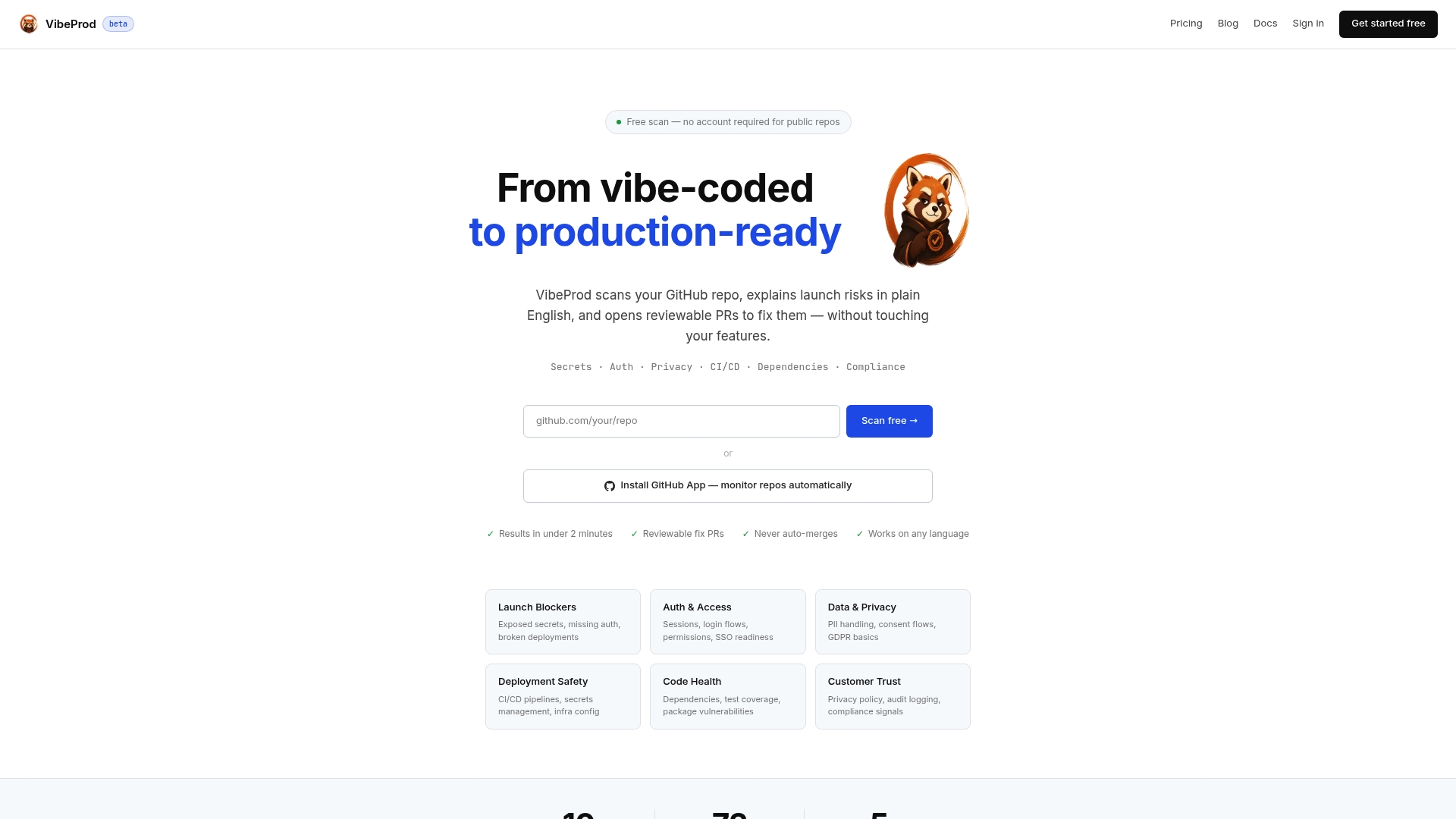
Vibeprod is a repo-level scanner that maps directly to the pre-merge and post-merge phases of the checklist above. Point it at a GitHub repository and it runs automated checks for exposed secrets, dependency vulnerabilities, authentication gaps, CI/CD misconfigurations, and privacy issues. Results come back in under two minutes.
The output is a SARIF-compatible findings report and, for each identified issue, a plain-English explanation of what the problem is and why it matters. Vibeprod then opens a reviewable fix pull request with the proposed remediation. It doesn’t auto-merge. You review, approve, and merge on your terms.
That maps to specific checklist items: exposed secrets detection satisfies the pre-merge secrets scan requirement; dependency vulnerability checks cover SCA at AISVS Level 1–2; the plain-English PR explanations give human reviewers the context they need to make an informed approval decision rather than rubber-stamping a green pipeline.
The workflow is: scan triggers on repo push or manual invocation, SARIF artifact is generated, fix PRs are routed to the relevant reviewer, reviewer decides. No black-box auto-fixes, no altered existing features.
Where most teams get the trade-offs wrong
The most common mistake isn’t skipping security checks. It’s configuring them as advisory instead of blocking, then wondering why vulnerabilities keep reaching production. A scan that posts a comment and lets the merge proceed is a suggestion, not a gate.
The second most common mistake is trusting non-deterministic LLM judgments as the primary review mechanism. An LLM-assisted PR review is useful for surfacing context-sensitive issues a rule-based scanner misses, but it’s probabilistic. It will miss things. It should feed human attention, not replace it.
Teams also consistently underestimate dependency metadata. Automated SCA catches known CVEs. It doesn’t catch a package registered two weeks ago by an unknown maintainer that happens to share a name with a popular library. That’s a typosquatting attack, and it’s exactly the kind of hallucinated dependency an AI assistant might suggest. Manual metadata checks, or a policy that blocks packages younger than 30 days, close that gap.
On prioritization: start with attribution (label your AI-assisted diffs), add blocking SCA and secrets detection, then add one focused SAST rule set. That combination catches the highest-impact, most common failures in AI-generated code with the least tuning overhead. Expand to IaC scanning and agent skill scanning once those three gates are stable and your exception workflow is documented.
The teams that get this right treat validation not as a compliance checkbox but as a feedback loop. Every blocked PR is a data point. Track which rule triggered it, how long it took to fix, and whether the same pattern reappears. That data tells you where to tighten your steering doc and where to add a test case.
Vibeprod scans your repo before a vulnerability reaches production
Shipping fast with AI assistance is the goal. Shipping with an exposed API key or a broken auth flow is the gap between a prototype and a product. Vibeprod closes that gap by scanning your GitHub repository for the exact issues this checklist covers: exposed secrets, dependency vulnerabilities, authentication gaps, CI/CD misconfigurations, and privacy issues, all surfaced in under two minutes with plain-English explanations and reviewable fix PRs.
Unlike a generic linter, Vibeprod produces SARIF artifacts and opens fix PRs you control. No auto-merging, no altered features. You get the evidence trail your audit needs and the remediation context your reviewer needs, without slowing down your shipping cadence.
If you’re building with AI assistance and haven’t run a structured security scan yet, Vibeprod and see what your pipeline is currently missing. The free tier gets you started without a credit card.
Sources
- OWASP Artificial Intelligence Security Verification Standard AISVS Docs | OWASP Foundation
- Secure Coding with AI Cheat Sheet | OWASP Cheat Sheet Series
- NIST AI RMF to ISO/IEC 42001 Crosswalk
- ISO/IEC 42001
FAQ
What does it mean to validate AI code security standards?
Validating AI code security standards means applying deterministic checks (SAST, SCA, secrets detection, IaC scanning) and human review to AI-generated code before it merges or deploys, mapped against recognized baselines like OWASP AISVS and NIST AI RMF.
Which standard should I start with for AI-generated code?
Start with OWASP AISVS Level 1 for baseline hygiene and move to Level 2 for any production system handling real users. AISVS provides 191 testable requirements you can map directly to CI gate configurations.
Why can’t I rely on the AI assistant itself to catch security issues?
AI assistants are non-deterministic and optimize for plausibility, not security. They miss context-sensitive issues, hallucinate safe-looking but vulnerable patterns, and can’t verify their own dependency suggestions against live CVE databases. Deterministic scanners catch what the model misses.
How do I make security scans blocking without slowing down every PR?
Run secrets detection and SCA first (both are fast) and fail immediately on critical findings. Tune SAST to block only on critical and high severity. Medium findings generate review comments rather than build failures. A well-tuned gate adds seconds to a pipeline, not minutes.
Can Vibeprod replace a full AppSec program?
Vibeprod is a repo-level scanner that covers secrets, dependencies, auth gaps, and CI/CD misconfigurations with SARIF output and fix PRs. It handles the automated pre-merge layer of the validation checklist. A full AppSec program also includes DAST, penetration testing, and runtime monitoring, which sit outside its scope.