Types of AI Coding Mistakes in Production: 2026 Guide
TL;DR:
- AI-generated code in production has a higher bug density and more security vulnerabilities than human-written code. Common issues include hallucinated APIs, silent logic failures, security gaps like XSS and hardcoded secrets, concurrency bugs, and weak observability, which require targeted guardrails. Human review and structured testing, along with tools like Vibeprod, help catch errors before deployment and ensure safer, more reliable AI-assisted development.
AI-generated code in production carries a 1.7x higher bug density and up to 2.74x more security vulnerabilities than human-written code. These are not random failures. The types of AI coding mistakes in production follow predictable patterns: hallucinated APIs, silent logic errors, missing auth checks, concurrency bugs, and weak observability. Infosecurity Magazine reported 35 AI-related CVEs in march 2026, up from just 6 in january 2026. That trajectory is a warning. Understanding these patterns is the first step toward shipping code that actually holds up under real user load.
1. What are hallucinated APIs in AI-generated code?
Hallucinated APIs are the most disorienting type of AI programming pitfall. The AI invents a function or method name that looks completely valid, compiles without error, and only fails at runtime when the function does not exist. You get no warning until production traffic hits that code path.

AI tools hallucinate method names in 40.9% of Python cases and 39% of Java parameter cases. That means nearly 4 in 10 AI-generated method calls in those languages carry a hallucination risk. Static analysis catches only 20–25% of these errors because the rest are semantically valid syntax pointing at nonexistent targets.
Common hallucination patterns include:
- Invented method names that match a library’s naming convention but do not exist in the current version
- Deprecated API calls pulled from training data that predates a major SDK update
- Wrong parameter signatures on real functions, such as passing a string where an object is required
- Outdated API usage like calling
stripe.subscriptions.cancel()when the current Stripe SDK uses a different method path
The root cause is training data cutoff. AI models learn from public code repositories, and those repositories contain years of deprecated examples. The model has no way to know which version of an API your project actually uses.
Pro Tip: Enable strict TypeScript or mypy type checking at every API boundary. Pair that with a pinned dependency manifest so your CI/CD pipeline flags version mismatches before they reach staging.
2. How silent logic failures undermine AI code correctness
Silent logic failures are the most dangerous category of common AI coding errors. The code runs. Tests pass. No exception is thrown. But the output is wrong, and you only find out when a user reports incorrect data or a financial calculation is off by a factor of ten.
Over 60% of AI defects are silent logic errors. That figure reframes the entire problem. Most AI bugs are not crashes. They are quiet, plausible-looking misfires that slip through every automated gate.
The HumanEval+ dataset shows that 54% of failures come from missing corner cases. Null handling, empty collections, timezone edge cases, and concurrent state mutations are the usual culprits. AI models optimize for the happy path because that is what most training examples demonstrate.
Typical silent logic failure patterns:
- Business logic that matches the prompt description but misses a domain rule the developer assumed was obvious
- Off-by-one errors in pagination or date range calculations
- Missing null checks that return a default value instead of raising an error, masking data corruption
- Stale cached data returned as fresh, causing users to act on outdated information
Linters and type checkers cannot catch these. They verify structure, not intent. The fix is executable specifications: property-based testing with tools like Hypothesis for Python or fast-check for JavaScript, plus integration tests that assert on actual business outcomes rather than just response shapes.
Pro Tip: Never use the same AI model to generate both the code and its tests. Circular validation means the tests share the same blind spots as the code. Write tests from your own specifications first.
3. Common security pitfalls in AI-generated production code
Security is where AI programming pitfalls become genuinely costly. AI-generated code produces 2.74x more XSS vulnerabilities than human-written code. In regulated industries, AI-generated pull requests produce 15–18% more security vulnerabilities overall. Those numbers reflect a structural problem, not occasional carelessness.
The most frequent security mistakes AI introduces:
- XSS through unsanitized inputs: AI renders user-supplied content directly into HTML templates without escaping, trusting that upstream validation already handled it.
- Missing CSRF tokens: Auth flows generated by AI often skip CSRF protection on state-changing endpoints, especially when the AI generates the route handler separately from the middleware stack.
- Optimistic auth middleware: AI-generated middleware applies authentication to known routes but defaults to open access on new routes added later. This pattern creates silent open endpoints.
- IDOR vulnerabilities: AI code frequently trusts user-supplied IDs without scoping authorization to the authenticated user’s data. A request for
/api/orders/12345returns the order regardless of who is asking. - Hardcoded secrets: API keys, database credentials, and JWT secrets appear inline in AI-generated configuration files, especially when the AI is given a working example to extend.
The fix is not a single tool. Default-deny authorization means every new route requires an explicit permission declaration, not an inherited open state. Structured security reviews using OWASP Top 10 as a checklist catch the categories AI consistently misses. Vibeprod scans GitHub repositories specifically for exposed secrets and compliance gaps, generating pull requests with plain-English explanations before those issues reach users.
4. Concurrency and resource management mistakes in AI code
Concurrency bugs are the category most likely to destroy production stability under load. AI models generate code that works perfectly in single-threaded tests and collapses when two requests arrive at the same millisecond.
The classic AI concurrency mistake is the check-then-act race condition. The AI writes code that checks a condition, then acts on it in a separate step, with no lock or atomic operation between them. Under concurrent load, another thread modifies state between the check and the act. The result is corrupted data or a duplicate transaction.
Resource management failures are equally common:
- Connection pool exhaustion: AI-generated database code acquires a connection inside a try block but only releases it in the success path. An exception skips the release. Under load, the pool drains and the application hangs.
- Retry storms: AI generates retry logic without exponential backoff or jitter. When a downstream service degrades, every client retries simultaneously, amplifying the load and preventing recovery.
- Missing idempotency keys: Payment and order endpoints generated by AI do not include idempotency checks, so network retries create duplicate charges.
Connection pool leaks require try/finally guards to guarantee resource release regardless of the execution path. This is a pattern AI models consistently omit because most training examples show the happy path only.
Pro Tip: Wrap every resource acquisition in a try/finally block. For retry logic, use exponential backoff with random jitter and a circuit breaker. Test concurrency behavior with load testing tools before any production deployment.
5. Observability and maintainability gaps in AI-generated code
AI-generated code is often hard to debug in production because the model treats logging as an afterthought. The default output is console.log statements scattered through the codebase with no structure, no severity levels, and no correlation IDs. When something fails at 2:00 AM, you have no way to trace a request across services.
Weak test suites compound the problem. Tests asserting only expect(result).toBeDefined() give false confidence. They pass on every code change, including ones that break the actual business logic. The test suite becomes a liability rather than a safety net.
Maintainability issues that AI code consistently introduces:
- Monolithic functions: AI frequently generates 400-plus line functions that handle multiple concerns. These are nearly impossible to unit test and create merge conflicts on every change.
- Inconsistent naming conventions: AI adapts to whatever style appears in the prompt context, producing camelCase in one file and snake_case in another within the same module.
- Missing error context: Caught exceptions are swallowed or re-thrown without adding context, making stack traces useless for diagnosing the root cause.
The fix for observability is structured logging with a library like Winston or Pino, using JSON output with request IDs and severity levels. For maintainability, splitting monolithic functions into single-responsibility components is the highest-leverage change you can make to AI-generated code before it reaches production.
Key takeaways
AI-generated code in production fails in predictable patterns: hallucinated APIs, silent logic errors, security gaps, concurrency bugs, and weak observability each require specific, targeted guardrails rather than generic code review.
| Point | Details |
|---|---|
| Hallucinated APIs fail at runtime | Static analysis catches only 20–25% of hallucinations; use strict type checking at API boundaries. |
| Silent logic errors dominate AI defects | Over 60% of AI bugs are silent; use property-based testing and human-written specs to catch them. |
| Security vulnerabilities are structural | AI code produces 2.74x more XSS issues; apply default-deny auth and scan for hardcoded secrets. |
| Concurrency bugs emerge under load | Use try/finally for resource release and exponential backoff with jitter for all retry logic. |
| Observability requires intentional design | Replace console.log with structured logging and write tests that assert on real business outcomes. |
What I’ve learned about trusting AI-generated code in production
The most dangerous thing about AI-generated code is not that it looks wrong. It is that it looks right. Human reviewers suffer AI plausibility bias: well-formatted, syntactically clean code triggers less scrutiny, even when the logic is broken. I have watched experienced engineers approve PRs that contained open auth endpoints simply because the surrounding code was polished.
The mental model that actually works is treating every AI output as an untested hypothesis. Top engineering teams gate AI-generated code behind human validation before merging, not because they distrust AI, but because they understand what AI optimizes for. It optimizes for plausibility, not correctness.
One practice that pays off faster than any tool is maintaining a Fail Log. Tracking AI-generated errors that reach production reveals your team’s specific blind spots within weeks. Once you see the pattern, you can build a targeted automated check that catches it every time. Teams that do this systematically cut their AI-related failure rate close to zero within a few months.
The balance is not “use AI less.” The balance is “add the right gates.” Ship fast. Ship safe. Those two goals are not in conflict if your pipeline has the right structure.
— Vibeprod
How Vibeprod catches AI coding mistakes before they ship
AI-generated code moves fast from prototype to pull request. The review process rarely keeps pace.
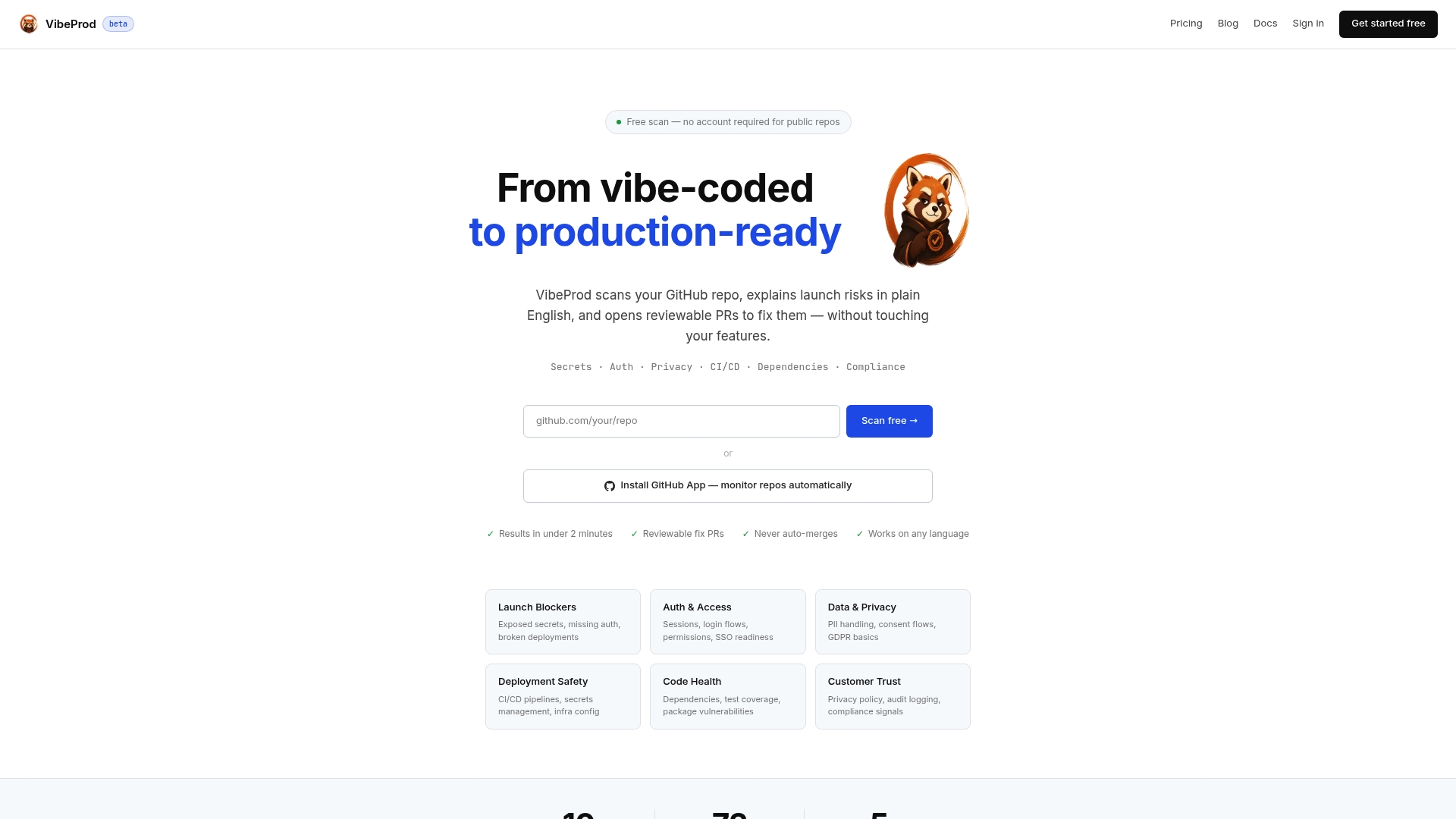
Vibeprod scans your GitHub repositories in under two minutes, identifying exposed secrets, missing auth checks, compliance gaps, and other launch risks that AI tools consistently overlook. It generates reviewable pull requests with plain-English explanations for every issue, so your team fixes problems without losing context on the core feature. For solopreneurs and small teams shipping with AI assistance, Vibeprod closes the gap between “it works on my machine” and production-ready code. You keep building. Vibeprod keeps watch.
FAQ
What makes AI-generated code more vulnerable than human code?
AI-generated code has up to 2.74x higher security vulnerability density than human code because models optimize for plausibility over correctness, frequently skipping auth checks, input sanitization, and secret management.
How do I detect hallucinated APIs before they reach production?
Enable strict type checking with TypeScript or mypy at every API boundary, and run static analysis in your CI/CD pipeline. These tools catch 20–25% of hallucinations; runtime contract tests catch the rest.
Why do AI code tests sometimes give false confidence?
Using the same AI model to generate both code and tests creates circular validation. The tests share the same blind spots as the code, so they pass even when the logic is wrong. Write tests from your own specifications instead.
What is the fastest way to improve AI code quality in production?
Maintain a Fail Log of every AI-generated error that reaches production. Patterns emerge within weeks, and targeted automated checks built from those patterns reduce failure rates faster than any generic linting rule.
How do I prevent concurrency bugs in AI-generated code?
Wrap every resource acquisition in a try/finally block to guarantee release on error paths. Add exponential backoff with random jitter to all retry logic, and load test concurrent scenarios before deploying to production.