The Role of Automated Code Review in Faster Deployments

Automated code review is the automatic analysis of source code to detect bugs, security vulnerabilities, and policy violations without a human reading every line. Tools like SonarQube, SAST scanners, and AI-powered linters run this analysis inside CI/CD pipelines, catching problems at the moment code is pushed rather than days later in a manual review queue. The role of automated code review has expanded significantly as engineering teams ship faster and AI-generated code volumes grow. Understanding how it works, where it fits alongside human reviewers, and how to scale it correctly is now a core competency for any team serious about production readiness.
How automated code review works inside CI/CD pipelines
Automated code review operates through a layered pipeline architecture built from three distinct layers: analysis, orchestration, and enforcement. Each layer has a specific job, and the system only works well when all three are properly connected.
The analysis layer is where the actual scanning happens. It runs multiple tool types in parallel:
- SAST scanners analyze source code without executing it, catching vulnerabilities like SQL injection and hardcoded secrets during the build phase.
- Linters enforce style rules, flag unused variables, and catch syntax errors before they reach a reviewer.
- Dependency scanners check third-party packages against known CVE databases.
- AI reviewers assess logic, readability, and patterns that rule-based tools miss.
The orchestration layer manages these tool runs. It handles parallelization so multiple scans finish simultaneously, applies caching to avoid re-scanning unchanged files, and deduplicates findings so the same issue does not appear five times from five different tools. This deduplication step is critical. Without it, developers face alert fatigue and start ignoring the output entirely.
The enforcement layer acts on the aggregated results. It applies quality gates that block a merge request if critical issues are present. Non-critical findings get flagged as advisory comments. This separation between hard blocks and soft warnings keeps the pipeline useful without grinding every merge to a halt.

Pro Tip: Set your enforcement layer to hard-block only on critical severity findings. Route medium and low severity issues as advisory comments. This keeps the pipeline moving while still surfacing problems that need attention.
Cloudflare’s engineering team offers a real-world example of this architecture at scale. Their system uses seven specialized AI reviewers coordinated by an orchestrator that ranks severity and merges output into a single structured comment. The result replaced median hours-long review waits with instant CI-native feedback across tens of thousands of merge requests. That is the practical payoff of getting the architecture right.
What security and compliance benefits does automated review deliver?
Automated code review changes your security posture in two concrete ways: it catches vulnerabilities before they merge, and it generates the audit evidence that compliance frameworks require.
On the security side, SAST tools scan source code without execution to identify vulnerabilities including SQL injection, cross-site scripting, and hardcoded credentials. These are exactly the categories listed in the OWASP Top 10 and CWE classifications. When a SAST scanner finds a critical issue, the enforcement layer blocks the pull request until the developer remediates the flaw or a senior engineer documents an explicit override. That override requirement matters. It creates accountability where previously a rushed reviewer might have approved a risky change without comment.
The compliance benefits are equally concrete:
- Audit trail generation: Every scan produces a structured record of what was checked, what was found, and what action was taken. This replaces periodic manual audits with continuous, timestamped evidence.
- SOC 2 alignment: Automated audit trails satisfy SOC 2 requirements for continuous security monitoring without additional manual documentation effort.
- Consistent enforcement: Human reviewers apply standards inconsistently under deadline pressure. Automated tools apply the same rules to every pull request, every time.
- Reduced human error: Security checks that depend on a reviewer remembering to look for a specific pattern will eventually be missed. Automation does not forget.
“Continuous enforcement and evidence generation replace periodic manual audits, easing the compliance burden on engineering teams.” This shift means compliance becomes a byproduct of your normal development workflow rather than a separate quarterly exercise.
For solopreneurs and small teams shipping fast, this matters even more. You do not have a dedicated security engineer reviewing every commit. Automated review fills that gap without adding headcount.
Automated vs. manual code review: which does what?
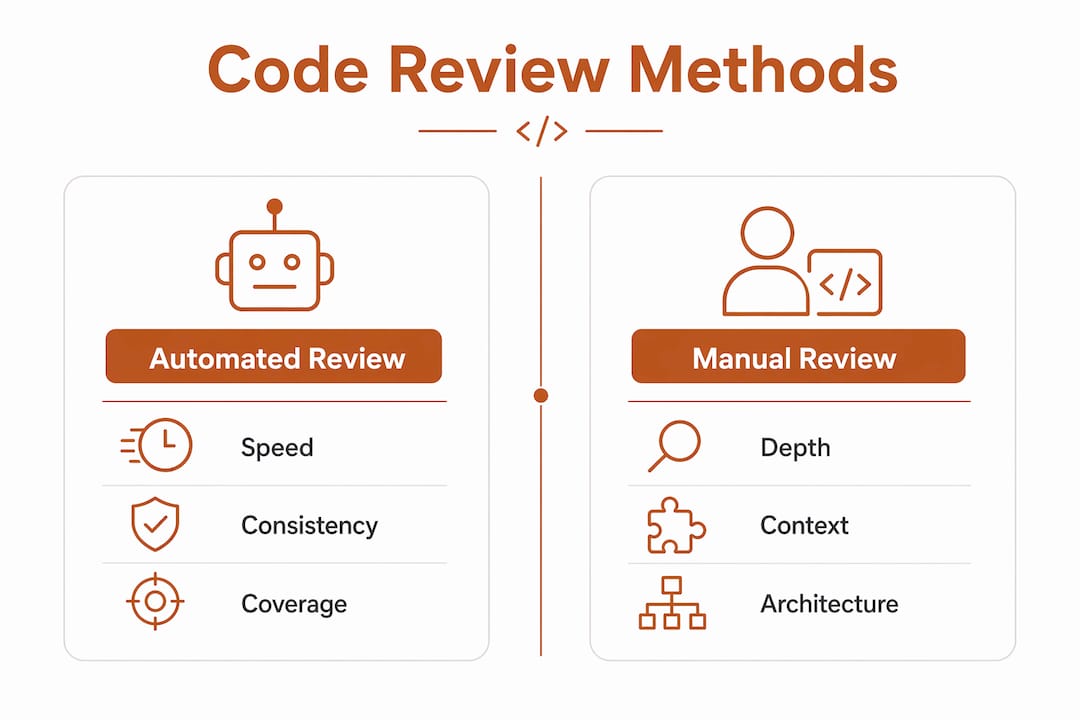
Automated and manual code review are not competing approaches. They cover different ground, and the best teams use both deliberately.
| Dimension | Automated review | Manual review |
|---|---|---|
| Speed | Instant, runs on every commit | Hours to days depending on queue |
| Consistency | Identical rules applied every time | Varies by reviewer experience and attention |
| Coverage | Style, security, dependencies, known patterns | Architecture, intent, business logic, edge cases |
| Scalability | Handles thousands of PRs without slowdown | Bottlenecks as team and codebase grow |
| Context | Limited to what rules and models can detect | Full understanding of system design and goals |
The practical implication is clear. Automation handles the mechanical work: style violations, known vulnerability patterns, dependency risks, and formatting. Human reviewers handle the work that requires judgment: is this the right architecture? Does this change introduce unintended side effects? Does the business logic actually match the requirement?
Automating routine defect detection frees senior engineers to focus their review time on architecture, intent, and security judgment. Studies show engineering teams spend 2 hours per week on review tasks that automation can handle instantly. That is 2 hours per engineer per week that can shift to higher-value work.
Pro Tip: Treat automated review output as a first-pass filter, not a final verdict. If automation approves a pull request, a human still needs to assess whether the change makes sense in context. Automation removes noise; it does not replace judgment.
Automation shifts review focus from subjective line-by-line checking toward evidence-based validation. Instead of debating whether a variable name is acceptable, reviewers can demand proof: does this change have tests? Does it have a demo? Does it break any existing behavior? That shift makes reviews faster and more productive for everyone involved.
Best practices for scaling automated code review effectively
Scaling automated code review in a large repository requires deliberate system design. The default approach of running a single monolithic scanner gets noisy and expensive fast.
The most effective pattern splits review into specialized agents. Each agent focuses on one quality dimension:
- A security agent runs SAST and dependency scanning.
- A performance agent flags inefficient queries, memory leaks, and blocking operations.
- A compliance agent checks license headers, data handling patterns, and regulatory requirements.
- A documentation agent verifies that public APIs have accurate docstrings and changelogs are updated.
A coordinator sits above these agents. It collects their outputs, deduplicates and ranks findings by severity, and posts a single unified comment to the pull request. This single-comment output is not a cosmetic choice. It prevents the pull request thread from becoming unreadable and keeps developer attention focused on what matters most.
Trust tiers are the other critical design decision. Hard-block deterministic findings like exposed secrets or known critical CVEs. Route ambiguous or semantic concerns to human reviewers as advisory comments. This separation reduces noise fatigue without letting serious issues slip through.
Large pull requests create their own challenges. A 2,000-line PR is expensive to scan and difficult to review meaningfully. The best teams enforce pull request size limits as a code review best practice. Smaller, focused changes are faster to scan, faster to review, and easier to revert if something goes wrong.
Finally, integrate feedback directly into the pull request workflow. Developers should see automated findings in the same place they see human comments. Context switching between tools kills productivity and causes findings to be ignored.
Key Takeaways
Automated code review accelerates deployment and strengthens security by running structured, consistent analysis on every pull request before human reviewers ever open the diff.
| Point | Details |
|---|---|
| Three-layer architecture | Analysis, orchestration, and enforcement layers must all work together for automated review to be effective. |
| Security enforcement | SAST tools block pull requests with critical vulnerabilities mapped to OWASP Top 10 and CWE categories. |
| Compliance automation | Continuous scan evidence satisfies SOC 2 and other audit requirements without separate manual documentation. |
| Human focus shifts | Automation handles routine checks so senior engineers can focus on architecture, intent, and business logic. |
| Specialized agents at scale | Splitting review into focused agents with a coordinator reduces noise and improves finding accuracy. |
What I’ve learned watching teams get automated review wrong
The most common mistake I see is treating automated code review as a binary: either you trust it completely or you ignore it. Both extremes cause problems.
Teams that trust it completely stop asking hard questions. They approve pull requests because the bot passed them, without checking whether the change actually solves the right problem. Automation does not replace human judgment. It removes the noise so human judgment can focus on what matters. When teams forget that distinction, they end up with technically clean code that does the wrong thing.
Teams that ignore automation because “it produces too many false positives” are usually dealing with a configuration problem, not a fundamental tool limitation. The fix is not to turn off the scanner. The fix is to tune severity thresholds, implement trust tiers, and route low-confidence findings to advisory mode instead of hard blocks.
The deeper shift that automated review forces is cultural. It moves teams away from “vibes-based” review, where approval depends on whether the reviewer likes the approach, toward evidence-based review. Did you write tests? Does the demo work? Does the automated scan pass? That shift is uncomfortable for teams used to informal review processes, but it produces better outcomes. Code quality becomes measurable rather than subjective.
The future of automated review is not more automation replacing more humans. It is better-calibrated automation that handles scale while preserving the human accountability that catches what tools cannot.
— Vibeprod
Vibeprod: automated code review built for teams shipping fast
Shipping fast without a production-ready review process is where most security and compliance problems start. Vibeprod closes that gap by scanning your GitHub repositories and identifying launch risks including exposed secrets, compliance issues, and known vulnerabilities, then generating reviewable pull requests with plain-English explanations for every finding.
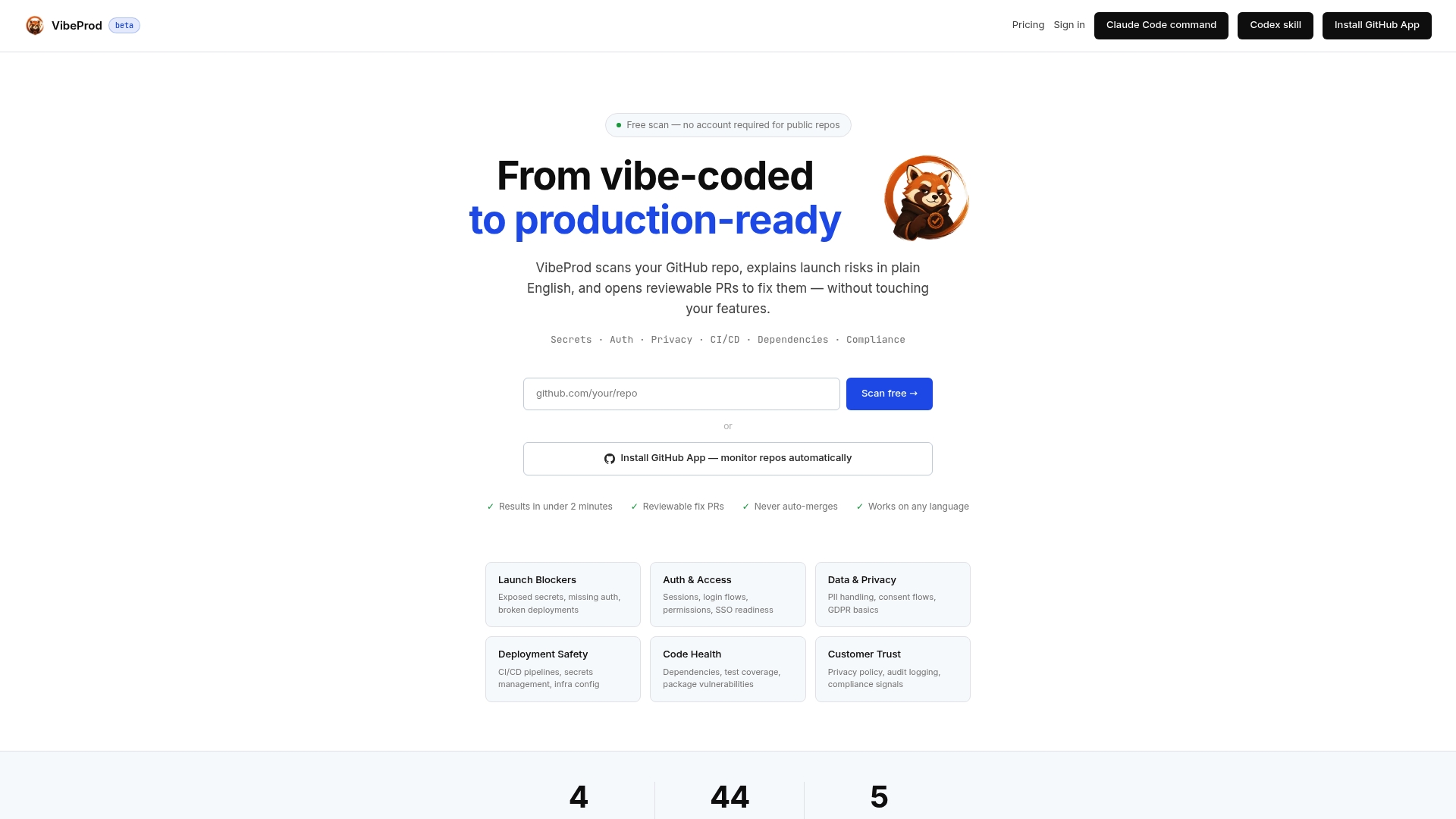
The process takes under two minutes. You get structured findings without altering your existing features, so you can stay focused on core business logic while Vibeprod handles the review layer that AI coding tools skip. For solopreneurs and small engineering teams who need to ship production-ready code without a dedicated security engineer, Vibeprod delivers the coverage that matters before real users ever hit your app.
FAQ
What is the role of automated code review in software development?
Automated code review is the process of using software tools to analyze source code for bugs, security vulnerabilities, and policy violations without manual reading. It runs inside CI/CD pipelines to provide immediate feedback on every pull request.
How does automated code review differ from manual review?
Automated review handles speed, consistency, and coverage of known patterns like style violations and dependency risks. Manual review covers architectural intent, business logic, and contextual judgment that tools cannot assess.
What security issues can automated code review detect?
SAST tools detect vulnerabilities including SQL injection, hardcoded secrets, and cross-site scripting, mapped to OWASP Top 10 and CWE categories. Critical findings trigger enforcement gates that block merges until the issue is resolved or overridden.
Does automated code review satisfy compliance requirements?
Automated review tools generate continuous audit trails documenting every scan, finding, and action taken on each pull request. This evidence satisfies compliance frameworks like SOC 2 without requiring separate manual audit processes.
How many specialized agents should an automated review system use?
The number depends on your quality dimensions, but effective systems separate security, performance, compliance, and documentation into distinct agents coordinated by a single orchestrator. Cloudflare’s production system uses seven specialized reviewers managed by one coordinator.