Developers: Prevent SQL Injection With Premerge Scans in 2 Minutes

Prepared statements with parameterized queries are the primary defense against SQL injection, full stop. Everything else, allow-list validation, least-privilege database accounts, and continuous testing exist to catch what parameterization can’t reach: structural inputs, legacy code you haven’t refactored yet, and the human error that slips past any single control. OWASP’s Top 10:2025 still lists injection as category A05, which tells you this isn’t a solved problem you can check off once.
TL;DR:
- Parameterized queries are the most effective defense against SQL injection, but they cannot protect against structural inputs like table names or order directions.
- Dynamic SQL inside stored procedures or client-side frameworks that transmit concatenated strings to the database reintroduces injection risks, especially with unsafe use of EXEC or sp_executesql.
- Validating user input against a fixed allow-list and avoiding string-based dynamic queries significantly reduces structural injection vulnerabilities.
- Implementing database privilege separation, views, and error output scrubbing limits the damage if injection occurs, forming a critical defense-in-depth layer.
- Automated tools that scan code repositories for risky patterns and block unsafe changes before deployment offer a practical solution for small teams to prevent injection vulnerabilities.
Table of Contents
- What Is SQL Injection and Where Does It Hide in Your Code?
- How Do Parameterized Queries and Safe ORMs Actually Stop Injection?
- What If You Can’t Parameterize Every Query?
- How Do You Limit the Damage if an Attack Gets Through?
- How Do You Test and Verify SQL Injection Defenses?
- How VibeProd Fits Into Your SQL Injection Prevention Workflow
- What Actually Matters Most in SQL Injection Prevention?
- Get Automated SQL Injection Checks Before You Ship
- Sources
- FAQ
What Is SQL Injection and Where Does It Hide in Your Code?
SQL injection happens when untrusted input gets concatenated directly into a query string, letting an attacker rewrite the command your database executes. The classic pattern looks harmless: "SELECT * FROM users WHERE name = '" + userInput + "'". Feed that a value like ' OR '1'='1, and the WHERE clause stops filtering anything.
Attacks split into three forms, and each one demands a different testing approach:
- In-band injection returns results directly in the application’s response, making it the easiest to spot during manual testing.
- Blind (inferential) injection gives no visible output. Attackers infer success through timing delays or boolean true/false behavior, which means your logs may show nothing unusual.
- Out-of-band injection exfiltrates data through a separate channel, like DNS or HTTP requests, often bypassing traditional monitoring entirely.
The vulnerability doesn’t only live in obvious query literals. It hides in dynamic ORDER BY clauses, in table or column names built from user selections, and inside stored procedures that construct SQL strings internally before executing them. That last one surprises a lot of developers who assume “stored procedure” automatically means “safe.”
How Do Parameterized Queries and Safe ORMs Actually Stop Injection?
Parameterized queries work by separating the SQL structure from the data. You write the query with placeholders first, SELECT * FROM orders WHERE customer_id = ?, and supply the actual value through a separate parameter binding. The database driver treats that value as pure data, never as executable code, regardless of what characters it contains. This is what the UC Berkeley security team calls the industry-standard defense, and OWASP’s framing backs it up: the goal is complete separation of data from commands, and safe APIs that avoid the SQL interpreter entirely are the most reliable path there, according to OWASP’s Top 10:2025 Injection category.
Every major language has this built in. Java uses PreparedStatement, .NET uses parameterized SqlCommand objects, Python’s psycopg2 and sqlite3 support parameter placeholders natively, and PHP’s PDO layer does the same. The pattern is nearly identical across all of them: define the query shape, bind the values, execute.
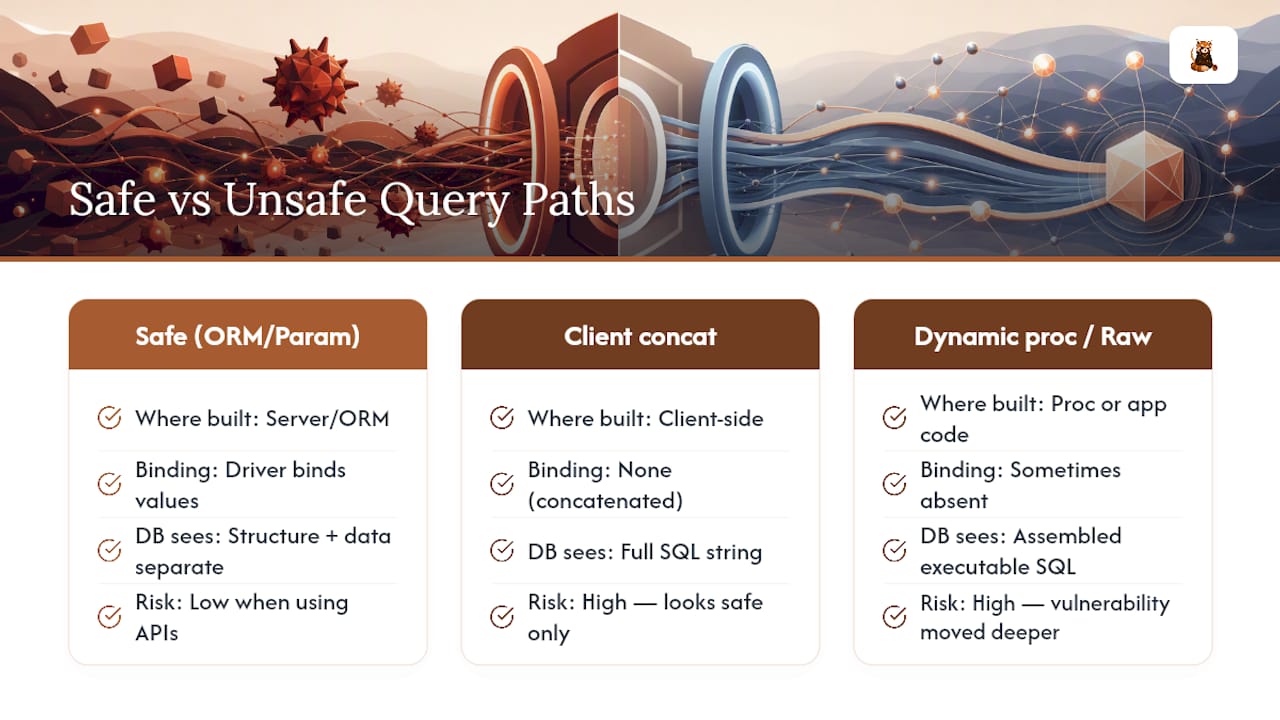
Here’s where it gets tricky. Some client-side frameworks perform parameterization locally but still transmit a fully concatenated SQL string to the server. That gives you the appearance of protection with none of the substance, because true safety requires server-side parameterization handled by the database driver itself, not by client-side string assembly that just looks tidy.
Stored procedures follow their own set of rules. A stored procedure that accepts parameters and uses them directly in a static query is genuinely safe. But plenty of stored procedures build SQL dynamically inside themselves, using EXEC or sp_executesql to run a string that was itself assembled from concatenated input. That pattern reintroduces the exact same vulnerability, just one layer deeper, where developers are less likely to look for it.
ORMs add another layer of nuance. Tools like Hibernate, Entity Framework, and SQLAlchemy generate parameterized SQL under the hood when you use their standard query-building methods. The risk reappears the moment a developer drops into raw SQL mode, writes a native query with string concatenation, or builds a “flexible” search feature that assembles WHERE clauses by hand.
Pro Tip: Search your codebase for the literal strings “EXEC(” and “sp_executesql” before you search for anything else. That single grep often surfaces more real risk than a full static analysis run, because it’s exactly where developers assume stored procedures already handle safety.
What If You Can’t Parameterize Every Query?
Parameterization has one hard limitation: it can’t bind structural elements of a query, things like table names, column names, or the direction of an ORDER BY clause. A placeholder can stand in for a value, but not for the word DESC or the name of a table. When user input has to influence one of these structural pieces, you need a different strategy.
- Map input to a fixed allow-list. If a user picks a sort column from a dropdown, don’t pass their string straight into the query. Map it to a small, hardcoded set of valid column names in your application code, and reject anything that doesn’t match.
- Canonicalize before validating. Normalize input (decode URL encoding, strip whitespace, standardize case) before you check it against your allow-list, or an attacker can smuggle a malicious value past a validator that only checks the raw string.
- Treat escaping as a last resort, not a strategy. Character escaping is database-specific, easy to get subtly wrong, and OWASP explicitly frames it as a secondary defense at best, useful only when retrofitting legacy code you can’t immediately rewrite around parameterized queries.
- Redesign instead of patching, when you can. If a feature depends on dynamic table or column selection, it’s often worth restructuring the query logic rather than layering validation on top of a fragile pattern indefinitely.
- Validate server-side, every time, at every boundary. Client-side checks improve user experience, but they don’t stop an attacker who bypasses your front end entirely and sends requests directly to your API.
None of these secondary defenses replace parameterized queries. They fill the gaps parameterization structurally cannot cover.
How Do You Limit the Damage if an Attack Gets Through?
Defense in depth means assuming one control will eventually fail, and building the next layer so that failure doesn’t turn into a breach. Database-side hardening does exactly that.
- Enforce least privilege on database accounts. An application account that only needs to read and write specific tables should never carry schema-modification or admin rights.
- Use views to restrict column access. If a query only needs three columns from a ten-column table, query through a view that only exposes those three.
- Separate roles for separate functions. A reporting service and a checkout service shouldn’t share the same database credentials.
- Scrub error output before it reaches the user. Raw SQL error messages can hand an attacker your table names and column structure for free.
Database-side controls like these reduce the blast radius of a successful injection rather than preventing the attempt outright. That distinction matters for how you prioritize: parameterization stops the attack, but privilege separation determines how bad it gets if something you missed slips through.
Auditing and logging close the loop. Query auditing that flags unusual patterns, an account suddenly running schema-level commands, or a spike in failed query attempts, gives you a chance to catch what your code review missed.
How Do You Test and Verify SQL Injection Defenses?
Testing has to happen at multiple layers, because no single method catches everything.
- Run static analysis on every pull request. Lint rules that flag string concatenation feeding into query execution functions catch the most common mistake before it ships.
- Add dynamic testing (DAST) and fuzzing. Automated tools that throw malformed payloads, quote characters, boolean logic strings, timing-based probes, at live endpoints reveal in-band and blind injection points that static analysis can’t see.
- Build a manual code-review checklist. Reviewers should specifically search for
EXEC,sp_executesql, and any string concatenation feeding a query, since these patterns hide dynamic SQL risk inside code that looks parameterized on the surface. - Gate CI/CD on high-risk findings. Integrating automated scans into your pipeline and blocking merges when a scan flags concatenated SQL keeps a vulnerable pattern from ever reaching production, rather than relying on someone remembering to check later.
- Treat monitoring and WAFs as detection, not prevention. A web application firewall configured with SQL injection signature rules can block obvious attack patterns and buy you time, but it’s a safety net, not a substitute for parameterized queries. Attackers routinely find encoding tricks that slip past generic WAF rules.
Pro Tip: Run your fuzzing suite against staging with logging turned up to full verbosity for that test cycle. Blind SQL injection often leaves subtle timing fingerprints that only show up when you’re actually watching for them.
How VibeProd Fits Into Your SQL Injection Prevention Workflow
Manually chasing down every concatenated query, checking every stored procedure for a stray EXEC, and reviewing every pull request for injection risk doesn’t scale once you’re shipping fast. That’s the gap Vibeprod is built to close.
- An automated tool scans GitHub repositories to surface risky code patterns, exposed secrets, and compliance gaps, including the string-concatenation and dynamic-SQL patterns this article walks through.
- Findings come back as plain-English explanations, rather than raw scanner output that requires decoding.
- Instead of silently auto-merging changes, the tool opens reviewable pull requests, allowing you to stay in control of what ships.
- The scan runs quickly, fast enough to run before every release rather than as an occasional audit.
Adding a pre-merge scan step that enforces parameterization and flags dynamic SQL is one of the cheapest security investments a small team can make.
What Actually Matters Most in SQL Injection Prevention?
The advice that gets repeated most often, “sanitize your inputs”, is also the advice most likely to leave a real gap. Escaping and validation feel proactive, but they’re patchwork by design. Parameterized queries solve the root problem: the database never sees user input as anything but data, no matter how creative the attacker gets.
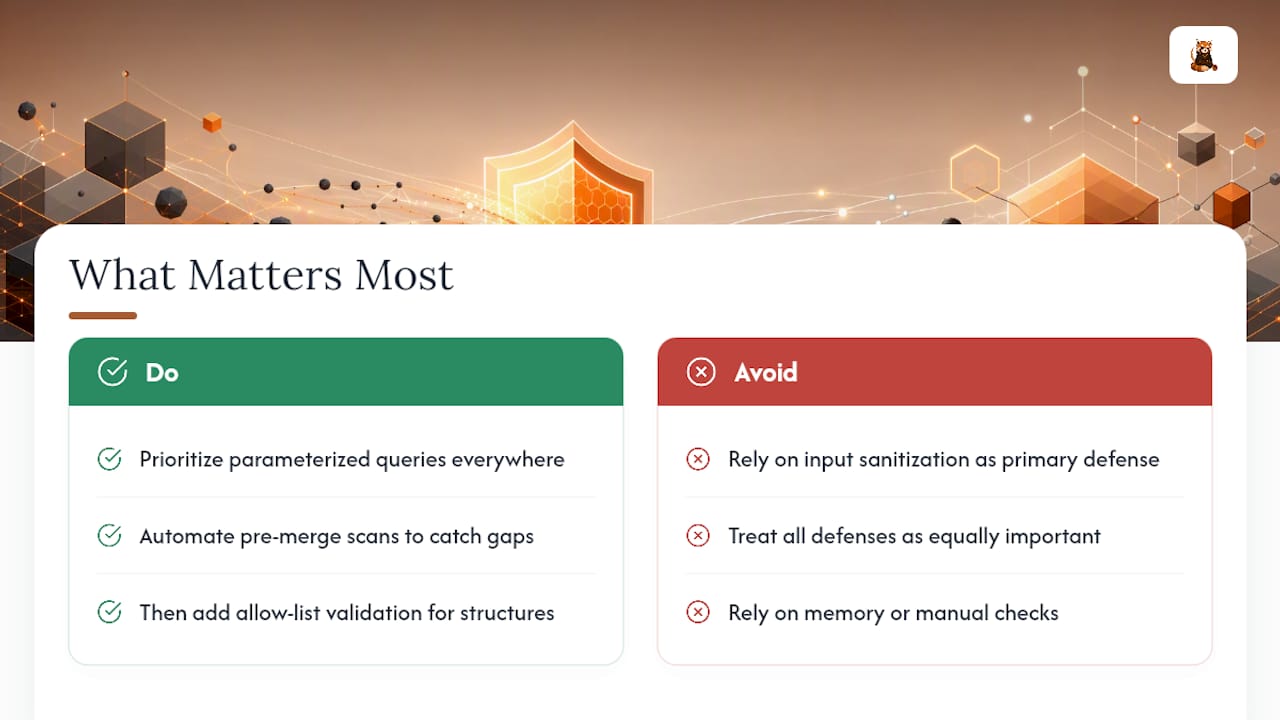
Where conventional guidance tends to fall short is treating every defense as equally important. It isn’t. Get parameterization right first, everywhere it applies, before spending a single hour on allow-list validation for structural inputs. Teams skip that order constantly, building elaborate input sanitization layers around queries that were never parameterized in the first place. That’s solving the easy problem while ignoring the one that actually matters.
The honest gap in most workflows isn’t knowledge, it’s follow-through. Developers know prepared statements are the answer. What’s missing is a consistent check that catches the one query someone wrote at 11 PM without thinking about it. That’s a detection and workflow problem, and it’s exactly the kind of thing worth automating rather than relying on memory or good intentions.
— Vibeprod
Get Automated SQL Injection Checks Before You Ship
This tool serves as an alternative to manual security review for solo developers and small teams shipping fast, catching patterns such as concatenated queries, risky EXEC calls, and exposed secrets, without requiring a dedicated audit.
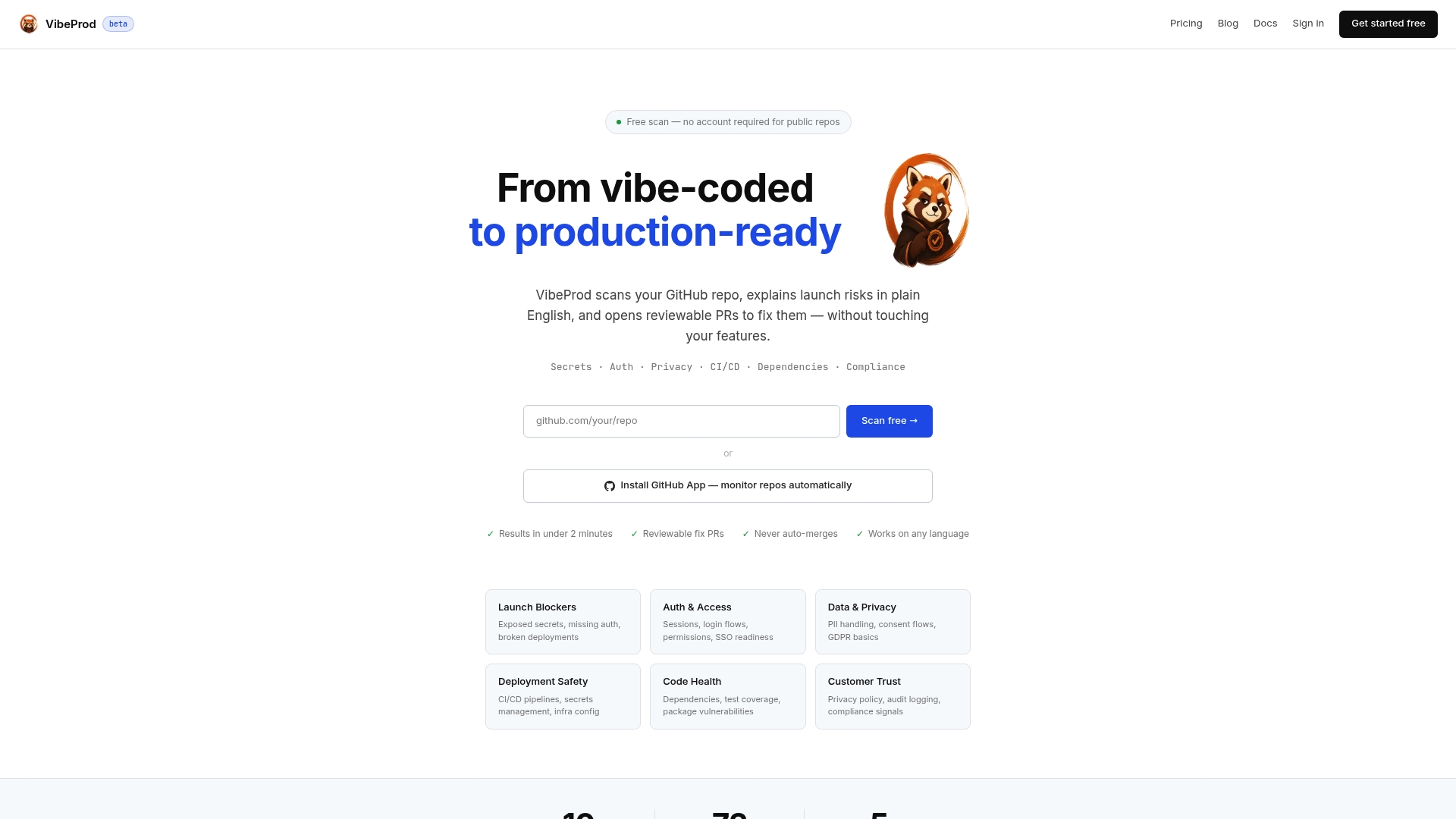
Instead of hoping your code review catches every dynamic SQL string, this tool scans your GitHub repository directly and flags the specific lines where injection risk exists, explained in plain English rather than a raw security report. When it finds something fixable, it opens a reviewable pull request instead of changing your code silently, so you decide what merges. For a broader look at why this kind of security groundwork matters for any data-driven application, see this overview of website security fundamentals. If your app also handles transactions, the same server-side validation discipline applies to securing online payment flows.
Run a scan on your repository at Vibeprod and see what turns up in under two minutes.
Sources
FAQ
How Can SQL Injection Attacks Be Prevented?
Use parameterized queries or prepared statements as the primary defense, since they separate SQL commands from user data at the driver level. Back that up with allow-list input validation, least-privilege database accounts, and automated testing in your CI pipeline.
Which Technique Is Used to Prevent SQL Injection?
Parameterized queries (also called prepared statements) are the standard technique, supported natively in virtually every language’s database driver, including Java’s PreparedStatement, PHP’s PDO, and Python’s psycopg2.
What Two Techniques Mitigate SQL Injection Attacks?
Parameterized queries and allow-list input validation are the two most-cited techniques: parameterization as the primary defense that removes the risk entirely, and allow-list validation as the secondary defense for structural inputs that can’t be parameterized, like column names.
Is SQL Injection Still Possible in 2026?
Yes. SQL injection remains categorized under A05:2025-Injection in the OWASP Top 10:2025, largely because legacy code, dynamic SQL inside stored procedures, and unparameterized structural inputs continue to slip through code review.
Are ORMs Automatically Safe From SQL Injection?
Not entirely. ORMs like Entity Framework or SQLAlchemy parameterize queries automatically when you use their standard query-building methods, but the risk returns the moment a developer writes raw SQL or concatenates strings inside a “custom query” feature.