SOC 2 for Startups: When to Start and How to Pass
You need SOC 2 when an enterprise buyer or procurement process asks for it, not before. The AICPA’s Trust Services Criteria set the bar auditors test against, and the fastest safe path is Security-only scope, starting with a Type 1 report to unblock a stalled deal while you build toward Type 2. Start the readiness work as soon as you see the ask coming, because a scramble under deal pressure is how startups end up over-scoping and overspending.
TL;DR:
- Pursuing SOC 2 early depends on a specific buyer request or contract value, with a focus on Security scope, especially for startups handling real customer data.
- Type 1 audits assess control design at a single point, while Type 2 audits verify control effectiveness over at least three months; many enterprises prefer Type 2.
- Building identity, access management, change controls, and monitoring first can significantly reduce audit time and costs, with automated tools speeding code-level evidence.
- Internal effort, including engineering hours and internal tools, usually dominates the total SOC 2 implementation cost, which typically ranges in the low five figures.
- Starting SOC 2 work after multiple stalled deals or without a clear buyer signal leads to inefficiency; the timing should match actual demand and scope discipline.
Table of Contents
- What SOC 2 Actually Tests
- Why SOC 2 Matters for Startup Sales and Fundraising
- When Should a Startup Start SOC 2?
- Type 1 vs. Type 2: Which Report Do You Need?
- How to Prepare for SOC 2: A Step-by-Step Playbook
- What Does SOC 2 Cost for a Startup?
- Common SOC 2 Mistakes Startups Make
- Technical Controls Engineering Teams Should Build First
- Where Automated Repo Scanning Fits in Readiness
- The Real Lesson Behind SOC 2 Timing
- Speed Up Code-Related Controls Before Your Audit
- Sources
- FAQ
What SOC 2 Actually Tests
SOC 2 is an attestation framework built by the AICPA for service organizations that store or process customer data. An independent auditor examines your controls against a defined set of criteria and issues a report. It is not a certification you hang on a wall. It is closer to a health inspection: a licensed professional checks your kitchen against a standard, then writes down exactly what they found.
The framework rests on five Trust Services Criteria, and only one of them is mandatory:
- Security (required for every SOC 2 report) — access controls, encryption, monitoring, and incident response
- Availability — uptime commitments and disaster recovery
- Confidentiality — protection of sensitive business information beyond personal data
- Processing integrity — accuracy and completeness of data processing
- Privacy — handling of personal information under stated policies
Most healthcare startups pursue Security alone, as explained in Healthcare Startup Regulatory Basics Explained for Founders. Adding Availability or Confidentiality only makes sense when a specific buyer contract demands it, since each additional criterion adds evidence requirements and audit hours.
One distinction trips up a lot of first-time founders: SOC 2 measures whether your controls exist and function as documented. It says nothing about whether your engineering practices are objectively good. A company can pass SOC 2 with mediocre code architecture and fail it with excellent code, because the auditor is grading process discipline, not craftsmanship.
Why SOC 2 Matters for Startup Sales and Fundraising
SOC 2 shows up as a line item in procurement, not a nice-to-have. Enterprise security teams routinely block contract signature until a vendor produces an attestation report, and that gate does not care how good your product is.
A few patterns show up repeatedly once a startup starts selling upmarket:
- Procurement teams request a SOC 2 report as a checkbox before legal will finalize a contract, and significant deals get stuck without one.
- Venture investors and channel partners increasingly ask about security posture during diligence, even when the check size doesn’t require it.
- A completed SOC 2 report functions as a sales asset you can hand to any prospect’s security team, cutting weeks off a security questionnaire cycle.
The market pressure behind this is real. U.S. small-business sentiment has been improving even as enterprise buyers grow more cautious about vendor risk, which means more startups are competing for the same enterprise budgets and getting judged on security readiness earlier in the sales cycle. Pursuing SOC 2 before any buyer has asked for it is usually premature. Pursuing it after three stalled deals cite the same objection is late.
When Should a Startup Start SOC 2?
Timing is the decision most founders get wrong, usually in the direction of starting too late. A useful gut check is a four-trigger test. Score yourself on each:
- A named buyer has asked for SOC 2 or a security questionnaire referencing it, not a hypothetical future customer.
- The contract value justifies the spend — a $150,000 annual deal easily covers audit fees; a $12,000 deal probably doesn’t yet.
- Your product handles real production customer data, not just a demo environment or sandbox.
- You have one person who can own this project for the next several months, even part time.
If fewer than two of these are true, hold off and spend your energy on fundamentals instead: SSO, logging, and a written security policy. If three or four are true, start now, because readiness work takes real time and buyers rarely wait quietly.
While the audit is underway, you don’t have to leave a deal frozen. A system description document, a signed data processing agreement, and results from a third-party penetration test can often satisfy a buyer’s security team on an interim basis. These artifacts buy you months, not indefinite patience, but they keep revenue moving while the formal report gets built.
Type 1 vs. Type 2: Which Report Do You Need?
Type 1 and Type 2 answer different questions, and confusing them wastes both money and buyer trust.
- Type 1 evaluates whether your controls are designed correctly at a single point in time. It’s a snapshot, and an auditor can typically issue it within weeks of fieldwork.
- Type 2 evaluates whether those same controls actually operated effectively over a period, usually a minimum of three months and often longer. It’s the report enterprise buyers generally prefer, because it proves the controls held up under real use, not just on paper.
Ask your buyer’s security team directly which one they’ll accept. Many enterprise procurement teams will accept a Type 1 as a bridge while you complete the observation period for Type 2, especially if you can show a signed engagement letter with an auditor. Don’t assume you need Type 2 on day one just because it sounds more rigorous.
On scope, the same discipline applies: start with Security only unless a specific buyer contract requires Availability, Confidentiality, or another criterion. Adding scope you don’t need is the single most common way early-stage companies inflate their audit cost and timeline for no commercial benefit.
How to Prepare for SOC 2: A Step-by-Step Playbook
Readiness work follows a fairly predictable sequence, and skipping steps almost always shows up later as a delay during fieldwork.
- Run a gap analysis against the Security criteria. Map every control the AICPA framework expects (access management, change management, monitoring, incident response, vendor management) against what you actually have today. Most startups find gaps in access reviews and logging first.
- Build a prioritized remediation plan. Rank gaps by evidence value and effort. A missing MFA policy is high value and low effort; a full SIEM rollout is high value but a much bigger lift. Fix the cheap, high-value items first.
- Implement the controls that generate the most evidence. Single sign-on paired with enforced multi-factor authentication, role-based access control, centralized logging, branch protection with mandatory pull request reviews, and documented change-management records cover a large share of what a Security-scoped audit will test.
- Automate evidence collection where you can. Manually screenshotting configuration pages every quarter does not scale past a handful of employees. Compliance automation platforms and repository-level scanning tools can pull evidence continuously instead of during a frantic pre-audit sprint.
- Engage an auditor early, not at the end. Reach out to firms three to four months before you want fieldwork to start. Ask direct questions: How many SaaS startups have you audited in the past year? What’s your typical fieldwork timeline for Type 1 versus Type 2? Can you provide references from companies our size? A reputable firm answers these without hesitation; a firm that dodges specifics or pushes an unusually fast timeline for a low price is worth a second look.
- Prepare for fieldwork. During fieldwork, expect the auditor to request configuration screenshots from your identity provider, exported log samples, your written security policies, access review sign-offs, and incident response documentation. Having these organized in one folder before the auditor asks cuts fieldwork time meaningfully.
Pro Tip: Assign one person as the sole point of contact for the auditor, even if a handful of engineers do the actual remediation work. Auditors lose days chasing down scattered answers from five different Slack threads, and a single owner keeps the whole process on schedule.
What Does SOC 2 Cost for a Startup?
Budget conversations tend to undersell the real cost driver, which is internal time, not the audit invoice.
- Type 1 audit fees for an early-stage company typically run in the low five figures, with Type 2 fees running somewhat higher because of the extended review period.
- Compliance automation platform subscriptions add an ongoing cost, usually justified once you’re managing evidence across more than a handful of controls and employees.
- Internal engineering hours dominate the total cost most founders underestimate, spread across whoever owns identity management, logging infrastructure, and policy documentation.
- Cross-functional time from HR, IT, and leadership adds up too, particularly around onboarding and offboarding documentation.
Together, audit fees and platform costs for a first-year SOC 2 engagement commonly land in the low five figures overall, and that number assumes internal effort is handled by existing staff rather than new hires.
The pressure behind these costs isn’t abstract. Data breaches have been climbing globally for years, and every high-profile incident makes enterprise security teams more conservative about which vendors they’ll approve without an attestation in hand.
On timeline, plan for readiness work to run one to two months before you’re ready for Type 1 fieldwork, and closer to four and a half to six months total if you’re going straight for Type 2, once you account for the minimum observation period plus fieldwork and report drafting.
Common SOC 2 Mistakes Startups Make
Most SOC 2 failures aren’t technical. They’re planning failures that show up months later as blown deadlines.
- Waiting until a deal is deep in procurement to start. By then you’re negotiating audit timelines against a signature deadline you don’t control. Start readiness the moment a serious buyer signal appears, not after the contract is on the table.
- Over-scoping systems that never touch customer data. Internal tools, marketing sites, and staging environments with synthetic data usually don’t belong in scope. Narrow scoping to customer-facing production systems keeps cost and audit time proportional to actual risk.
- Having no single owner. Compliance work that’s “everyone’s responsibility” quietly becomes no one’s responsibility. Name one person, set a weekly check-in, and hold that cadence even when nothing dramatic happened that week.
- Going quiet with buyers mid-audit. If a deal is waiting on your report, tell the buyer’s security team exactly where you are in the process and share interim artifacts. Silence reads as risk; a clear status update usually doesn’t.
Technical Controls Engineering Teams Should Build First
A handful of technical controls generate most of the evidence a Security-scoped audit requires, and building them before you engage an auditor saves real fieldwork time.
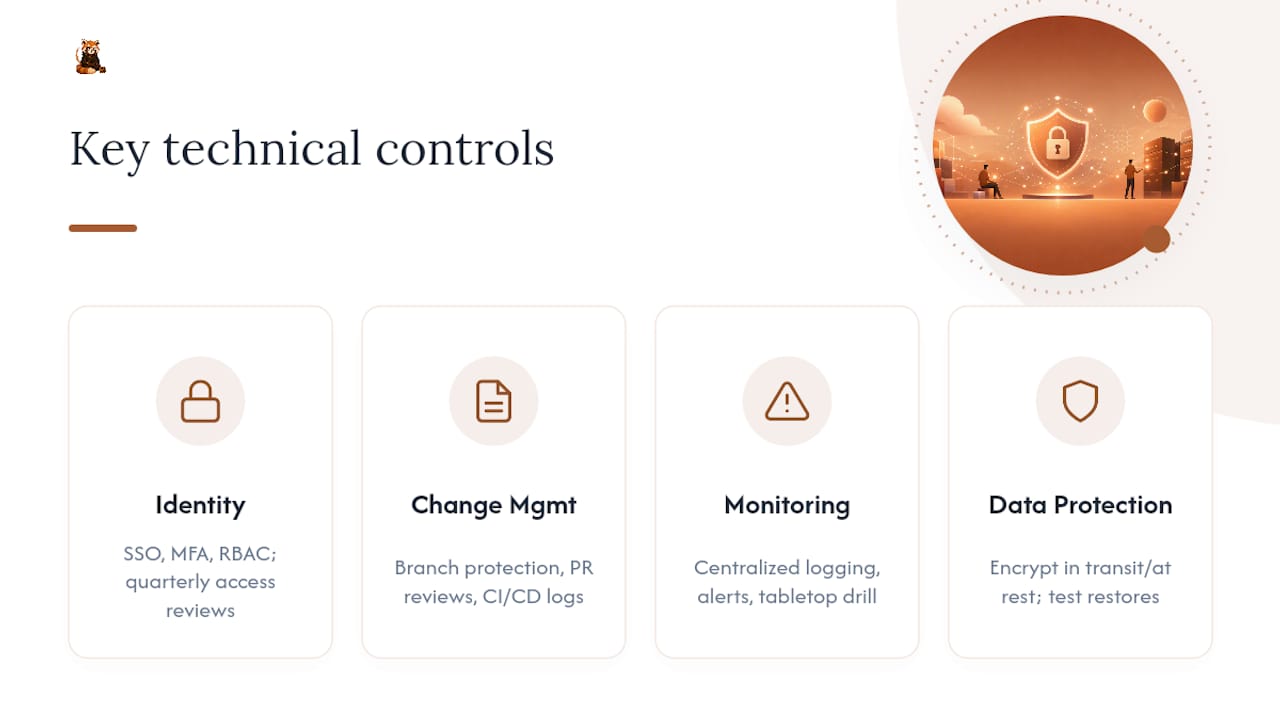
Identity and access management comes first. Enforce single sign-on across every system that touches customer data, require multi-factor authentication without exception, and implement role-based access control so permissions map to job function rather than convenience. Document quarterly access reviews in writing, and make offboarding fast enough that a departed employee loses access the same day, not the same week.

Change management and code evidence matter just as much. Auditors want to see clean Git history, branch protection rules that block direct pushes to production branches, mandatory pull request reviews before merge, and CI/CD logs that show what deployed and when. Separating development, staging, and production environments cleanly is one of the easiest wins available, and it’s also one of the most commonly missed.

Monitoring and incident response round out the Security criterion. Centralized logging across your infrastructure, alerting tied to anomalous access patterns, and a written incident response plan are all standard asks. Run at least one tabletop drill before your audit window opens; an untested plan reads as a paper exercise to an experienced auditor.
Data protection closes the loop: encrypt data at rest and in transit, automate backups, and actually test your restore procedure rather than assuming it works.
Pro Tip: Auditors weight documented access reviews more heavily than most founders expect. A quarterly spreadsheet showing who has access to what, reviewed and signed off by a manager, often carries more evidential weight than an expensive access-management tool nobody has configured to log anything.
Where Automated Repo Scanning Fits in Readiness
Change-management evidence, pull request review records, and exposed-secrets checks are exactly where engineering teams lose the most time during SOC 2 prep, because most of that evidence lives scattered across commit history and configuration files nobody has audited in months.
Vibeprod scans your GitHub repositories directly and surfaces launch risks like exposed secrets, authentication gaps, and misconfigured CI/CD pipelines, then opens reviewable pull requests with plain-English explanations of each fix. It doesn’t merge anything automatically. It hands your team a clear, reviewable trail of what was found and what changed, which is close to the exact evidence format an auditor requests for change-management and code-review controls. Paired with a compliance automation platform handling policy documentation and access reviews, a tool like this shortens the remediation phase that usually eats the most calendar time before fieldwork begins.
The Real Lesson Behind SOC 2 Timing
Most SOC 2 advice tells founders to start “as early as possible,” which is technically true and practically useless. Startups don’t have unlimited engineering hours to spend on a report no customer has asked for yet. The better rule is to start the moment a real signal appears, not before, and to treat scope discipline as the actual lever that controls cost, not the auditor you pick.
The conventional wisdom also overstates how much evidence buyers actually need before they’ll sign. A completed Type 1 report, a solid system description, and a recent penetration test satisfy a surprising number of enterprise security teams on an interim basis. Chasing a perfect Type 2 report before any deal requires it is often energy spent in the wrong place.
What should come first, in practice, is identity and access control work: SSO, MFA, and access reviews cover more audit ground than any other single investment. Everything else, including the code-level evidence that tools like automated repo scanning can help produce faster, matters more once those fundamentals are solid. Get the sequencing right, and SOC 2 stops being a fire drill and starts being a normal part of shipping software to customers who expect it.
— Vibeprod
Speed Up Code-Related Controls Before Your Audit
Vibeprod gives engineering teams a faster way to clean up exactly the kind of code-level risk that slows down SOC 2 remediation: exposed secrets, missing authentication checks, and CI/CD misconfigurations that otherwise get found manually, weeks before fieldwork, under deadline pressure.
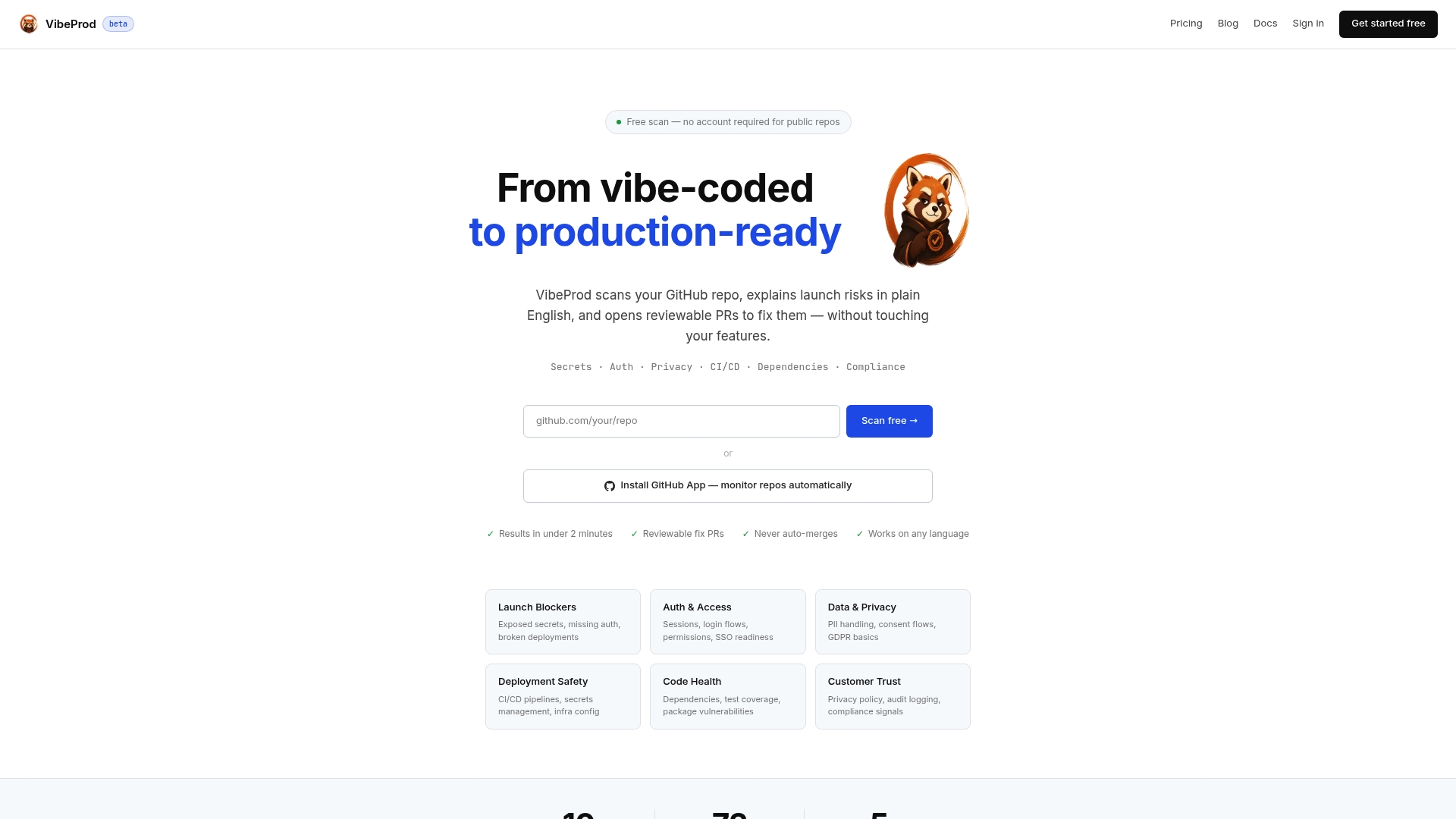
It scans your GitHub repositories and flags launch risks in under two minutes, then opens reviewable pull requests with plain-English explanations for each fix, without touching your existing features or merging anything without your review. For a small engineering team juggling readiness work on top of shipping product, that turns a vague, half-documented remediation backlog into a specific, trackable list of fixes your auditor can actually see evidence of. If your team is heading into a Type 1 or Type 2 engagement and code-related controls are still a question mark, start with Vibeprod and see what your repositories turn up before your auditor does.
Sources
- SOC 2 for Startups: What You Actually Need | Chiaro
- SOC 2 for Startups: A Practical Guide | Bastion
- Complete SOC 2 Compliance Checklist for SaaS Companies (2026 Guide)
- Reuters: US small business surges, sentiment improves (2024)
FAQ
Do Startups Really Need SOC 2?
Only if a buyer, investor, or partner requires it as a condition of the deal. Building it speculatively, with no near-term buyer signal, usually wastes engineering time better spent elsewhere.
How Long Does SOC 2 Take for a Startup?
Readiness plus Type 1 fieldwork often runs one to two months, while a full Type 2 engagement, including the minimum observation period, typically takes four and a half to six months from start to report.
What’s the Difference Between SOC 2 Type 1 and Type 2?
Type 1 confirms your controls are designed correctly at one point in time, while Type 2 confirms those controls operated effectively over an observation period, usually a minimum of three months.
How Much Does SOC 2 Cost a Startup?
Audit fees and platform tools for a first-year engagement commonly land in the low five figures combined, though internal engineering time is usually the larger real cost.
Can Automated Tools Help With SOC 2 Readiness?
Yes. Tools that scan your codebase for exposed secrets, misconfigurations, and missing security controls, such as Vibeprod, help produce evidence for change-management and code-review controls faster than manual review.