Secure Deployment Pipeline Explained for Dev Teams

A secure deployment pipeline is an automated workflow that embeds security controls at every stage from code commit to production, not as an afterthought but as a structural requirement. The industry term is secure CI/CD pipeline, where CI/CD stands for Continuous Integration and Continuous Delivery. For developers and tech leads shipping fast, this means tools like GitHub Actions, Terraform, and SAST scanners are not optional add-ons. They are the gates that keep vulnerable code from reaching your users. Get this architecture right, and you ship fast and safe.
What is a secure deployment pipeline and why does it matter?
A secure deployment pipeline is defined as an automated software delivery process that integrates security controls such as SAST (Static Application Security Testing), SCA (Software Composition Analysis), and secret scanning at each stage from source to production. The goal is to catch vulnerabilities before they become incidents, not after. Without this structure, security becomes a manual checkpoint at the end of the release cycle, which is too slow and too error-prone for modern teams.
The pipeline replaces ad hoc security reviews with automated, repeatable gates. Every pull request triggers a scan. Every build validates dependencies. Every deployment requires an approval workflow. This is what separates a prototype from a production-ready product.

Teams that skip this structure pay for it later. A single exposed API key or an unpatched CVE in a dependency can compromise your entire application. The secure CI/CD pipeline exists to make those failures structurally impossible, not just unlikely.
What are the key components and stages of a secure deployment pipeline?
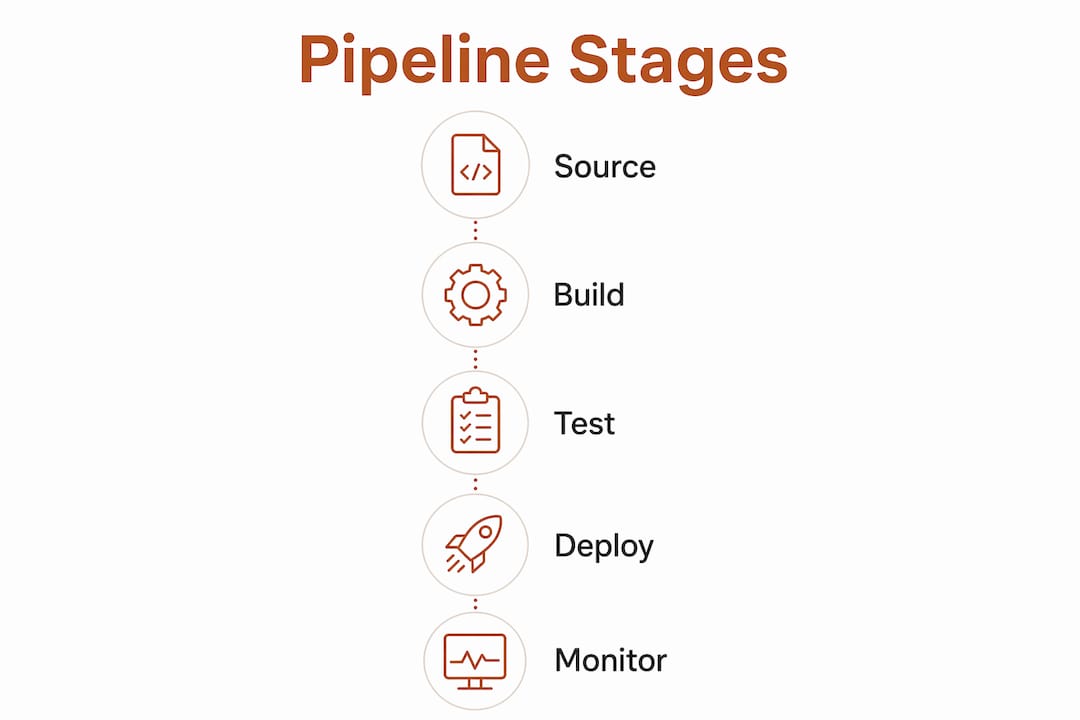
Pipeline stages include source, build, test, deploy, and post-deployment monitoring, each with distinct security controls applied as gates. Understanding what happens at each stage is the foundation of any deployment security best practice.
| Stage | Security controls | Main risks |
|---|---|---|
| Source | Branch protection, signed commits, code review | Unauthorized changes, credential leaks |
| Build | Dependency validation, artifact signing, SBOM generation | Supply chain attacks, tampered artifacts |
| Test | SAST, SCA, IaC scanning, security validation gates | Undetected vulnerabilities, misconfigured infrastructure |
| Deploy | Approval workflows, environment isolation, TLS 1.2+ | Unauthorized deployments, config drift |
| Post-deploy | Drift detection, runtime monitoring, alerting | Silent breaches, configuration changes |
At the source stage, branch protection rules prevent direct pushes to main branches. Signed commits using GPG or SSH keys verify that code comes from a trusted author. These controls sound basic, but they block a wide class of supply chain attacks before a single line of code is compiled.
At the build stage, artifact signing using tools like cosign or Sigstore creates a verifiable chain of custody. A security checklist covering authentication, encryption, and runtime monitoring spans at least 25 control points across a mature pipeline. That number reflects how many places things can go wrong.
Post-deployment monitoring closes the loop. Drift detection tools flag when your production environment diverges from its declared configuration. Without this, a manual change made at 2 a.m. becomes an invisible risk that no pre-deploy scan would have caught.
Pro Tip: Set up drift detection alerts before you need them. By the time you notice configuration drift manually, the damage is often already done.
How does shift-left security improve your pipeline?
Shift-left security means integrating SAST, SCA, dependency scanning, and Infrastructure-as-Code (IaC) scanning into the earliest stages of the pipeline, specifically at the pull request and build stages, before code is ever merged. The name comes from moving security controls to the left side of the delivery timeline.
The business case is straightforward. A vulnerability caught at the PR stage costs minutes to fix. The same vulnerability caught in production costs hours of incident response, potential data exposure, and compliance reporting. Implementing shift-left practices like SAST and SCA during PR and build stages significantly reduces remediation costs and blocks insecure code before deployment.
The AegisFlow pipeline case study makes this concrete. By applying automated security gates at the PR and build stages, the team reduced critical and high security findings from over 30 to zero before any code reached production. That is not a marginal improvement. It is a structural change in how risk accumulates.
Here is what an effective shift-left setup looks like in practice:
- SAST scanning runs on every pull request, flagging injection flaws, insecure deserialization, and hardcoded credentials before merge.
- SCA scanning checks every dependency against known CVE databases, blocking packages with critical vulnerabilities.
- IaC scanning tools like Checkov or tfsec analyze Terraform and CloudFormation templates for misconfigured storage buckets, open security groups, and missing encryption.
- Automated gating fails the build when findings exceed a defined severity threshold, preventing risky code from progressing downstream.
The risk of shift-left done wrong is noise. If every PR triggers 50 low-severity alerts, developers start ignoring all of them. Tune your severity thresholds carefully. Block on critical and high findings. Report medium and low findings without blocking.
Pro Tip: Start with a single SAST tool and one SCA scanner. Add IaC scanning only after your team has calibrated alert thresholds. Stacking tools before tuning them creates alert fatigue faster than any single vulnerability would.
What are best practices for artifact integrity and secrets management?
Secrets management is the top attack vector in CI/CD pipelines, and using long-lived static credentials stored in environment variables is the most common critical vulnerability. This is where many teams get breached, not through sophisticated exploits but through a hardcoded token that never rotated.
The principle of Build Once, Deploy Many addresses artifact integrity directly. Promoting the same immutable artifact through every environment, from staging to production, proves that what you tested is exactly what you deployed. Rebuilding in production introduces drift and breaks the chain of custody. If an incident occurs, you need to know with certainty what code was running.
Follow these steps to secure your secrets lifecycle within the pipeline:
- Remove all static credentials from environment variables, config files, and source code. Use a secrets scanner like Gitleaks or Trufflehog to find what is already there.
- Adopt a secrets vault such as HashiCorp Vault or AWS Secrets Manager. Inject credentials at runtime, not at build time.
- Use OIDC federation where your cloud provider supports it. GitHub Actions, for example, can authenticate to AWS or GCP using short-lived OIDC tokens with no stored secret at all.
- Set short TTLs on all dynamic tokens. A credential that expires in 15 minutes cannot be abused for long even if it leaks.
- Audit log all secret access. Know who or what retrieved a credential and when. This is non-negotiable for compliance under frameworks like SOC 2 or ISO 27001.
| Secrets approach | Risk level | Recommended use |
|---|---|---|
| Static env variables | Critical | Never use in production |
| Long-lived API keys | High | Avoid; rotate frequently if used |
| Vault-injected secrets | Low | Preferred for all environments |
| OIDC short-lived tokens | Very low | Best practice for cloud auth |
A common pitfall is secrets leaking through log output or error messages. If your application logs request headers or stack traces in production, a secret injected into a header can appear in plain text in your logging system. Sanitize logs and mask sensitive patterns at the middleware layer.
Pro Tip: Audit your existing repositories for secrets before you build any new pipeline controls. Tools like Gitleaks run in minutes and often surface credentials committed months or years ago that are still active.
How can teams enforce security policies consistently across pipelines?
Policy-as-code enables enforceable, automated security gates that prevent manual review errors and deliver consistent compliance across every deployment. Tools like Open Policy Agent (OPA), Conftest, and Kyverno let you write security rules as code, version them in Git, and apply them automatically at build or deploy time.
The shared responsibility model is a critical concept here. Cloud providers do not secure your CI/CD pipelines under their shared responsibility model. Misconfigurations, exposed credentials, and insecure workflows remain entirely your organization’s responsibility, even on fully managed platforms like GitHub Actions or AWS CodePipeline. Many teams discover this the hard way.
Common misconfigurations to watch for:
- Overly broad IAM permissions granted to pipeline service accounts, giving a compromised runner access to your entire cloud environment.
- Missing approval gates on production deployments, allowing automated pushes to live environments without human review.
- Weak pipeline isolation, where a compromised job in one workflow can read secrets or artifacts from another.
- Unreviewed third-party actions in GitHub Actions workflows, which can execute arbitrary code with your pipeline’s permissions.
Automating too many security gates risks alert fatigue and deployment delays. Successful teams use a tiered approach: automated blocking for critical and high findings, manual review for complex policy decisions. This balance maintains velocity without sacrificing rigor.
Pro Tip: Pin all third-party GitHub Actions to a specific commit SHA, not a tag. Tags are mutable and can be silently updated to point to malicious code.
Key takeaways
A secure CI/CD pipeline requires automated security gates at every stage, immutable artifact promotion, dynamic secrets management, and policy-as-code enforcement to ship fast without creating exploitable gaps.
| Point | Details |
|---|---|
| Shift-left security | Integrate SAST, SCA, and IaC scanning at the PR stage to catch vulnerabilities before they merge. |
| Immutable artifacts | Build once and promote the same artifact through every environment to maintain chain of custody. |
| Dynamic secrets | Replace static credentials with vault-injected or OIDC short-lived tokens to eliminate the top CI/CD attack vector. |
| Policy-as-code | Automate security gates with tools like OPA or Kyverno to enforce consistent compliance without manual review. |
| Tiered enforcement | Block automatically on critical findings and reserve manual review for complex cases to avoid alert fatigue. |
What I’ve learned watching teams get pipeline security wrong
Most teams I work with understand the theory. They know they should scan for secrets and sign their artifacts. The gap is almost always in execution, specifically in the distance between “we have a scanner” and “our scanner actually blocks bad code.”
The most common failure pattern is treating security tools as reporting tools rather than gates. A SAST scanner that flags 40 issues per PR but never blocks a merge is not a security control. It is a dashboard nobody reads. The fix is not adding more tools. It is making the tools you have consequential.
The second failure pattern is secrets sprawl. Teams adopt Vault or AWS Secrets Manager for new services but leave old static credentials in place for legacy workflows. Those old credentials are the ones that get breached. A full audit of existing secrets, not just new ones, is the unglamorous work that actually reduces risk.
The third pattern is the shared responsibility blind spot. I have seen teams spend weeks hardening their application code while their GitHub Actions workflows run with admin-level cloud permissions and no approval gates on production deployments. The pipeline itself is an attack surface. Treat it like one.
The teams that get this right share one trait: they treat security as a first-class engineering concern, not a compliance checkbox. They write policy-as-code the same way they write application tests. They review pipeline changes with the same rigor as application changes. That cultural shift is harder than any tool configuration, and it matters more.
— Vibeprod
How Vibeprod helps you ship production-ready code
Shipping fast is only half the equation. The other half is knowing your code is actually ready for real users.
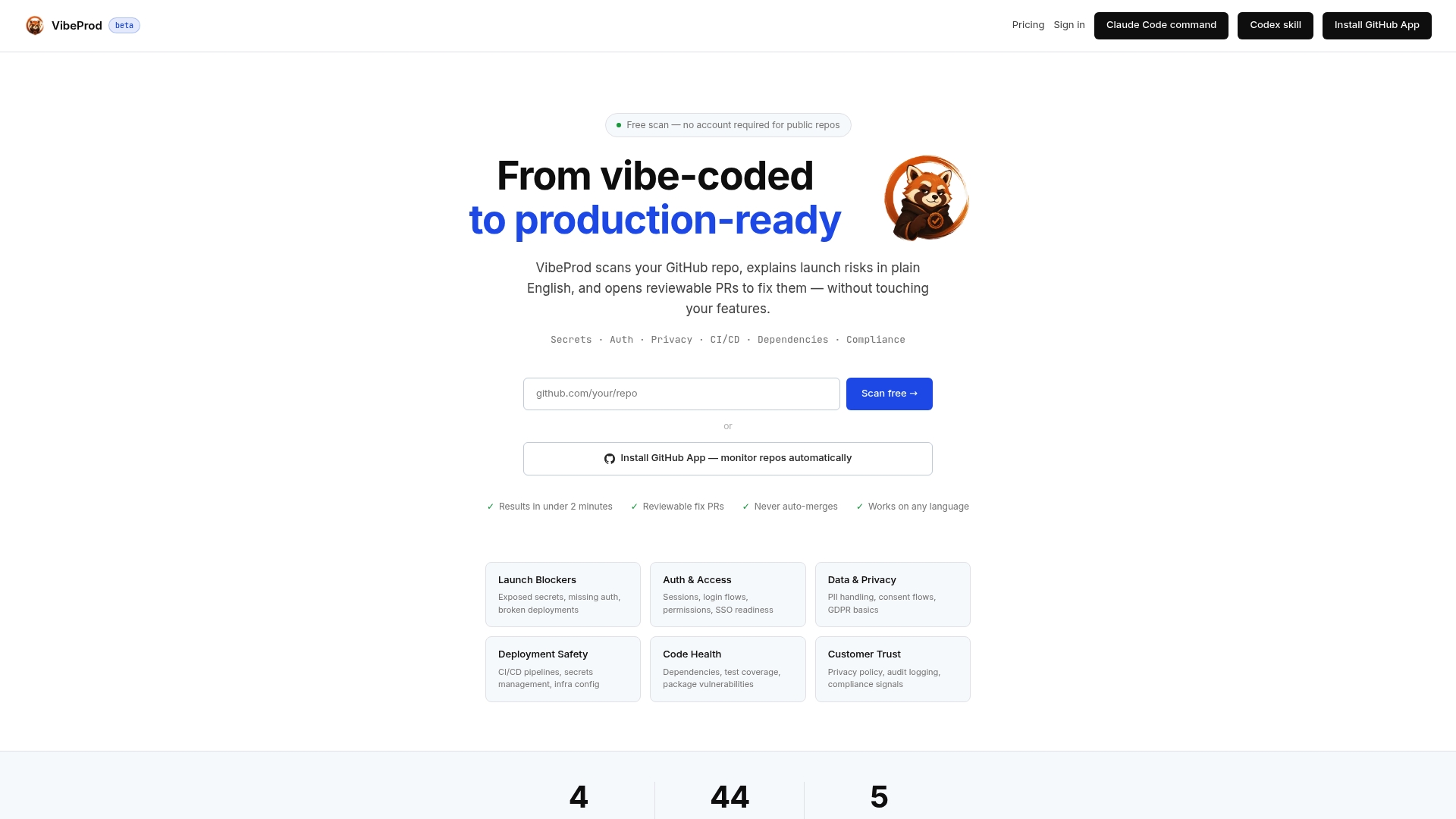
Vibeprod scans your GitHub repositories and identifies launch risks including exposed secrets, missing auth controls, and compliance gaps before they reach production. It generates reviewable pull requests with plain-English explanations for every issue it finds, so you understand the problem and the fix without digging through documentation. The entire process takes under two minutes. For solo developers and small teams who need to stay focused on core features, Vibeprod handles the security review layer that most AI coding tools skip entirely. Get production-ready and close the gap between prototype and product.
FAQ
What is a secure deployment pipeline?
A secure deployment pipeline is an automated CI/CD workflow that integrates security controls such as SAST, SCA, secret scanning, and approval workflows at every stage from code commit to production. Its purpose is to catch and block vulnerabilities before they reach live environments.
What does shift-left security mean in a CI/CD pipeline?
Shift-left security means moving security scanning and validation to the earliest stages of the pipeline, specifically pull requests and builds, rather than testing at the end. This approach reduces remediation costs and prevents vulnerable code from progressing downstream.
Why is secrets management the biggest CI/CD security risk?
Secrets management failures account for the majority of CI/CD pipeline breaches because static credentials stored in environment variables are easy to expose and rarely rotated. Short-lived, dynamically injected tokens via tools like HashiCorp Vault or OIDC federation eliminate this risk.
What is the “Build Once, Deploy Many” principle?
Build Once, Deploy Many means creating a single immutable artifact and promoting it through every environment without rebuilding. This proves that the code deployed to production is exactly what was tested and scanned, supporting both security and compliance audits.
Who is responsible for securing a CI/CD pipeline on a managed cloud platform?
Your organization is fully responsible for securing pipeline configurations, credentials, and workflows even on managed platforms like GitHub Actions or AWS CodePipeline. Cloud providers secure the underlying infrastructure, not your pipeline logic or access controls.