Plain-English Code Explanations: A Dev Team Guide

TL;DR:
- Plain-English explanations translate security findings into understandable summaries that include intent, behavioral impact, and remediation steps. Including provenance identifiers and behavioral examples increases review acceptance and auditability, especially for small teams. Vibeprod automates this process, delivering verified, context-rich explanations and fixes within two minutes for efficient security reviews.
Plain-English code explanations translate automated security and compliance findings into human-readable summaries that capture intent, behavioral impact, and remediation steps, helping your team to review, approve, and audit fixes without decoding raw scanner output.
The immediate payoffs for small teams:
- Intent capture: explains why a flag was raised, not just what line triggered it
- Behavioral diff: shows what the code does now versus what it should do, with a concrete input/output example
- Remediation steps: tells the reviewer exactly what to change and why the change is safe
- Provenance: ties the explanation back to a rule ID, AST node, or CVE so auditors can trace the finding
Tools like Vibeprod, OpenAI GPT models (used in generative explanation pipelines), and static analyzers like Semgrep and SonarQube all operate in this space, but the explanation quality varies and distinguishes useful automated reviews from noise.
Table of Contents
- Why do plain-English explanations change security review outcomes?
- What does a high-quality plain-English explanation contain?
- How do current automated tools generate (or fail to generate) explanations?
- How should you evaluate the quality of an explanation?
- How should small teams embed explanations into their workflow?
- What pitfalls should you watch for with automated explanations?
- How does Vibeprod apply this in practice?
- Key Takeaways
- The case for starting small
- Vibeprod brings auditable plain-English explanations to your CI flow
- FAQ
Why do plain-English explanations change security review outcomes?
Without a plain-English explanation, your team loses the intent layer: the rationale behind a flag, the tradeoffs considered, and the reason a particular fix was chosen over alternatives. Reviewers often reject or ignore automated patches they cannot understand, and explainable patches include the patch itself, a natural-language explanation, and a behavioral diff with examples to earn acceptance.explainable patches
Academic research backs this up. High-level code explanation correlates with the ability to write robust, bug-free code, because understanding purpose rather than syntax drives sound decisions. The same applies to reviewers evaluating automated fixes.
Patches without explanations are frequently ignored or rejected. Explainable contributions bundling a patch, a plain-English behavioral diff, and a concrete input-output example integrate better into human workflows than raw diffs alone. — Repairnator program-repair research
Two concrete impacts: a PR that explains why a hardcoded secret was flagged and how the proposed environment-variable swap works gets merged faster than a bare diff. An audit trail that records the rule ID, the behavioral change, and the reviewer’s sign-off satisfies compliance requirements without a separate documentation sprint.
What does a high-quality plain-English explanation contain?
A complete explanation covers: intent + behavioral difference + remediation + provenance/confidence. Every element earns its place.
- Intent layer: one sentence on why this pattern is a risk (e.g., “This endpoint skips auth token validation, allowing unauthenticated requests to reach admin routes.”)
- Behavioral impact: what the code does now vs. what it does after the fix, with a short input/output example
- Remediation: a clear next step (“Add
requireAuthmiddleware before the route handler”) with no ambiguity about scope - Provenance: rule ID (e.g.,
semgrep/owasp-a01), AST node reference, CVE number, or confidence score - Tradeoffs and rejected alternatives: note why simpler fixes were skipped (e.g., “Disabling the route entirely would break the health-check flow”)
An empirical study of bug-fixing pull requests found that reviewers prefer high-level abstract language over line-by-line restatement. The five elements that predict acceptance are condition, consequence, position, cause, and change.empirical study
Example PR blurb:
What changed: Replaced hardcoded
DB_PASSWORDwithprocess.env.DB_PASSWORD. Why: Hardcoded credentials are exposed in version control (CWE-798, rulesemgrep/secrets-hardcoded). Behavioral diff: Before — password visible in source; After — resolved at runtime from environment. Risk: None; existing tests pass. RequiresDB_PASSWORDset in deployment environment.
Pro Tip: Use inline // why: comments for single-line intent that future maintainers need immediately. Reserve PR-level descriptions for behavioral diffs and remediation context that spans multiple lines or files.
How do current automated tools generate (or fail to generate) explanations?
Traditional static analyzers like SonarQube and CodeQL surface findings fast, but their explanations are often templated and context-free. Research indicates that legacy tools suffer from high false-positive rates and explanations too generic to enable confident action.Research confirms Newer AST-aware generative approaches, including models built on OpenAI GPT APIs, can produce richer intent summaries but introduce hallucination risk and may omit provenance.
| Approach | Accuracy | Explainability depth | Actionability | Provenance | False-positive rate | CI integration |
|---|---|---|---|---|---|---|
| Legacy static analyzers (Semgrep, SonarQube rules) | High on known patterns | Low (syntax-level) | Low | Rule ID only | High | Strong |
| AST-aware generative models | Medium | High (intent + behavioral) | Medium | AST node + rule | Medium | Moderate |
| LLM summarizers (GPT-based) | Medium | High (intent + tradeoffs) | High | Low without grounding | Low–Medium | Varies |
The gap is provenance. LLM-based summarizers can write fluent, high-level explanations, but without grounding to an AST node or rule ID, a reviewer cannot verify the claim. Research on Bugsplainer shows structural information from ASTs is critical; removing it reduces explanation accuracy significantly.Bugsplainer research
How should you evaluate the quality of an explanation?
Avoid “does this feel right” reviews. Use objective checks instead.
- Correctness vs. code (0–2): Does the explanation match what the diff actually does? Score 0 for factual errors, 1 for partially correct, 2 for fully accurate.
- Intent captured (0–2): Is the why stated, not just the what?
- Behavioral diff present (0–1): Is there an input/output or before/after example?
- Remediation clarity (0–2): Can a developer act on this without a follow-up question?
- Provenance present (0–1): Is a rule ID, CVE, or AST node cited?
- Confidence indicator (0–1): Does the explanation signal its own certainty level?
- PII/secrets safety (0–1): Does the explanation avoid echoing sensitive values?
- Estimated reviewer time (qualitative): Would a mid-level developer understand this in under two minutes?
Track four metrics over time: PR acceptance rate for automated fixes, average review time per finding, false-positive rate, and remediation success rate. A 7-point rubric developed for “Explain in Plain English” assessments validates that correctness, abstraction level, and ambiguity are the three dimensions that matter most.
How should small teams embed explanations into their workflow?
Put explanations as close to the change as possible. PRs, READMEs, and commit messages are primary homes for intent content; inline comments handle single-line rationale; Architecture Decision Records (ADRs) capture system-level tradeoffs.source AI drafts the mechanical layers (parameters, return types), but humans write intent and tradeoffs.

| Placement | Traceability | Discoverability | Maintenance cost |
|---|---|---|---|
Inline // why: comment |
High (co-located) | Low (requires file open) | High (drifts with code) |
| PR description | Medium (linked to diff) | High (visible in review) | Low (point-in-time) |
| ADR | High (versioned) | Medium (requires ADR index) | Low (rarely changes) |
| External docs | Low (decoupled) | Low (often stale) | High |
Minimal PR template fields:
- What changed / Why / Behavioral examples / How to test / Risk and tradeoffs / Rule ID and confidence
For CI: generate a draft explanation during the pipeline run, surface it in the PR body automatically, then require a human confirmation step before merging. Assign one team member to own intent notes per sprint; store ADRs in /docs/decisions/ and link them from the PR.
What pitfalls should you watch for with automated explanations?
Explanations can mislead as much as they help when teams skip validation.
- Model hallucinations: LLMs can generate plausible but factually wrong explanations. Mitigate by grounding every explanation to an AST node or rule ID and running a correctness check against the actual diff.
- Missing provenance: An explanation with no rule ID or CVE reference is unverifiable. Require provenance as a merge gate.
- Overconfidence without scores: An explanation that sounds certain but carries no confidence indicator trains reviewers to over-trust automation. Always surface a confidence level.
- PII and secrets leakage: Generative models can echo sensitive values from code context into the explanation text. Run a PII scan on explanation output before it hits the PR body.
- Stale intent: An explanation written for v1 of a function misleads maintainers working on v3. Set a policy: update the intent note whenever the function’s behavior changes.
Comments should explain why, not restate what, to avoid noise and maintain trust.source
Pre-merge defensive checklist: confirm explanation matches the diff, rule ID is present, no sensitive values are echoed, confidence level is stated, and a human has signed off.
How does Vibeprod apply this in practice?
Vibeprod bundles a detected issue, a plain-English explanation, and a remediation PR into a single reviewable artifact, with confidence and provenance metadata attached.
The flow: Vibeprod scans your GitHub repository, identifies a launch risk (exposed secret, missing auth check, compliance gap), generates a plain-English explanation covering intent and behavioral diff, drafts a pull request with the fix, and surfaces the whole package for human review. The explanation appears in the PR body, with a change comment at the relevant line and an auditable note for compliance trails. The process delivers actionable findings in under two minutes, without touching your existing features.
This is particularly practical for solopreneurs and small teams who cannot afford a dedicated security reviewer on every PR. You get the intent layer, the behavioral diff, the remediation step, and the rule ID, all in one place, ready to approve or question.
Key Takeaways
Plain-English explanations that include intent, behavioral diff, remediation, and provenance are the difference between automated findings your team acts on and noise they ignore.
| Point | Details |
|---|---|
| Intent layer is non-negotiable | Every explanation must state why a flag was raised, not just what line triggered it. |
| Provenance gates trust | Tie each explanation to a rule ID, AST node, or CVE so reviewers and auditors can verify the claim. |
| Measure acceptance rate | Track PR acceptance rate for automated fixes and average review time to know if explanations are working. |
| Human gate before merge | Generate draft explanations in CI, but require a human confirmation step before any automated fix merges. |
| Vibeprod automates the triad | Vibeprod delivers scan, plain-English explanation, and remediation PR with provenance in under two minutes. |
The case for starting small
The conventional wisdom says you need a mature security program before plain-English explanations add value. That’s backwards. The explanation layer is exactly what makes a security program legible to a small team in the first place. Without it, automated findings pile up in a backlog nobody trusts.
Start with two PRs. Require an intent sentence on each. Track whether reviewers ask fewer follow-up questions. That single data point will tell you more about your team’s review friction than any tool benchmark. The teams that adopt this pattern earliest tend to find that the discipline of writing intent forces them to think more carefully about why a fix is correct, not just whether the tests pass. That’s the real payoff: not faster reviews, but better ones.
The tools matter less than the habit. Semgrep and CodeQL surface findings. OpenAI GPT models can draft explanations. But if your process doesn’t require intent, provenance, and a behavioral example before a fix merges, the explanation is decorative. Make it structural.
Vibeprod brings auditable plain-English explanations to your CI flow
Security findings that sit in a backlog don’t protect your users. Vibeprod turns a GitHub scan into a reviewable pull request with a plain-English explanation and remediation steps attached, in under two minutes, without altering your existing features.
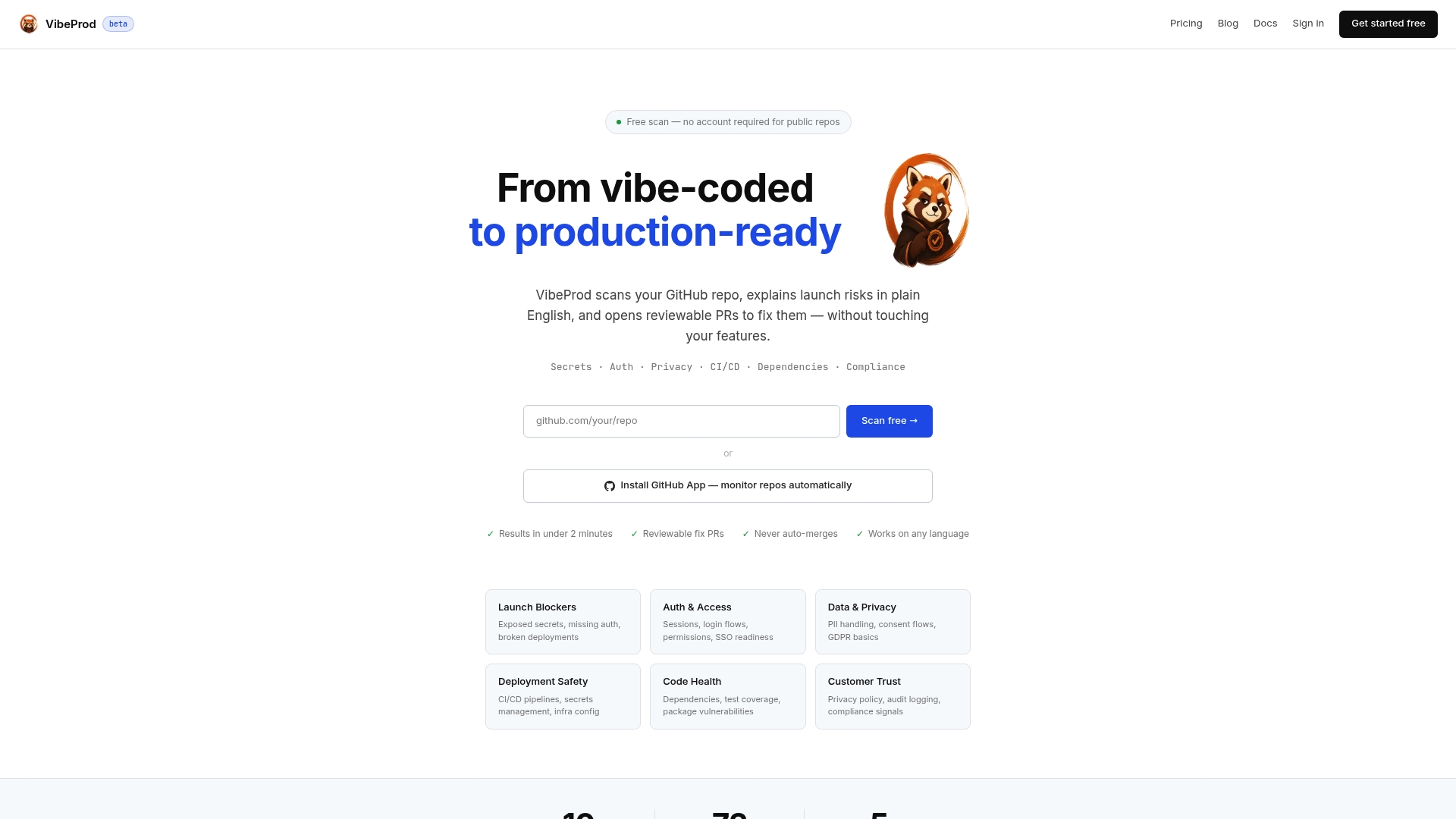
- Scan to PR in under two minutes: Vibeprod detects exposed secrets, auth gaps, and compliance issues and drafts a fix with full explanation.
- Provenance included: every finding links to a rule ID and confidence level so your team can verify, not just trust.
- Built for small teams: no dedicated security staff required; the explanation does the heavy lifting.
Ready to ship safe? Try Vibeprod and get your first auditable security explanation on your next PR.
FAQ
What are plain-English code explanations in security reviews?
Plain-English code explanations translate automated security findings into human-readable summaries covering intent, behavioral impact, remediation steps, and provenance, so developers can act on findings without decoding raw scanner output.
Why do automated patches get rejected without explanations?
Program-repair research shows that patches lacking natural-language explanations and behavioral examples are frequently ignored or rejected by reviewers who cannot verify the fix changes.source
Which tools generate plain-English security explanations?
Semgrep and SonarQube surface rule-based findings; AST-aware models like Bugsplainer add structural context; LLM-based pipelines with OpenAI GPT models can generate intent summaries. Vibeprod integrates scanning, explanation, and remediation PR generation in one automated workflow.
How do you measure whether an explanation is good enough?
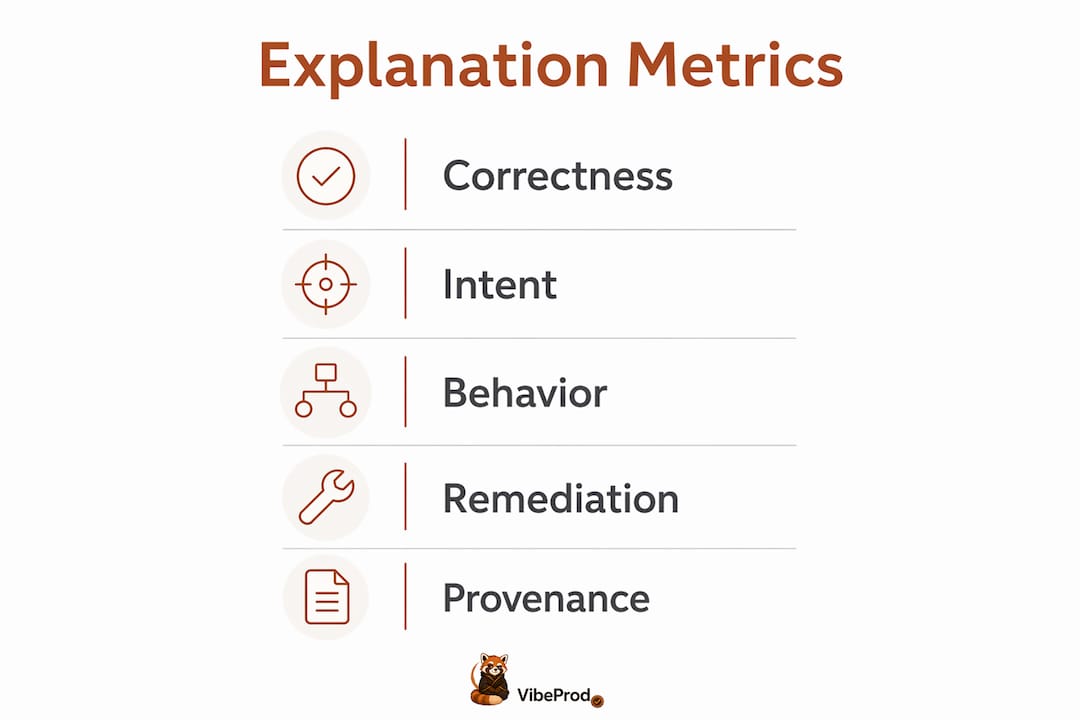
Score each explanation on correctness, intent capture, behavioral diff presence, remediation clarity, and provenance using a simple 0–2 rubric per item, then track PR acceptance rate and average review time as your primary improvement metrics.
How does Vibeprod handle provenance in its explanations?
Vibeprod ties each plain-English explanation to a rule ID and confidence indicator, giving reviewers and auditors a traceable link between the finding, the explanation, and the proposed fix.