The Real Role of Instant Code Feedback in 2026
Instant code feedback is the practice of delivering real-time, actionable insights to developers as they write or review code. Its role goes well beyond catching typos or flagging syntax errors. Done right, it catches bugs before they compound, accelerates how fast developers learn, and keeps teams aligned on quality standards without slowing delivery.
Here is what instant feedback actually does for your development process:
- Catches errors early, before a bug travels from a feature branch into a production incident
- Accelerates learning by showing developers the gap between what their code does and what it should do
- Increases engagement and persistence, particularly for developers newer to a codebase or language
- Supports CI/CD pipelines by automating the first layer of quality checks so human reviewers focus on architecture and logic
- Reduces idle time by keeping developers moving rather than waiting on review queues
- Strengthens shared code ownership by spreading knowledge across the team through every review cycle
The research backs this up. Adaptive immediate feedback significantly increases novice programmer engagement and intention to persist in computer science, with studies from 2020 through 2022 showing reduced idle time and improved task completion. That finding holds well beyond classrooms. Any developer blocked on unclear feedback, or receiving none at all, loses momentum fast.
Why instant code feedback is a core engineering practice
Feedback that arrives early in the development cycle prevents the kind of rework that quietly kills sprint velocity. A bug caught in a pull request costs a fraction of the time it takes to debug the same issue after it reaches production. That math compounds across a team.

Atlassian research connects early, frequent feedback directly to developer mindfulness. When developers know their code will be reviewed, they write cleaner code and run their tests more carefully before pushing. The discipline feedback creates shows up before a single review comment is written.
Instant feedback also plays a structural role in CI/CD pipelines. Automated checks on every push, covering formatting, test coverage, and static analysis, mean that human reviewers spend their time on what machines cannot assess: architecture decisions, security implications, and business logic. That separation is what keeps review cycles fast without sacrificing depth.
- Shared code ownership: every review cycle exposes more team members to more of the codebase, reducing the risk that one developer becomes the only person who understands a critical module
- Consistent standards: automated linting and formatting checks enforce style rules without consuming human review time
- Faster onboarding: new developers get immediate, specific feedback rather than waiting days for a senior engineer to review their first pull requests
- Better estimates: developers who have reviewed a section of code give more accurate time estimates for future work in that area
Teams that treat feedback as a continuous loop, not a gate at the end of a feature, ship fewer bugs and onboard new developers faster.
What happens when you skip or rush code feedback
Skipping feedback feels fast. It rarely is. Hidden bugs accumulate into technical debt that compounds with every new feature built on top of them. By the time the debt becomes visible, fixing it requires understanding code that no one fully remembers writing.
Poor feedback practices also damage team morale in ways that are harder to measure but just as real. When feedback is vague, personal, or inconsistent, developers learn to dread pull request reviews. High cognitive load from poorly structured feedback leads to frustration, avoidance, and long-term performance decline. The quality and clarity of feedback matters as much as its speed.
Common feedback mistakes that teams repeat:
- No severity labeling: every comment feels equally urgent, so developers cannot triage what to fix first
- Vague comments: “this could be better” gives the author nothing to act on
- Personal framing: directing feedback at the developer rather than the code creates defensiveness and erodes trust
- Feedback without explanation: flagging a problem without explaining why it matters teaches nothing
- Inconsistent standards: reviewers enforcing different rules on different days creates confusion and inconsistency across the codebase
- Knowledge silos: when only one reviewer sees a module, expertise concentrates instead of spreading
The result of skipping feedback is not just worse code. It is a team that stops learning from each other.
Best practices for effective instant code feedback in your team
The most effective feedback cultures treat code review as a conversation, not a command. Feedback framed as a collaborative discussion focused on learning, not judgment, protects team morale while still raising quality. The code is a draft. Every draft can be improved.

Structure every comment with what, why, and how. “This will raise a ZeroDivisionError when orders is empty” is specific and actionable. “This could be better” is neither. If you cannot articulate what the concern is and why it matters, the comment probably should not be left.
Severity labels remove ambiguity about urgency. A practical labeling system looks like this:
| Label | Meaning | Expected action |
|---|---|---|
| Blocker | Security vulnerability or critical bug | Must be fixed before merge |
| Required | Significant design or performance concern | Must be addressed before merge |
| Suggestion | Alternative approach worth considering | Author decides |
| Nit | Minor style preference | Author can ignore |
| Question | Seeking understanding | Author explains; no change required |
Additional practices that consistently improve feedback quality:
- Keep pull requests small. A 50-line PR gets thorough review. A 500-line PR gets rubber-stamped or delayed.
- Respond to every comment, even with a brief acknowledgment. Silence frustrates reviewers and stalls the cycle.
- Separate automated from human feedback. Let linters and formatters handle style. Reserve human attention for logic, security, and architecture.
- Use Socratic prompting rather than giving the full answer. Graduated hints that move from direction to approach to structure keep developers engaged with problem-solving rather than passively accepting solutions.
- Acknowledge good decisions. A comment like “this separation of concerns is clean” takes seconds and reinforces the behaviors you want repeated.
Pro Tip: Set a team norm for review turnaround time. Most teams benefit from a first response within one business day. Long review queues kill flow state and create the bottlenecks that make developers skip reviews entirely.
How AI and automation are changing instant code feedback
AI has shifted what is possible in code feedback, mostly in speed and scale. Tools like LiveCode Mentor inside VS Code explain code line by line, detect mistakes before a developer runs the code, and adapt their explanations based on the developer’s skill level. That kind of real-time, personalized feedback was not practical at scale before large language models made it cheap to generate.
The advantages AI brings to feedback are real:
- Speed: AI can analyze a pull request and surface issues in seconds, not hours
- Scalability: one AI reviewer can handle hundreds of simultaneous submissions without a queue
- Consistency: AI applies the same rules every time, without mood or fatigue affecting the output
- Personalization: adaptive systems adjust feedback depth and tone to match the developer’s experience level
The limitations are equally real. AI models sometimes hallucinate, marking correct solutions as wrong or missing genuine bugs. Trustworthiness requires prompt engineering, test suites, and human oversight. AI feedback that only indicates whether code is correct, without explaining the gap between expected and actual behavior, can push developers toward trial-and-error rather than genuine understanding.
The most effective setups in 2026 combine automated AI checks in CI/CD pipelines with human review for architecture and business logic. AI handles the first pass. Humans handle the judgment calls. For teams exploring how AI models fit into their broader tooling, AI business strategist software comparisons can help clarify where automation adds value and where it falls short.
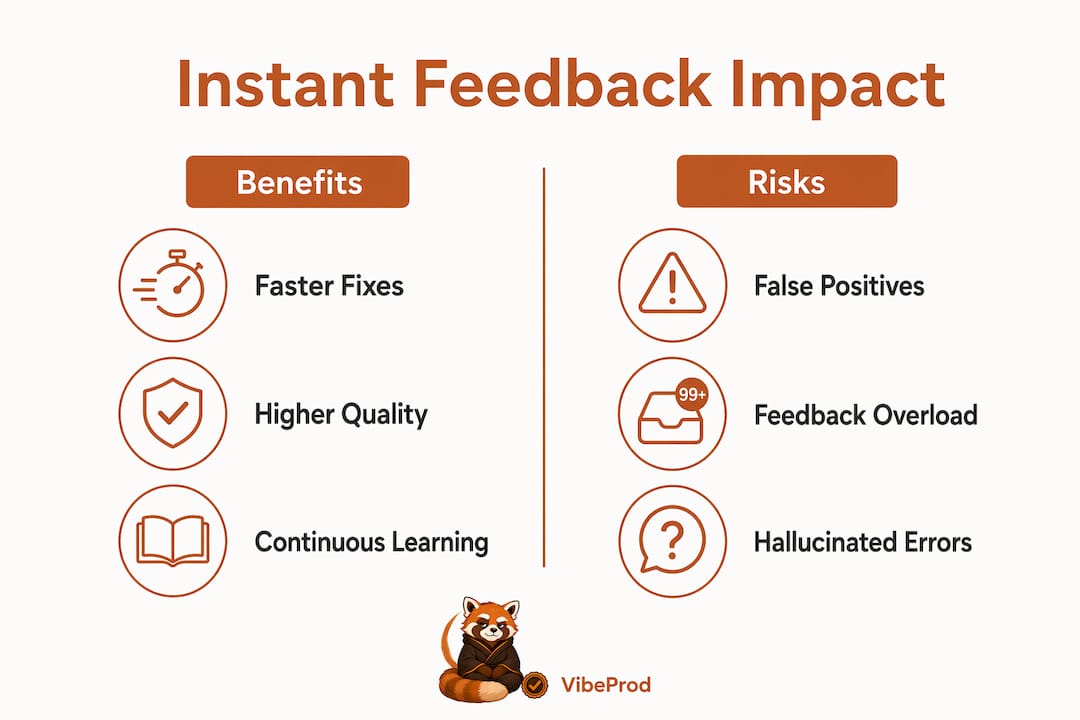
The future direction is adaptive feedback that learns from a developer’s history, adjusting hint depth and focus areas based on where that developer tends to make mistakes. That is already available in some IDE-integrated tools and will become standard practice across most development environments.
What the research says about feedback’s cultural and technical impact
The research on feedback in programming is consistent on one point: the design of feedback matters as much as its immediacy. Automated feedback that only signals correctness without explaining the gap between expected and actual outputs leads to trial-and-error behavior rather than learning. Developers need to understand not just that something is wrong, but what the code actually did versus what it should have done.
Engagement data reinforces this. Controlled studies on adaptive immediate feedback show that positive and corrective real-time feedback raises both persistence and task completion rates. Developers who receive encouragement alongside correction stay engaged longer and complete more of what they start.
Research finding: A 15-week Python course study found that AI models like ChatGPT correlate strongly with teacher evaluations in assessing code quality, generating repeatable feedback quickly at scale, though often grading more conservatively than human instructors.
Cultural factors shape how well feedback lands. Teams where senior developers publicly receive and respond to critique normalize feedback as a standard part of the process, not a judgment of competence. That cultural signal matters more than any individual review comment. When the most experienced person on the team says “good point, I’ll fix that,” it changes how everyone else receives feedback.
Separating automated feedback from human feedback also improves outcomes at the team level. Automated systems handle syntax and formatting. Human reviewers focus on architecture and design. Treating blocking issues differently from optional improvements reduces friction and keeps iteration moving without sacrificing the depth that human judgment provides.
Key research-backed findings for teams:
- Feedback explaining the gap between expected and actual outputs is critical to effective learning
- Severity labeling reduces cognitive load and makes feedback easier to act on
- Small, frequent pull requests produce better reviews than large, infrequent ones
- Positive feedback alongside corrective feedback increases developer persistence
- AI feedback works best when paired with human oversight for complex decisions
Vibeprod closes the gap between shipping fast and shipping safe
Most code feedback tools focus on style and syntax. Vibeprod focuses on what actually breaks production: exposed secrets, compliance gaps, and security vulnerabilities that slip through when you are moving fast.
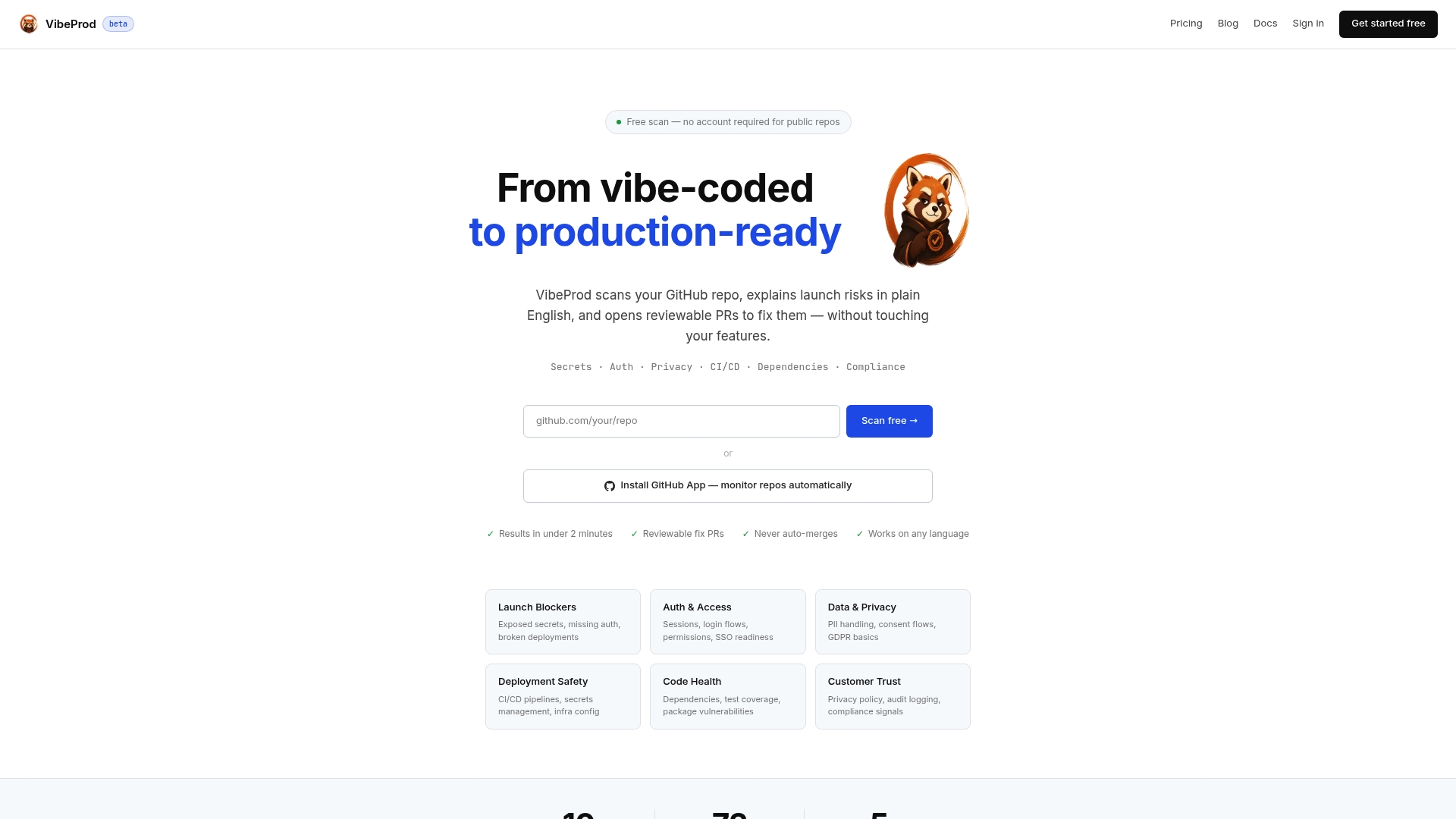
Vibeprod scans your GitHub repository, identifies launch risks, and generates reviewable pull requests with plain-English explanations for every issue it finds. No altered features. No cryptic error messages. Just clear, specific feedback on what needs fixing before real users hit your app. The whole process takes under two minutes. For solopreneurs and small teams who need to ship quickly without a dedicated security reviewer, that speed and clarity is the difference between a prototype and a production-ready product. See what Vibeprod finds in your repository before your next deploy.
FAQ
Why is instant feedback important in software development?
Instant feedback catches bugs before they compound into technical debt and keeps developers learning continuously rather than waiting on delayed review cycles. Research shows it also increases developer engagement and persistence, particularly for those newer to a codebase.
What is code feedback?
Code feedback is the process of reviewing code changes and communicating specific, actionable observations about correctness, design, security, and style. Effective feedback explains both what the issue is and why it matters, not just that something is wrong.
What are the downsides of instant feedback?
Poorly designed instant feedback can push developers toward trial-and-error behavior if it only signals correctness without explaining the gap between expected and actual outcomes. AI-generated feedback can also hallucinate, marking correct solutions as wrong or missing real bugs, which is why human oversight remains necessary.
How does the 80/20 rule apply to code reviews?
In practice, most code review value comes from focusing on logic errors, security vulnerabilities, and architectural decisions, while style and formatting issues, which automated tools handle well, account for the rest. Prioritizing human attention on concerns that machines miss is where most teams find the biggest quality gains.
How can teams avoid feedback overload for developers?
Use severity labels like Blocker, Required, Suggestion, and Nit so developers can triage comments by urgency. Keep pull requests small to limit the volume of feedback per cycle, and separate automated checks from human review so each layer handles only what it does best.
Key Takeaways
Instant code feedback improves code quality, accelerates developer learning, and strengthens team collaboration when it is specific, well-structured, and delivered early in the development cycle.
| Point | Details |
|---|---|
| Early feedback prevents compounding bugs | Catching issues at the pull request stage costs far less time than debugging the same problem after production deployment. |
| Feedback design determines learning outcomes | Feedback explaining the gap between expected and actual outputs drives real learning; correctness-only signals push developers toward trial and error. |
| Severity labels reduce cognitive load | Labels like Blocker, Suggestion, and Nit let developers triage comments by urgency, reducing frustration and improving review efficiency. |
| AI feedback scales but needs human oversight | AI models correlate strongly with instructor evaluations on code quality but tend to grade conservatively and can hallucinate, making human review essential for complex decisions. |
| Vibeprod delivers security-focused feedback fast | Vibeprod scans GitHub repositories and generates reviewable pull requests with plain-English explanations for launch risks in under two minutes. |