Reviewing AI Code: What It Means for Dev Teams
TL;DR:
- Reviewing AI-generated code requires a structured process to address potential security flaws hidden beneath its polished surface.
- The process involves automated checks, a separate AI reviewer, and human judgment focused on architecture and security risks.
Reviewing AI code is the process of validating AI-generated source code for correctness, security, and system fit before it merges into production. The industry term for this practice is AI code quality assurance, and it goes well beyond a standard pull request check. AI tools have collapsed the time from idea to working prototype, but that speed creates a gap. The code looks clean, compiles without errors, and passes basic tests. What it often lacks is production readiness, and that gap is exactly where your review process must do its hardest work.
What does reviewing AI code mean for your workflow?
Reviewing AI-generated code means applying a structured verification process to source code that was written by an AI model rather than a human engineer. The standard industry term is AI code review, and it covers three distinct layers: automated mechanical checks, AI-driven semantic analysis, and human judgment focused on architecture and domain logic.

The core challenge is intent. When a human writes code, the reasoning often lives in comments, commit messages, and the author’s memory. When an AI writes code, that reasoning is absent. Reconstructing intent takes 441% longer compared to reviewing human-written code where intent is explicit. That single statistic reframes the entire effort. Your review is not just checking syntax. It is reverse-engineering a decision process that was never documented.
AI-generated code also introduces a category of error that traditional review rarely encounters: the polished mistake. The code looks authoritative. It follows style conventions, uses correct variable names, and structures logic cleanly. That surface quality creates a false sense of security. Reviewers who treat AI output like senior engineer output will miss the architectural and security flaws hiding underneath.
The benefits of reviewing AI-written code are real, but only when the review process matches the actual risk profile of AI-generated output.
How does AI-assisted code review differ from traditional code review?
Traditional code review assumes a human author who made deliberate choices and can explain them. AI code review assumes an output that is statistically plausible but not necessarily correct.
The differences show up in four specific areas:
- Error types. Human code tends to fail on logic or edge cases. AI code tends to fail on architectural fit, trust boundaries, and security assumptions that require contextual knowledge the model did not have.
- Intent documentation. Human authors leave trails. AI authors do not. Requiring AI-generated pull requests to include attached rationale and decision logs reduces reviewer effort significantly by cutting intent reconstruction time.
- Confidence calibration. Developers assisted by AI often write less secure code yet report higher confidence in its correctness. That overconfidence is contagious. Reviewers absorb it from the author and skip the checks that matter most.
- Scope of review. Traditional review focuses on the change. AI code review must also assess whether the change fits the system, the operational environment, and the security model.
Pro Tip: Never review AI-generated code in the same mental mode you use for a trusted colleague’s PR. Treat it as code from an unknown external contributor until you have verified every trust boundary.
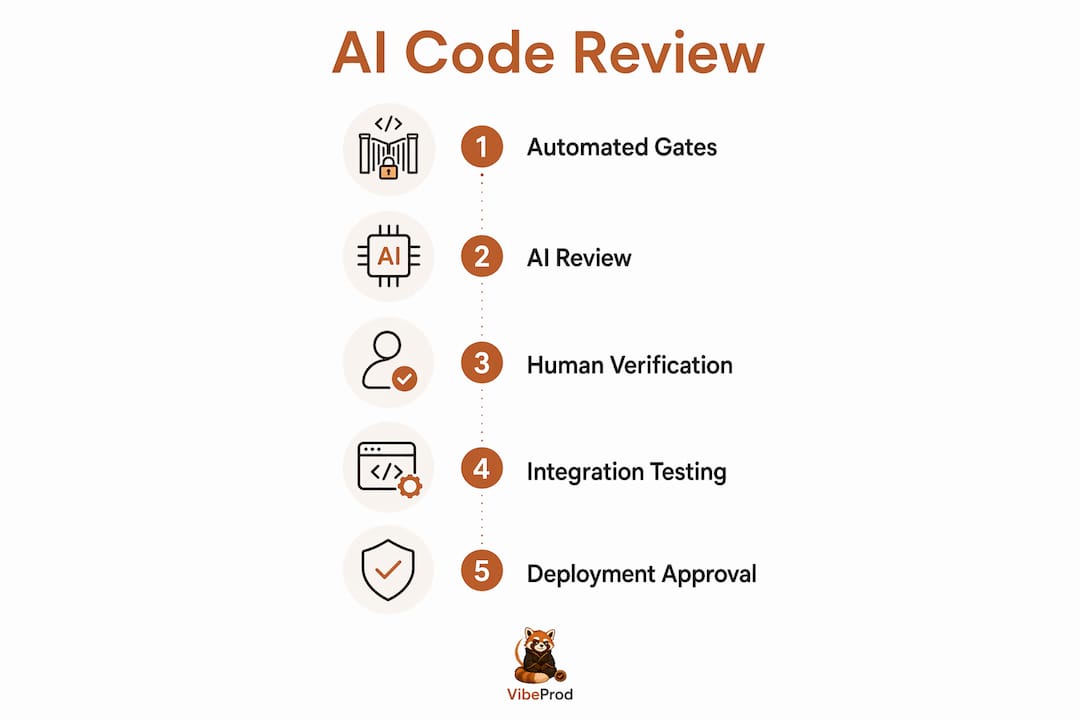
The multi-stage verification loop is now the industry standard workflow for AI code review. Automated tools handle syntax and style. A separate AI agent handles semantic checks. A human reviewer handles architectural and domain judgment. Each stage filters a different class of problem.
What are the key risks in AI-generated code?
The biggest risk is not that AI code is wrong. It is that AI code looks right. AI-generated code often hides fundamental architectural or security flaws beneath a polished surface. Reviewers who focus on style and syntax will miss them entirely.
The failure modes that appear most often in AI-generated code include:
- Weak authentication flows. AI models generate auth logic that passes unit tests but skips edge cases like token expiration handling or session fixation.
- Injection risks. SQL, shell, and template injection vulnerabilities appear in AI code because the model optimizes for functionality, not for input sanitization.
- Missing back-pressure. AI-generated async code frequently omits rate limiting and queue depth controls, which causes cascading failures under load.
- Brittle error handling. Catch blocks that swallow exceptions silently are common. The code runs in development and fails in production without a clear signal.
- Trust boundary gaps. HTTP clients, shell executions, and file system operations generated by AI often lack the validation layer that a security-conscious human engineer would add automatically.
The gap between code readiness and system readiness is the core problem. AI usually produces functioning code that is rarely production-ready without human contextual judgment applied on top. Testing coverage does not close this gap. A test suite written by the same AI model that wrote the code will test the assumptions the model made, not the assumptions your system requires.
Developers assisted by AI write less secure code with higher confidence in its correctness. That combination is the most dangerous outcome of AI-assisted development. Your review process must compensate for both the security gaps and the overconfidence.
What are the best practices for reviewing AI-generated code?
Effective AI code review follows a layered structure. Each layer has a specific job, and skipping any layer pushes its class of problems into production.
- Run automated quality gates first. Linting, secret scanning, dependency vulnerability checks, and test coverage thresholds should all pass before a human reviewer sees the code. These gates catch the mechanical issues that waste human attention.
- Use a separate AI reviewer agent. Sunk-cost bias limits AI models from self-reviewing effectively. A distinct AI agent with a different prompt, acting as reviewer rather than writer, catches many errors before a human sees the code. This writer-reviewer pattern is now a documented best practice.
- Require rationale documentation. Every AI-generated PR should include a plain-English explanation of what the code does, why each major decision was made, and what alternatives were considered. This cuts the 441% intent reconstruction overhead.
- Focus human review on architecture and domain logic. Manual line-by-line review is inefficient. Human reviewers should focus on the shape of the change: does it fit the system architecture, does it respect domain boundaries, and does it introduce operational risk?
- Verify trust boundaries explicitly. Check every HTTP client call, shell execution, file system operation, and external API integration. These are the areas where AI-generated code most often skips the validation layer.
Pro Tip: Build a short checklist specific to your stack and attach it to every AI-generated PR template. Cover auth flow, input validation, error handling, and back-pressure. A five-minute checklist prevents a five-hour incident.
The table below maps each review stage to its primary focus and the tool category that handles it best.
| Review stage | Primary focus | Tool category |
|---|---|---|
| Automated gates | Syntax, secrets, dependencies | CI/CD pipeline tools |
| AI semantic check | Logic, edge cases, CVE patterns | Separate AI reviewer agent |
| Human review | Architecture, domain fit, business impact | Engineering judgment |
How does responsible AI coding shape the review process?
Responsible AI code generation is defined by four pillars: understand, respect, include, and maintain transparency. Each pillar has a direct effect on how you structure your review.
The responsible AI coding framework translates into concrete review requirements:
- Understand. Reviewers must confirm that the AI-generated code actually solves the stated problem, not a statistically adjacent problem the model substituted.
- Respect. User privacy and data handling must be verified. AI models frequently generate data processing logic that collects more than necessary or retains data longer than required.
- Include. Accessibility and internationalization are areas where AI code often cuts corners. Review must check that diverse user needs are met, not just the happy path for a default user.
- Transparency. Document where AI generated code in the codebase. Regulated environments require auditability. Even unregulated products benefit from knowing which sections carry AI-origin risk.
The chain of accountability stays with human developers who must document decision rationale, perform layered testing, and maintain oversight checkpoints. AI automation does not transfer responsibility. It concentrates it. The human who merges the PR owns the outcome, regardless of who or what wrote the code.
Embedding responsibility checks into normal development workflows keeps governance real. When review becomes a checkbox ritual, it stops catching problems. When it is built into CI/CD gates, PR templates, and agent workflows, it catches problems automatically and consistently.
Key Takeaways
Reviewing AI-generated code requires a multi-stage verification loop combining automated quality gates, a separate AI reviewer agent, and human judgment focused on architecture, security, and domain fit.
| Point | Details |
|---|---|
| Intent reconstruction is costly | Reconstructing AI code intent takes 441% longer than reviewing human-written code. |
| AI code hides security flaws | Polished output masks auth gaps, injection risks, and missing back-pressure controls. |
| Use the writer-reviewer agent pattern | A separate AI reviewer agent catches errors before human review and reduces sunk-cost bias. |
| Human review targets architecture | Focus human effort on system fit, domain logic, and trust boundaries, not syntax. |
| Responsibility stays with humans | The engineer who merges AI-generated code owns the outcome and must document the rationale. |
The review is where the real engineering happens
Here is what I have seen teams get wrong repeatedly: they treat AI code review as a faster version of standard code review. It is not. It is a fundamentally different task that requires a different mindset and a different process.
The polished surface of AI-generated code is the trap. When code looks clean, reviewers unconsciously lower their guard. They scan instead of read. They approve instead of question. That is exactly when the weak auth flow or the silent exception handler slips through to production.
The teams that get this right treat every AI-generated PR as a black box that needs to be opened, not a trusted contribution that needs a quick look. They build rationale documentation into the PR template so intent reconstruction is not a manual archaeology project. They run a separate AI reviewer agent before the human ever sees the code. They focus human attention on the architectural questions that no automated tool can answer.
Speed is not the enemy here. The goal is to ship fast and ship safe. Those two things are compatible when your review process is built for the actual risk profile of AI-generated code, not the risk profile of a senior engineer’s output.
The teams that skip this work are not moving faster. They are accumulating debt that will surface as a production incident, a security disclosure, or a compliance failure. The review is not overhead. It is where the real engineering happens.
— Vibeprod
How Vibeprod helps you ship AI code with confidence
Shipping AI-generated code without a structured review process is the fastest way to turn a prototype into a production liability.
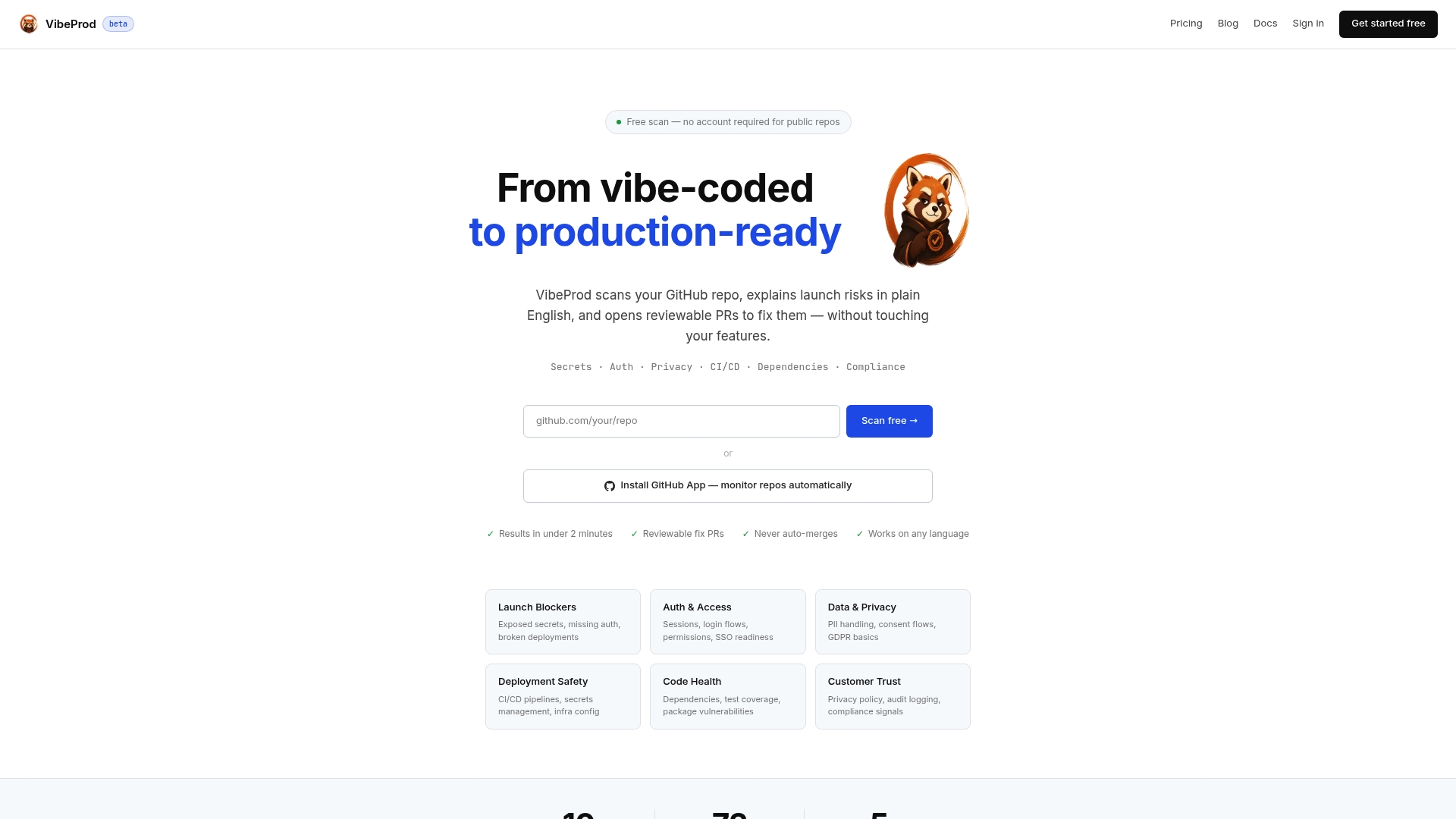
Vibeprod scans your GitHub repository and identifies launch risks like exposed secrets, weak auth patterns, and compliance gaps in under two minutes. It generates reviewable pull requests with plain-English explanations for each issue, so you understand the problem before you fix it. You stay focused on production-ready code without manually auditing every line your AI tools produced. For solopreneurs and small dev teams shipping fast with AI assistance, Vibeprod fills the review gap that AI coding tools leave open.
FAQ
What does reviewing AI code mean?
Reviewing AI code means validating AI-generated source code for correctness, security, and system fit before it merges into production. The process combines automated quality gates, AI semantic checks, and human judgment focused on architecture and domain logic.
Why does AI-generated code carry more security risk?
Developers assisted by AI write less secure code while reporting higher confidence in its correctness. AI models optimize for functional output and frequently skip input validation, trust boundary checks, and secure error handling.
What is the writer-reviewer agent pattern?
The writer-reviewer pattern uses two separate AI agents with distinct prompts: one writes the code and one reviews it. This approach bypasses sunk-cost bias that prevents AI models from effectively self-reviewing their own output.
How is AI code review different from traditional code review?
Traditional code review assumes a human author who documented intent. AI code review must reconstruct intent, which takes significantly more effort, and must focus on architectural fit and security assumptions rather than syntax or style.
Who is responsible when AI writes the code?
The human engineer who merges the pull request owns the outcome. Accountability stays with the development team regardless of how much of the code an AI model generated.