Production-Ready Code Standards: 10 Practical Examples
TL;DR:
- Production-ready code follows strict architectural, security, testing, and automation standards to ensure safe deployment. Enforcing these standards through automated pipelines and detailed documentation minimizes risks and accelerates team onboarding. Using configuration files and AI tool rules maintains code quality and consistency at scale.
Production-ready code standards are defined as the complete set of architectural, security, testing, and operational rules a codebase must satisfy before it can safely serve real users. These standards go far beyond “it works on my machine.” They cover everything from 80% minimum unit test coverage and async I/O enforcement to environment-based secrets isolation and parameterized query validation. Bodies like CERT, CWE, and engineering teams at scale have codified these expectations into repeatable blueprints. The gap between a working prototype and a production-ready system is exactly where most launch risks hide, and closing that gap requires concrete examples, not vague guidelines.

1. Examples of production-ready code standards in architecture
Solid architecture is the foundation every other standard builds on. Production-ready applications require design for observability, stateless services, and idempotent APIs from the very first commit. That means you cannot bolt these properties on later.
The clearest architectural examples follow these principles:
- Hexagonal boundaries: Controllers handle HTTP. Use cases contain business logic. Repositories manage data access. Domain objects stay pure. No layer reaches across another.
- Immutable data structures: Pass value objects, not mutable state, between layers. This eliminates entire classes of concurrency bugs.
- Explicit dependency injection: FastAPI and Go 1.22+ both support constructor injection. Avoid global state or module-level singletons that hide dependencies.
- Anti-corruption layers: When integrating third-party APIs, wrap them in an adapter. Your domain logic never speaks the vendor’s language directly.
- Bulkhead patterns: Isolate failure domains. A slow payment service should not block your auth flow.
Next.js 15 reference apps demonstrate this with a clear split between server components, API route handlers, and data-fetching layers. Each boundary is explicit and testable in isolation.
2. Minimum test coverage and error handling
Coding standards reduce cognitive overhead and help teams maintain velocity as codebases grow. The most direct way to enforce that is through measurable testing thresholds.
The industry benchmark is 80% unit test coverage, with test suites running on every code change. That number is not arbitrary. It reflects the point at which most critical paths have at least one regression guard. Below 80%, regressions slip through undetected.
- Typed error handling: Replace generic
Exceptioncatches with typed failure classes. In Python, use custom exception hierarchies. In Go, return explicit error types, not bareerrorstrings. - Boundary validation: Validate all inputs at the entry point using Pydantic v2 models in Python or struct tags in Go. Never trust data that crosses a service boundary.
- Regression tests on every bug fix: When a bug reaches production, the fix ships with a test that would have caught it. This is non-negotiable in production-grade teams.
Pro Tip: Set your CI pipeline to fail the build if coverage drops below your threshold. A coverage gate costs nothing to configure and prevents the slow erosion that kills test suites over months.
3. Code formatting and linter enforcement
Consistent formatting is not a style preference. It is a quality standard. Unformatted code increases review time and hides logic errors inside visual noise.
The production standard is automated formatting on every commit. For Python projects, Ruff and Black handle formatting and import sorting. For JavaScript and TypeScript, ESLint with Prettier covers both linting and style. Pre-commit hooks run these tools before code ever reaches the remote branch.
The result is that every code review focuses on logic, not whitespace. Manual review alone is insufficient for consistent standards adherence. Automation removes the human bottleneck entirely.
4. Security standards: secrets, queries, and access control
Security is not a feature you add at the end. It is a set of constraints you build around from the start. Deployment security mandates environment-based secrets, parameterized SQL, and HTTPS for all external interfaces. Each of these prevents a distinct class of vulnerability.
- Environment-based secrets isolation: API keys, database credentials, and tokens live in environment variables or a secrets manager like AWS Secrets Manager or HashiCorp Vault. They never appear in source code or config files committed to version control.
- Parameterized queries: Every database query uses parameterized statements or an ORM that handles escaping. Raw string interpolation in SQL is a direct injection vector.
- HTTPS enforcement: All external communication uses TLS. HTTP endpoints either redirect or do not exist. This applies to internal service-to-service calls as well.
- Default-deny access models: Authorization logic lives in one place, typically middleware or a policy layer. Every route starts as denied. Access is granted explicitly, not assumed.
- Salted password hashing: Passwords are stored as bcrypt or Argon2 hashes with unique salts. Plaintext or MD5 storage is a CVE waiting to happen.
5. CI/CD pipeline enforcement
Embedding standards into your CI/CD pipeline is the only way to guarantee they hold under deadline pressure. Automated enforcement in CI/CD pipelines integrates linters, tests, and documentation freshness checks into every push.
The table below shows what a production-grade pipeline enforces at each stage:
| Pipeline stage | What it checks | Failure behavior |
|---|---|---|
| Pre-commit | Formatting, import order, secrets scan | Blocks local commit |
| Pull request | Linting, unit tests, coverage gate | Blocks merge |
| Merge to main | Integration tests, static analysis | Blocks deployment |
| Release | Documentation freshness, changelog | Blocks release tag |
Branch protections require at least one approved code review before any merge to main. Pull request templates prompt authors to confirm test coverage, security review, and documentation updates. Code ownership rules route changes to the right reviewer automatically.
Pro Tip: Add a secrets scanner like truffleHog or git-secrets to your pre-commit stage. Catching an exposed API key before it hits the remote branch costs seconds. Rotating a leaked key after a breach costs days.
6. Documentation aligned with code releases
Continuous documentation aligned with code releases prevents knowledge drift and keeps teams operational when the original author is unavailable. This is a production standard, not a nice-to-have.
The practice is straightforward. Documentation updates ship in the same pull request as the code change. If you add an API endpoint, the OpenAPI spec updates in the same commit. If you change a configuration option, the README reflects it before the PR merges. Automated checks flag documentation drift by comparing changed files against doc coverage rules.
Teams that skip this step accumulate invisible debt. New developers spend days reverse-engineering behavior that a single paragraph would have explained. Onboarding time drops measurably when docs stay current.
7. Dependency management and version pinning
Unpinned dependencies are a silent production risk. A patch release from an upstream library can introduce a breaking change or a CVE without any action on your part.
Production code pins every dependency to an exact version in a lockfile. Python projects use poetry.lock or pip-tools compiled requirements. Node projects commit package-lock.json or yarn.lock. Go modules use go.sum. The lockfile is committed to version control and updated deliberately, not automatically.
Dependency updates run through the same CI pipeline as any other change. Automated tools like Dependabot or Renovate open pull requests for updates. A human reviews and merges them. This keeps dependencies current without surrendering control.
8. Observability and structured logging
A service that fails silently in production is worse than one that fails loudly. Production-ready code emits structured logs, metrics, and traces from the start.
Structured logging means JSON output with consistent fields: timestamp, log level, request ID, service name, and the event message. No unstructured print statements. Logs feed into a centralized system where you can query and alert on them. Metrics expose request latency, error rates, and queue depths. Distributed traces connect a user request across multiple services so you can find exactly where it slowed down.
The engineering principle here is design for observability from inception. Retrofitting logging into a production system that was never built for it is expensive and error-prone.
9. Modular code and avoiding premature abstractions
Modularity means each file, class, or function has one clear responsibility. It does not mean creating abstractions for every possible future use case. Premature abstraction is as dangerous as no abstraction.
The production standard is to write the simplest code that satisfies the current requirement, then refactor when a second use case appears. This is the rule of three: abstract on the third repetition, not the first. FastAPI route handlers that call service functions, which call repository methods, follow this pattern naturally. Each layer is thin, testable, and replaceable.
No universal coding standard exists, which means your team must agree on conventions before writing code. The agreement itself is the standard. Document it, enforce it in CI, and revisit it quarterly.
10. AI-assisted coding with production constraints
AI coding tools like Claude Code and Cursor produce working code quickly. They do not produce production-ready code by default. AI tools require configuration files that constrain behavior to generate disciplined, audit-ready output.
The configuration approach works like this:
- CLAUDE.md or
.cursor/rules: These files define architectural constraints the AI must follow. Specify your layer boundaries, forbidden patterns, required error types, and testing expectations. - Prompt engineering for domain rules: Tell the AI to enforce idempotency on all write operations, use bulkhead patterns for external calls, and return typed errors. Vague prompts produce vague code.
- Treat AI output as a draft: Review every generated function for security assumptions, error handling completeness, and test coverage. AI agents do not know your threat model.
- Architecture linting tools: Run the same linters on AI-generated code as on human-written code. The pipeline does not care who wrote the function.
Production-level AI coding agents leverage repository-based skill files and architecture linting to produce standardized code from the first prompt. The configuration is the discipline.
Key takeaways
Production-ready code requires enforced standards across architecture, security, testing, and CI/CD pipelines. Manual review alone cannot sustain quality at speed.
| Point | Details |
|---|---|
| Test coverage threshold | Maintain 80% minimum unit test coverage with a CI gate that fails the build on regression. |
| Security from the start | Isolate secrets, parameterize queries, and enforce HTTPS before the first deployment. |
| Automate enforcement | Embed linters, formatters, and coverage checks in CI/CD so standards hold under deadline pressure. |
| AI tools need rules | Configure CLAUDE.md or cursor rules to constrain AI output to your architectural standards. |
| Document in the same PR | Ship documentation updates with code changes to prevent knowledge drift and reduce onboarding time. |
What I’ve learned enforcing these standards across real teams
The hardest part of production-ready standards is not writing them. It is keeping them alive after the first sprint pressure hits.
Every team I have worked with starts with good intentions. The test coverage gate goes in. The linter runs on commit. Then a deadline arrives, and someone asks to “just merge it this once.” That one exception is where standards die. The fix is not stricter rules. It is removing the human decision entirely. When the pipeline blocks the merge automatically, there is no negotiation. The standard holds because the system enforces it, not because someone remembers to check.
The second lesson is about AI-assisted development. Developers who configure their AI tools with explicit architectural rules ship cleaner code than those who prompt freely. The configuration file is the senior developer in the room. It does not get tired, does not skip the security review, and does not forget the error handling. Teams that treat AI output as a first draft and run it through the same CI pipeline as human code get the speed benefit without the quality cost.
Onboarding is where the investment pays off most visibly. A new developer who joins a team with documented standards, enforced by automation, contributes meaningful code in days instead of weeks. The standards are the onboarding guide. That is the real return on the investment.
— Vibeprod
How Vibeprod helps you close the gap between prototype and production
Shipping fast is not the problem. Shipping without knowing what you missed is.
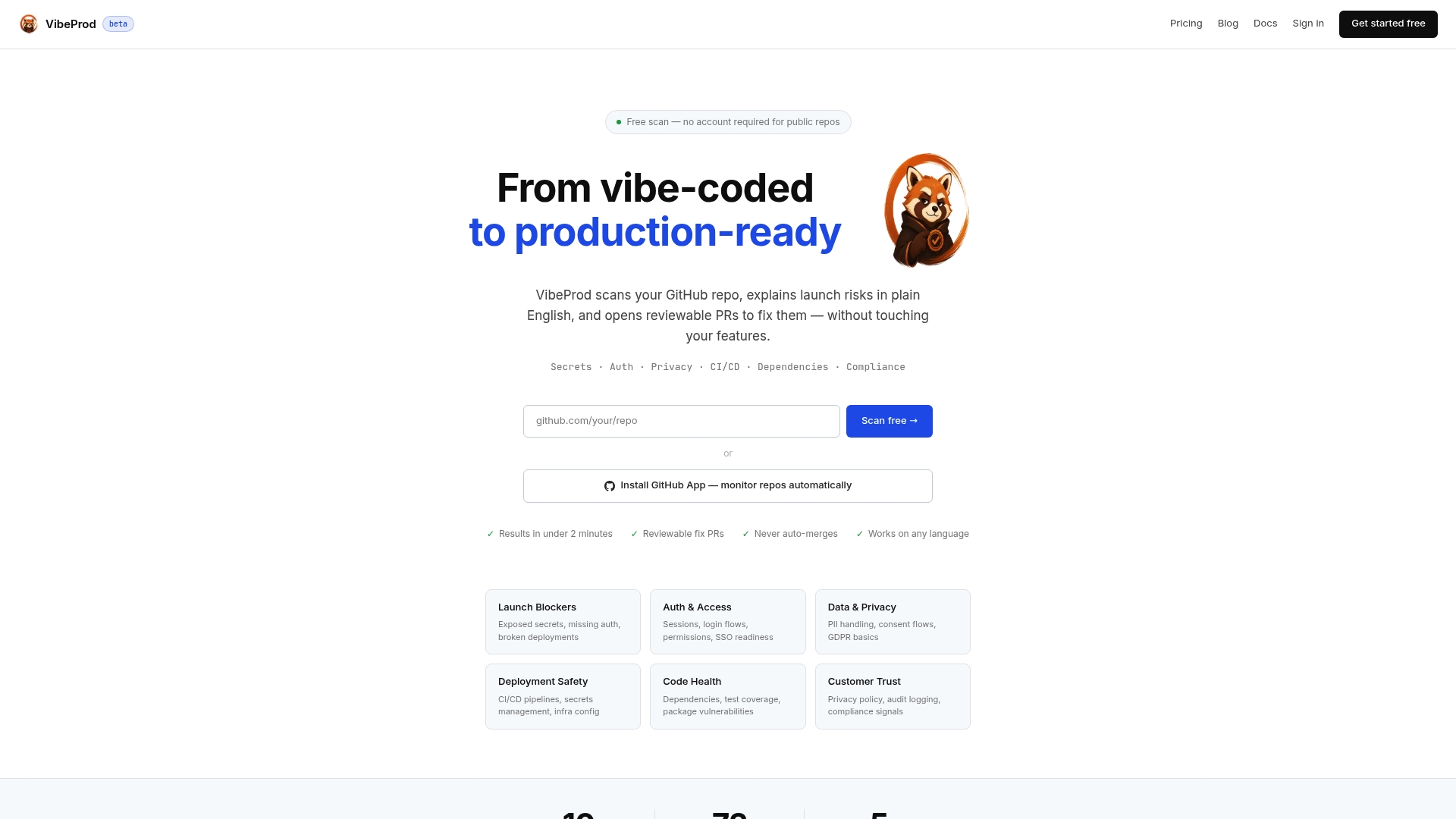
Vibeprod scans your GitHub repository and identifies the exact gaps between your current code and production-ready standards. It flags exposed secrets, missing input validation, and compliance issues, then generates reviewable pull requests with plain-English explanations for each finding. You see the risk, understand why it matters, and merge the fix. The entire process takes under two minutes. Vibeprod is built for solopreneurs and small teams who need production quality without a dedicated security or DevOps hire.
FAQ
What is the minimum test coverage for production code?
The production standard is 80% minimum unit test coverage, enforced by a CI gate that fails the build if coverage drops below that threshold.
How do I prevent secrets from leaking in production code?
Store all secrets in environment variables or a dedicated secrets manager. Never commit credentials to version control, and add a secrets scanner to your pre-commit hooks.
What configuration files make AI coding tools production-ready?
Files like CLAUDE.md and .cursor/rules define architectural constraints for AI agents. They specify layer boundaries, required error handling patterns, and forbidden shortcuts that would otherwise appear in generated code.
How do coding standards reduce onboarding time?
Documented standards enforced by automation give new developers a clear map of how the codebase is structured. They spend less time reverse-engineering conventions and more time writing code that fits the existing patterns.
What does “fail the build” mean in a CI/CD pipeline?
Failing the build means the CI system rejects a pull request or deployment if any check fails, such as a linter error, a test failure, or a coverage drop. No non-compliant code reaches the main branch.