Top 4 kaiki.dev Code Security Alternatives 2026
Checking AI-enhanced code for security flaws before release slows teams down and often misses critical issues. Most tools require manual triage, restrict integration to a few platforms, or hide full pricing behind sales calls. You can compare these four code security automation platforms and choose one that fits your repository host, workflow, and team budget.
Table of Contents
VibeProd
At a Glance
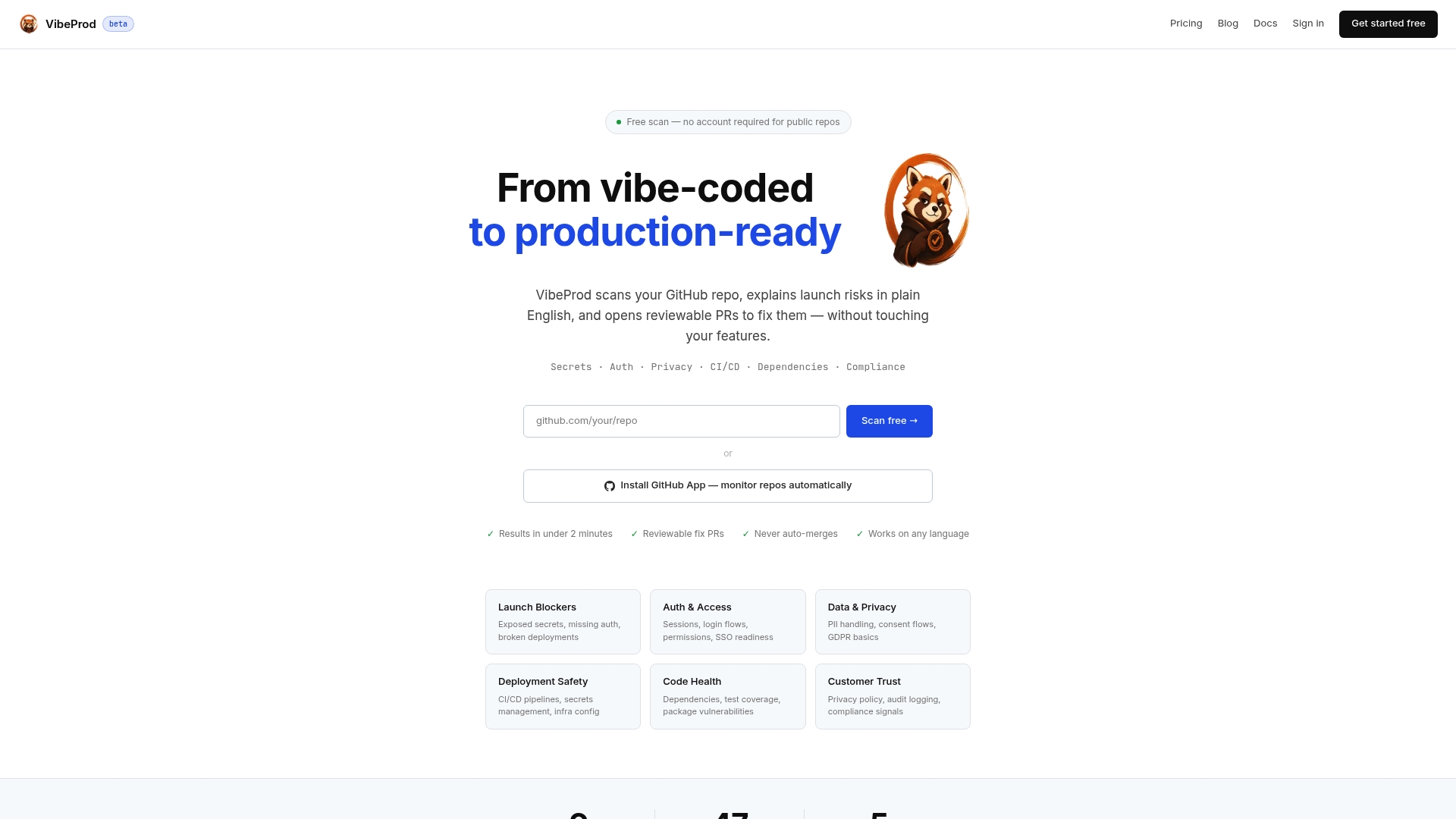
VibeProd’s marketing materials state it can scan a GitHub repository and return a production readiness report in under 2 minutes. It flags launch risks such as exposed secrets, auth gaps, and compliance issues. The tool proposes fixes as reviewable pull requests and adds plain-English explanations for each issue.
Core Features
VibeProd runs an automated production risk scan that covers launch blockers, auth and access controls, data privacy, deployment safety, code health, and customer trust. It generates reviewable pull requests that propose fixes without changing existing features and pairs those PRs with plain-English explanations. The product connects as a GitHub App and integrates with Claude Code and Codex to fit into existing developer workflows.
Key Differentiator
VibeProd automates the production readiness checklist that teams often perform manually by combining detection with proposed, reviewable fixes. The platform keeps feature code intact while proposing corrective PRs, which reduces the risk of accidental behavior changes. This focus on production blockers and compliance rather than code synthesis is what separates it from tools that only write or suggest code.
Pros
VibeProd automates critical checks so you spend less time hunting for exposed secrets and misconfigured auth. The plain-English explanations reduce cognitive load during reviews and make security findings easier to triage. It supports multiple languages and plugs into GitHub and established AI code assistants, so you can add it to an existing CI pipeline without replacing your tooling. The vendor claims fast feedback. That timeline helps catch problems before a release candidate is promoted.
Cons
- Pricing details are not publicly listed, so you may need to contact the vendor to get full plan and billing information.
Notable Integrations
- GitHub App
- Claude Code slash command
- Codex skill plugin
Who It’s For
Developers and DevOps teams deploying AI-enabled features from GitHub repositories who need automated checks for security and compliance. Solo founders and small teams that lack a dedicated security reviewer will get the most immediate benefit. Teams that already use Claude Code or Codex will find it easier to fold VibeProd into existing code review flows.
Unique Value Proposition
Generates reviewable pull requests that propose fixes without altering feature code. That workflow reduces the chance that automated corrections break intended behavior. As a result, you get recommended fixes, plain-English context, and a change proposal you can review and merge if appropriate.
Real World Use Case
A startup shipping an AI feature runs VibeProd on its repo as part of CI. VibeProd surfaces an exposed API key, creates a PR to remove the secret from code, and adds a clear explanation of why the key is risky. The engineering lead reviews the PR, merges the change, and the release proceeds with the secret removed.
Pricing
Public information lists free scanning, but full pricing and tier details are not available publicly. Expect to contact sales for team plans, enterprise features, or support SLAs.
Website: https://vibeprod.ai
Xygeni
At a Glance
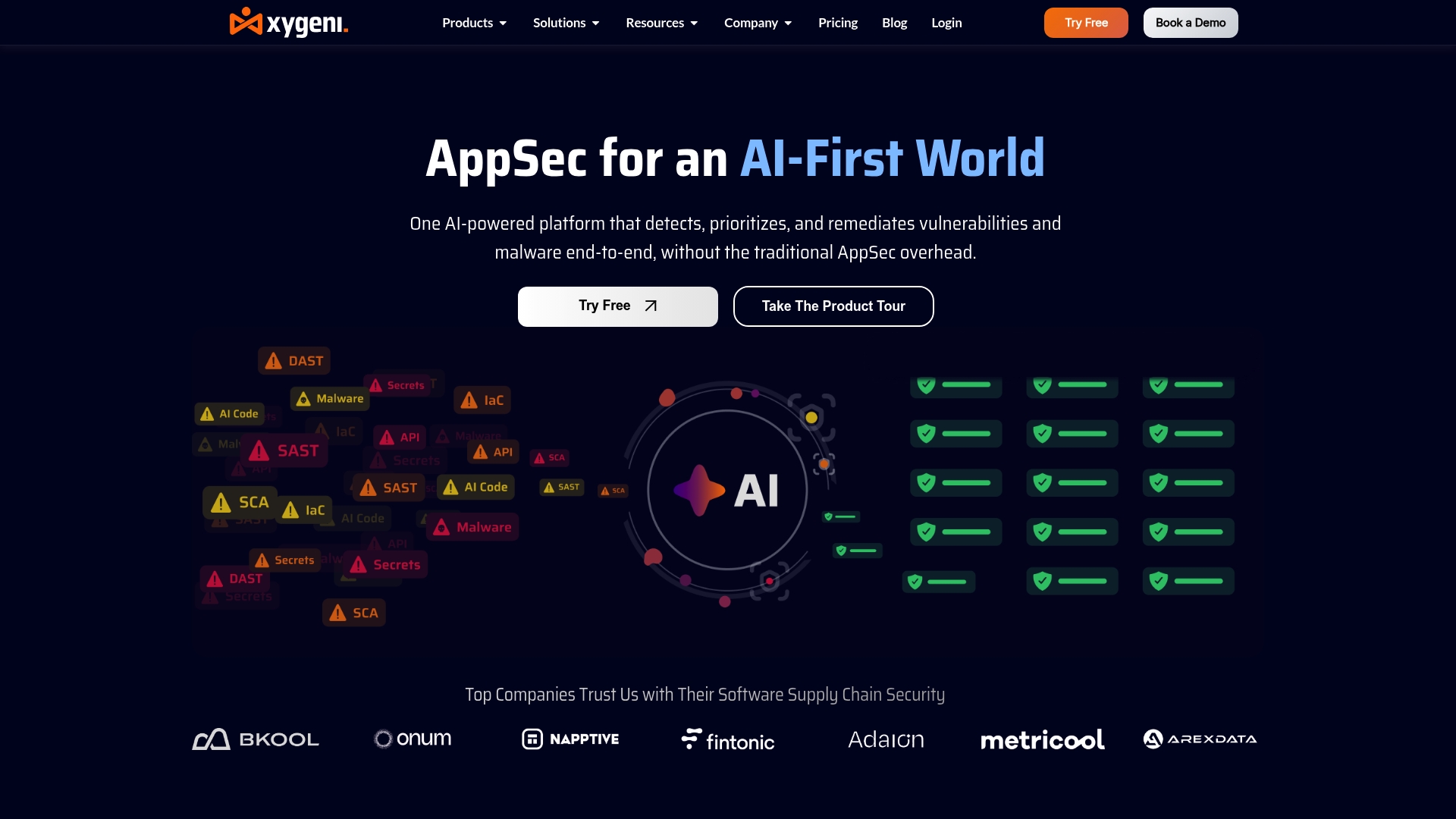
Xygeni’s marketing materials state a financial technology firm cut manual review time by over 50% after automating vulnerability detection. The platform targets AI first development and regulated environments with end to end application security across code, pipelines, and cloud. It advertises interactive AI agents and automated remediation to keep fixes in developer flow.
Core Features
Xygeni combines AI powered vulnerability detection and remediation with end to end coverage across source code, CI/CD pipelines, and cloud environments. It applies risk prioritization to reduce noise and false positives while supplying developer first interactive agents to guide fixes. The platform also performs threat detection, malware blocking, and supply chain validation for dependencies and builds.
Key Differentiator
Xygeni centers on AI driven end to end detection and remediation paired with developer first support for modern AI first development. That pairing moves security suggestions directly into developer workflows with runnable fix guidance. The product emphasizes handling AI generated code and compliance needs for regulated industries.
Pros
The vendor advertises that major industry players trust the platform and that it has earned recognition and awards. Deep alignment with AI driven developer workflows tends to reduce alert noise and speed triage. Automated remediation and real time threat detection help teams respond faster to supply chain and dependency risks.
Cons
-
Onboarding can require technical expertise and significant integration effort. This limits how quickly small teams can adopt the platform.
-
Advanced capabilities demand skilled security and development staff to extract full value from the tool.
-
Pricing and enterprise licensing often need direct consultation rather than clear self service tiers.
When It May Not Fit
Teams without modern CI/CD maturity or without a dedicated security person may find Xygeni heavy for their needs. Organizations seeking a drop in replacement for legacy scanners will miss some traditional workflows. If you lack in house security expertise, managed or fully outsourced AppSec may suit you better.
Who It’s For
Security and development teams building AI enhanced or regulated software get the most value from Xygeni. Enterprise DevSecOps groups, CIOs, CISOs, and development managers who need supply chain checks will benefit. Teams should have CI/CD maturity and at least one security engineer on staff.
Real World Use Case
A fintech firm used Xygeni to automate vulnerability detection in AI generated trading algorithms, cutting manual review time by over 50%. The automation also helped the team document fixes for compliance audits. That saved reviewer hours while maintaining strict industry controls.
Pricing
Plans start at $399/month for small teams and expand into standard, premium, and enterprise tiers. Custom pricing is available for large organizations and enterprise licensing. Visit the vendor site for exact tier feature maps and licensing options.
Website: https://xygeni.io
FlowLessAI
At a Glance
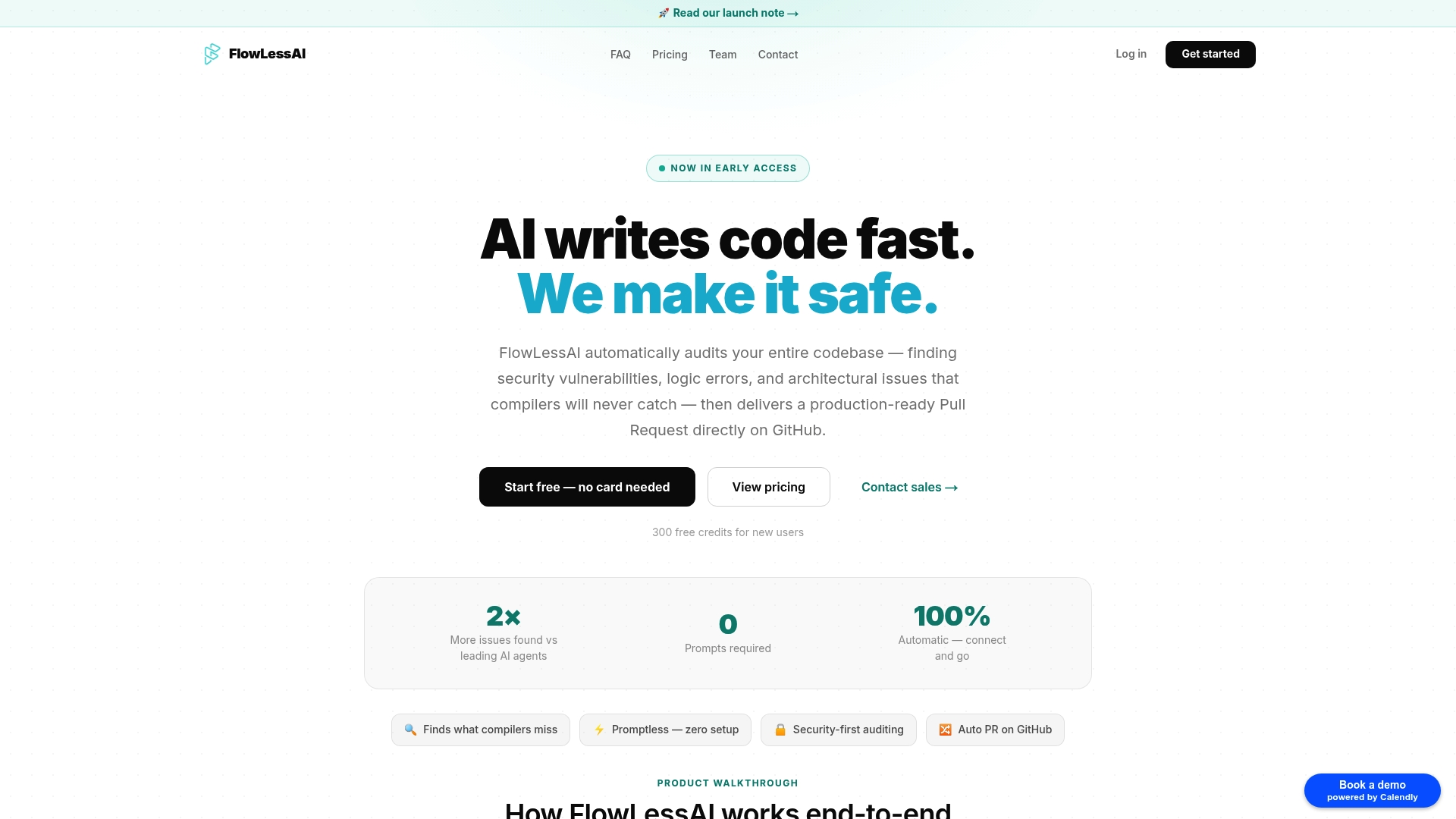
FlowLessAI reports finding 16 issues in a controlled test where a competing agent found 3. That claim highlights its emphasis on broad, system level detection across repositories. The tool performs a full codebase audit without prompts or manual setup and creates reviewable pull requests on GitHub. It also exports audit artifacts for compliance and runs analysis in isolated environments for privacy.
Core Features
FlowLessAI runs an automated full codebase audit that looks for security vulnerabilities, logic errors, and architecture issues across JavaScript, TypeScript, and Python. It performs promptless analysis and generates ready-to-merge pull requests with reviewable diffs directly in GitHub. The platform also exports detailed artifacts for compliance and incident response while analyzing code in temporary isolated environments.
Key Differentiator
The product pairs full system understanding with automatic pull request generation so fixes arrive as reviewable code changes rather than alerts. That flow reduces developer overhead when you need concrete, mergeable fixes instead of problem lists. The promptless setup means repositories begin analysis with minimal friction.
Pros
FlowLessAI claims a higher issue detection rate in head-to-head tests, and that result implies stronger cross-file and architectural analysis compared with simpler agents. It turns findings into reviewable diffs and pull requests so your team reviews code instead of reproducing fixes from notes. The platform also provides exportable artifacts for compliance and runs analysis in temporary, isolated environments to protect source privacy.
Cons
- Pricing details are not accessible on the vendor site, which complicates budgeting and procurement.
- Integration detail beyond GitHub is limited, so multi platform or non GitHub workflows may be a poor fit.
- The vendor does not publish analysis speed or scalability metrics for very large monolithic codebases.
- The site shows an application error for pricing, indicating that transparent plan tiers are not currently available.
When It May Not Fit
If your organization stores primary code outside of GitHub the product may not integrate cleanly. Large monolithic repositories with long static analysis windows could require a performance trial before committing. Teams that need clear, published pricing tiers for procurement will find the current site information insufficient. Organizations that require out of the box support for multiple repository hosts may need a different tool.
Notable Integrations
- GitHub
Who It’s For
Developers and technical founders shipping AI generated or complex web applications who want systemic, automated code review before deployment. Small teams that lack dedicated security reviewers will benefit from fixes delivered as pull requests. Teams that require audit artifacts for compliance or incident response will also find this workflow useful.
Real World Use Case
A development team connects its GitHub repository and FlowLessAI runs a system wide audit. The tool finds exposed secrets and interdependent logic bugs across modules and opens a patch pull request with the fixes. Reviewers inspect the diff, merge the PR, and deploy with fewer manual patches and less back and forth.
Pricing
Not available due to an application error on the vendor site. The vendor indicates pricing likely requires contact or depends on a credit system, but specific tiers and costs are not published.
Website: https://flowlessai.one
CodeThreat
At a Glance
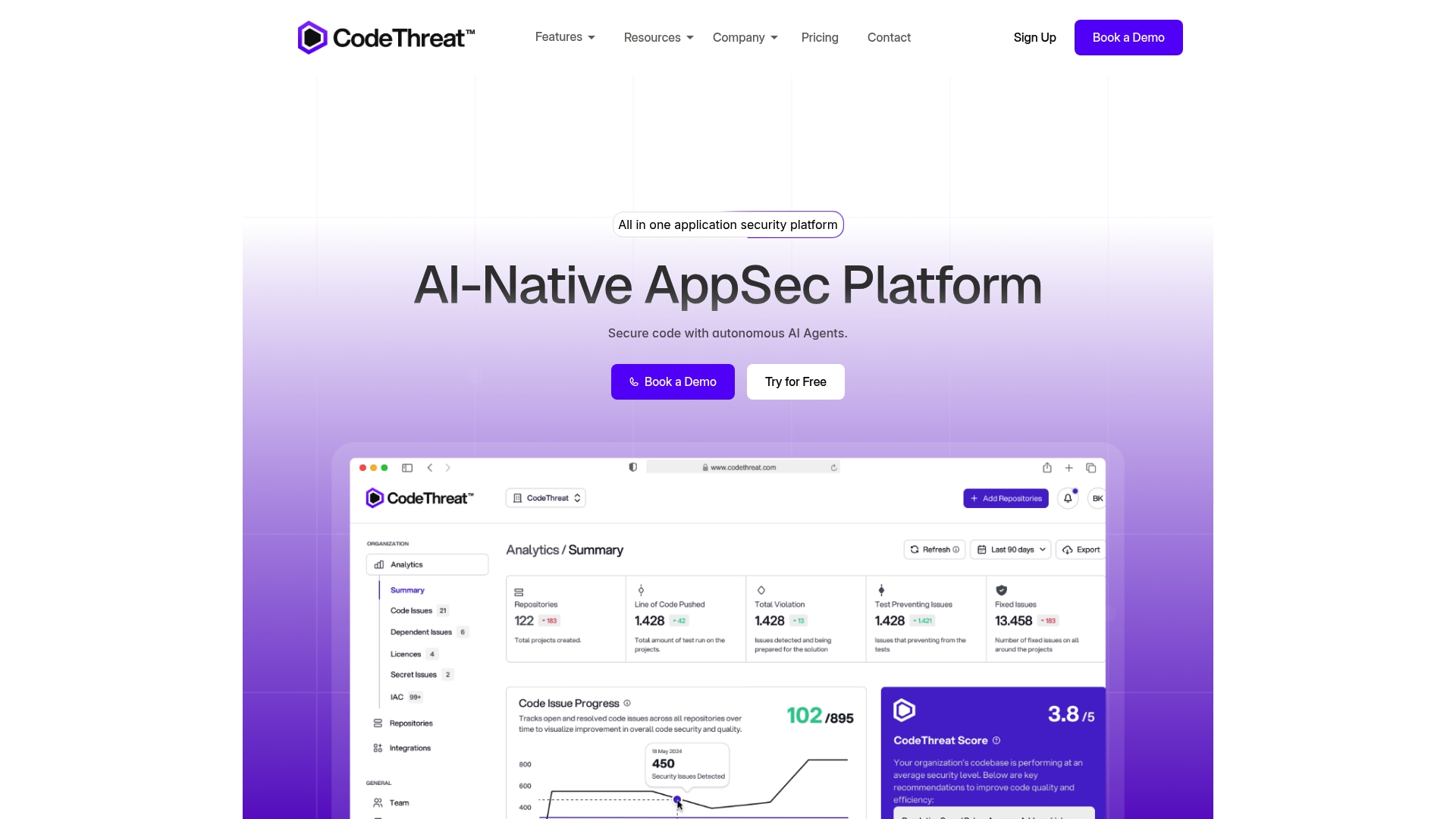
Supports 27+ programming languages and frameworks. That coverage makes CodeThreat useful for polyglot repositories and multi service stacks.
CodeThreat combines static analysis, dependency checks, infrastructure scanning, and secret detection into one product. The platform includes automated pull request reviews and AI driven agents that reduce noisy alerts.
Core Features
CodeThreat runs SAST, SCA, IAC, and secret scanning in a single workflow while linking findings to repository context. Its AI driven agents triage results, remove false positives, and generate focused review comments for pull requests. The platform also offers repo analysis and integration hooks for popular code hosts and CI systems.
Key Differentiator
CodeThreat centers on AI Agents that interpret code context and surface only relevant security issues. The agents claim to filter noise and cut down on manual triage. That approach shifts effort from chasing alerts to fixing real problems. The emphasis on contextual filtering separates it from simple scanner tools.
Pros
Deep AI integration yields contextual security insights and fewer spurious alerts, which speeds reviewer decisions and reduces reviewer fatigue. Automated false positive filtering and PR comments keep security work inside developer workflows, so teams spend less time switching tools. Broad language support and direct connections to common CI systems help teams adopt the tool without rewriting pipelines.
Cons
- Limited free plan features, including only three private repositories and constrained AI reviews, restrict trial depth for larger projects.
- Advanced AI features require onboarding and some training, which adds upfront setup time for teams new to agent workflows.
- Pricing may grow expensive for very large teams because contributor based billing scales with headcount.
- Public third party review data was not provided, so independent comparison points are limited.
When It May Not Fit
Small solo developers who need a lightweight scanner and minimal onboarding may find the platform complex. Teams that cannot dedicate time to configure AI settings will hit a learning curve before seeing full value. Organizations with strict budget caps on per contributor billing should model costs before committing.
Notable Integrations
CodeThreat connects to major code hosts, CI systems, and cloud providers to run checks where code lives. Integrations include repository hosting, pipeline triggers, and cloud configuration scanning. Those hooks let findings appear as pull request comments and CI pipeline checks.
- GitHub
- GitLab
- Bitbucket
- Azure DevOps
- CI/CD tools
- Cloud providers
Who It’s For
Security and development teams that want an integrated app security tool built into existing DevOps workflows will get the most value. Teams managing many languages or microservices benefit from the multi language support. Mid sized teams that use GitHub or GitLab and want PR level security feedback are a natural fit.
Real World Use Case
A midsize development team wires CodeThreat into its CI pipeline and GitHub pull requests. The agents triage findings and reduce false positives, allowing reviewers to approve fixes faster. The team now sees fewer repeat alerts and spends more time closing verified vulnerabilities.
Pricing
There is a free tier for small teams with limited features and three private repositories. The Pro plan starts at $39 per contributor/month. Enterprise pricing is available by contacting the vendor.
Website: https://codethreat.com
Comparison of alternatives
When evaluating code security solutions, distinguishing features often influence the choice for specific team requirements. The listed tools all aim to optimize development processes by identifying and mitigating vulnerabilities within code and deployment pipelines. However, these providers each exhibit unique strengths that cater to specific scenarios.
Automated production readiness
Among competitors, VibeProd excels at automating production-readiness validation with heightened emphasis on end-to-end resolution workflows. Offering pull-request-generated fixes paired with clear explanations, VibeProd simplifies complex interdependencies involved in ensuring a codebase is compliant and secure for deployment. While FlowLessAI impresses with its system-level detection and Xygeni emphasizes threat detection under higher compliance scrutiny, VibeProd’s delivery of PR-ready solutions ensures real-world applicability with minimal manual intervention during the release-critical stages of development.
Tool coverage and compatibility
Both FlowLessAI and CodeThreat distinguish themselves by offering support for diverse systems and languages. FlowLessAI is designed to identify more intricate code dependencies, and CodeThreat supports over 27 programming languages and frameworks. Their adaptability makes these tools versatile and capable of addressing highly heterogeneous development environments. On the other hand, the GitHub-centric design of VibeProd and FlowLessAI provides highly integrated workflows specifically catering to repositories on this platform, making them excellent candidates for projects housed there.
Best fit
- Teams focusing on rapidly achieving production-ready code with an emphasis on compliance diagnostics should choose VibeProd.
- Enterprises with advanced CI/CD maturity seeking integration of application security measures can benefit from Xygeni.
- Development groups requiring extensive language compatibility across polyglot environments will find CodeThreat advantageous.
- Organizations relying on automated full-system assessments with strong remedial output to GitHub repositories might prefer FlowLessAI.
Our pick
Given its unique ability to facilitate production readiness efficiently by generating fix-proposing pull requests supplemented with plain-English context, VibeProd is a natural choice for teams prioritizing rapid security and compliance analysis paired with remedial actions. However, teams seeking broader use-case solutions might explore competitors addressing their requirements directly.
Compare these platforms to identify the best fit for your development team’s code security and compliance needs.
| Platform | Key Differentiator | Best for | Pricing | Notable Limitation |
|---|---|---|---|---|
| Vibeprod | Automated, reviewable production risk checks | Developers and DevOps teams on GitHub | Price not published | Pricing details require direct inquiry |
| Xygeni | AI-driven vulnerability detection with remediation | CI/CD mature teams in regulated sectors | Starts at $399/month | Onboarding complexity limits initial adoption for small teams |
| FlowLessAI | System-wide audits with PR-based fixes | Teams needing compliance artifacts | Price not published | Limited integration and performance metrics available |
| CodeThreat | Contextual issue triage with multi-language support | Mid-sized teams managing diverse stacks | Pro plan starts at $39/user/month | Advanced AI features require onboarding and training |
How Can You Improve Production Readiness Beyond kaiki.dev Alternatives?
When shipping AI-enabled features, spotting hidden launch risks like exposed secrets and auth gaps is vital. Many developers struggle with manual checks that slow down release cycles or miss critical compliance issues. Vibeprod closes this gap by scanning GitHub repos in under two minutes and proposing pull requests with fixes that leave feature code untouched. It pairs these fixes with clear, plain-English details to simplify code review and speed validation.
Ideal for solo founders and small teams without dedicated security reviewers, Vibeprod lets you focus on coding while making your application safer and compliance-ready. Learn more at Vibeprod and see how fast feedback can improve your deployment confidence. Visit Vibeprod to start receiving easy-to-review fix proposals for your codebase today.
FAQ
How does VibeProd automate critical code security checks?
VibeProd automates key security checks by scanning GitHub repositories for launch risks like exposed secrets and compliance issues. It generates reviewable pull requests with proposed fixes and plain-English explanations for each issue. Developers can expect a faster and more efficient way to identify and resolve risks before deployment.
What is the difference between Xygeni and VibeProd?
Xygeni excels in providing AI-driven end-to-end vulnerability detection and remediation, especially for regulated environments. VibeProd focuses on automating production readiness checks, which is ideal for teams looking to catch launch blockers without altering existing feature code.
Can I integrate VibeProd with existing developer workflows?
Yes, VibeProd integrates smoothly as a GitHub App and works with Claude Code and Codex, fitting comfortably into established development workflows. Developers should find it easy to add VibeProd to their CI pipelines without significant disruptions.
How does VibeProd provide feedback within the development process?
VibeProd aims for quick feedback by scanning repositories in under 2 minutes, allowing teams to catch problems early in the release cycle. This rapid assessment helps maintain pace without sacrificing security or compliance standards.
What pricing options does VibeProd offer?
Pricing details for VibeProd are not publicly listed, and potential users may need to contact the vendor for team plans and support SLAs. This approach ensures that you receive tailored pricing that fits your specific needs.