Input Validation in AI Code: A Developer’s Guide

Input validation in AI code is defined as the process of verifying that all data fed into an AI system conforms to expected formats, safety policies, and structural constraints before any processing occurs. This practice covers far more than traditional type checks. It includes prompt injection detection, instruction-data separation, and schema enforcement that together act as a security choke point between your users and your model. Tools like Pydantic, AST parsers, and classifier-based filters are the practical building blocks of this discipline. Skip validation, and you are shipping a prototype dressed up as a product.
What is input validation in AI code: core concepts and layers
Input validation in AI systems operates across multiple layers, each targeting a different failure mode. Understanding those layers is the first step toward building code that holds up under real user behavior.
The foundation is standard validation, the same checks you apply in any software system:
- Type checking: Confirm that a field is a string, integer, or boolean before passing it to the model.
- Range and length limits: Reject inputs that exceed token budgets or fall outside acceptable numeric bounds.
- Format validation: Enforce patterns like ISO dates, email addresses, or structured JSON before the data reaches your pipeline.
- Required field checks: Reject requests missing mandatory parameters rather than letting the model infer or hallucinate them.
AI systems add a second layer that traditional web apps never needed. The prompt layer is where most attacks happen. Prompt injection occurs when a user embeds instructions inside their input that override your system prompt. Semantic boundary enforcement means your validation logic must recognize when a user is trying to escape the intended context, not just submit malformed data.
The retrieval layer matters too, especially in RAG architectures. Documents pulled from a vector store can carry adversarial content that hijacks the model’s response. Validating retrieved chunks before they enter the context window is a defense most developers skip entirely.

The application layer sits above all of this. Here, allowlist-based filtering defines exactly which input patterns are permitted and rejects everything else. Allowlist validation is stronger than blocklist approaches because it does not try to anticipate every dangerous pattern. It simply defines what is safe and discards the rest. Classifier-based detection adds a second check, running a lightweight model over the input to flag adversarial phrasing before it reaches your primary model.
Delimiter enforcement is a practical technique that separates user-supplied content from system instructions using explicit markers. This makes it structurally harder for injected instructions to blend into your prompt template.
How does AI-generated code validation differ from standard linting?
Standard linters catch syntax errors and style violations. AI-generated code validation goes further because the failure modes are different. AI models optimize for plausibility over correctness, which means generated code confidently cites deprecated library versions, invents method signatures, and produces auth flows that look correct but contain logic gaps.
Abstract Syntax Tree analysis addresses this at the structural level. AST parsing converts code into a tree representation of its syntax, which lets you detect security anti-patterns that a text-based linter would miss. Common anti-patterns caught by AST analysis include:
- SQL injection vulnerabilities: String concatenation inside query builders instead of parameterized queries.
- Deprecated API calls: References to library methods that no longer exist or carry known CVEs.
- Weak authentication handling: Hardcoded credentials, missing token expiry checks, or skipped signature verification.
- Unsafe deserialization: Passing raw user input directly into
pickle.loads()or equivalent functions.
Combining Static Application Security Testing with dynamic runtime validation covers both dimensions. SAST catches structural problems before execution. Runtime validation tests actual code behavior against real inputs, including edge cases that static analysis cannot simulate.
Manual tracing through scenarios is still necessary. Experienced developers walk AI-generated code through null inputs, empty arrays, and boundary values because automated tests often pass on the happy path while missing the cases that break production systems.
Pro Tip: Cross-reference every library import in AI-generated code against the current package registry. AI models frequently cite library versions from their training cutoff, which may be months or years out of date and carry unpatched vulnerabilities.
What are the best practices for implementing input validation in AI systems?
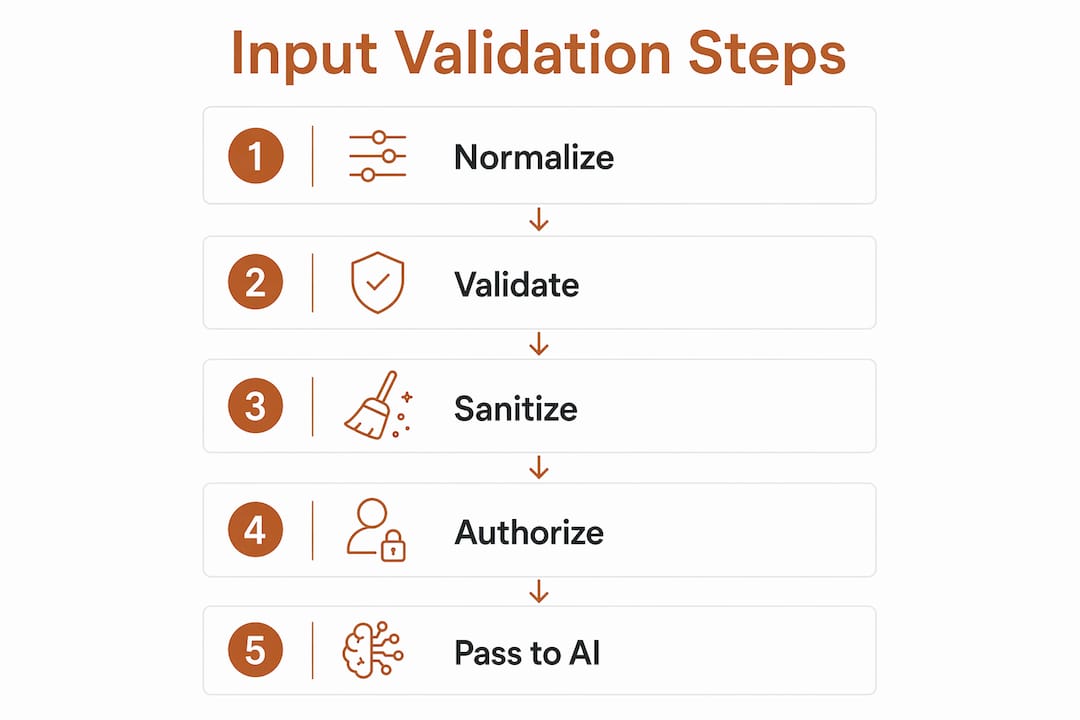
Practical validation in AI systems follows a pipeline: normalize first, validate second, sanitize third, then pass to the model. Each stage has a specific job.
Use schema validation with Pydantic
Pydantic is the standard choice for schema validation in Python-based AI systems. You define a typed model, and Pydantic rejects any request that does not match the schema before it touches your LLM call. Implementing Pydantic schema validation typically takes an afternoon but eliminates an entire category of silent API failures and unpredictable outputs. The cost savings alone justify the work. Every malformed request that reaches your model wastes tokens and produces garbage output.
Build a normalization and sanitization pipeline
- Normalize: Convert input to a consistent format. Lowercase strings, strip leading and trailing whitespace, and convert date formats to ISO 8601 before any further processing.
- Sanitize: Remove or escape characters that carry special meaning in your system. HTML entities, SQL metacharacters, and prompt delimiter sequences all need handling at this stage.
- Standardize: Apply business rules. A phone number field should always arrive in E.164 format. A country code should always be ISO 3166-1 alpha-2. Enforce these before the data enters your pipeline.
- Validate: Run the cleaned input against your schema. Reject anything that fails with a structured error response, not a silent fallback.
Input sanitization in AI also means enforcing character limits. Long inputs are not just a token cost problem. They can dilute your system prompt, push critical instructions out of the context window, and give adversarial content more surface area to work with.
Add classifier-based prompt injection detection
A lightweight classifier running before your primary model call can flag inputs that match adversarial patterns. This is not a replacement for structural validation, but it catches semantic attacks that schema checks cannot see. Reject flagged inputs with a clear error rather than attempting to sanitize them. Attempting to clean a prompt injection attempt often fails and wastes resources.
Pro Tip: Validate early in your middleware stack, before any database call or external API request. A rejected input at the entry point costs nothing. A rejected input after a database read and an LLM call costs time, money, and potentially exposes data.
What are the common challenges in AI input validation?
AI input validation has limits that developers need to understand before designing their systems around it.
The biggest misconception is treating validation as a substitute for output encoding. Validation and output encoding serve different functions. Validation rejects bad input at the entry point. Output encoding makes sure that data rendered in a browser or downstream system cannot execute as code. Skipping either one creates a gap. You need both.
Natural language input is the hardest case. Structured data has clear rules. A free-text prompt field does not. Users can phrase the same adversarial intent in thousands of ways, and no blocklist covers them all. This is why allowlist strategies and classifier-based detection matter more than blocklists in hostile input environments.
Adversarial perturbations make this harder. Attackers use character substitutions, Unicode lookalikes, and zero-width characters to bypass text-based filters. Your normalization step must handle Unicode normalization explicitly, converting all input to a canonical form before any pattern matching runs.
Silent failure modes are the most dangerous. Consider what happens when validation is absent or incomplete:
- Silent token waste: Malformed inputs reach the model and produce useless output. You pay for the API call and get nothing back.
- Error propagation: A bad value in one field corrupts downstream processing, causing failures that are hard to trace back to the original input.
- Model confusion: Contradictory or ambiguous inputs cause the model to produce inconsistent responses, which erodes user trust and makes debugging nearly impossible.
“Defining exactly what is permitted and rejecting all else reduces risk compared to trying to block dangerous patterns individually.” — cybersecurity101.net
Leading AI security frameworks consistently recommend layered validation over any single control. No single check catches everything. The combination of schema validation, normalization, classifier detection, and runtime testing is what produces a system that holds up under real-world conditions.
Key Takeaways
Input validation in AI code requires layered defenses across the prompt, retrieval, and application layers to prevent security failures and wasted model calls.
| Point | Details |
|---|---|
| Validate at every layer | Apply checks at the prompt, retrieval, and application layers, not just at the API entry point. |
| Use Pydantic for schema enforcement | Pydantic rejects malformed requests before they reach your LLM, cutting token waste and bad outputs. |
| Prefer allowlists over blocklists | Define what is permitted and reject everything else rather than trying to block individual attack patterns. |
| Separate validation from output encoding | Validation stops bad input; output encoding stops bad rendering. Both are required for secure applications. |
| Test AI-generated code against edge cases | Trace null, empty, and boundary inputs manually because AI models frequently fail these despite passing standard tests. |
What I’ve learned from watching developers skip this step
The pattern I see most often is developers who validate their traditional API endpoints carefully and then wire up an LLM call with almost no guardrails. The reasoning is usually that the model is “smart enough” to handle bad input gracefully. It is not. Models produce confident-sounding garbage when given malformed or adversarial input, and that garbage propagates through your system before anyone notices.
The second mistake is treating prompt injection as a theoretical risk. It is not theoretical. Any public-facing AI feature that accepts free-text input is a target. The fix is not complicated. Delimiter enforcement and a classifier check before the primary model call stop the majority of injection attempts. Most developers skip these steps because they are not visible in the happy-path demo.
The third thing I have noticed is that developers underestimate the cost of missing validation. Silent token waste adds up fast. A pipeline that accepts malformed inputs and passes them to a paid API burns budget on every bad request. Schema validation with production-ready AI code practices pays for itself within days on any system with real traffic.
Layered validation is not optional for production AI systems. It is the difference between a prototype that works in your demo and a product that works for your users.
— Vibeprod
Ship validated AI code with Vibeprod
Vibeprod scans your GitHub repository and identifies the exact gaps that put AI-assisted projects at risk before real users find them.
Exposed secrets, missing input guardrails, compliance issues, and insecure API patterns all surface in under two minutes. Vibeprod generates reviewable pull requests with plain-English explanations for each issue, so you understand what needs fixing and why. For solopreneurs and small teams shipping AI features fast, that kind of automated review is the difference between a production-ready application and a security incident waiting to happen. Check your repository before your next deploy.
FAQ
What is input validation in AI code?
Input validation in AI code is the process of verifying that data conforms to expected formats, safety policies, and structural constraints before it reaches an AI model. It includes type checks, schema enforcement, prompt injection detection, and instruction-data separation.
Why does prompt injection make input validation harder?
Prompt injection embeds adversarial instructions inside user input to override system prompts. Standard format validation cannot catch semantic attacks, which is why classifier-based detection and delimiter enforcement are required alongside schema checks.
What is the difference between input validation and output encoding?
Validation rejects invalid data at the entry point, while output encoding makes sure data renders safely in downstream systems. Both are necessary. Substituting one for the other creates security gaps.
How does Pydantic help with AI input validation?
Pydantic enforces typed schemas on incoming data and rejects any request that does not match before it reaches your LLM call. This eliminates silent API failures and reduces wasted token costs on malformed inputs.
How should developers validate AI-generated code?
Developers should combine AST-based static analysis with dynamic runtime testing and manual edge case tracing. AI models frequently produce code that passes general tests but fails on null inputs, boundary values, and deprecated library calls.