How to Review AI Written Code Before Launch
TL;DR:
- Most teams ship AI-generated code without proper review, risking security and compliance breaches. A structured audit process with automated tools, human oversight, and governance controls is essential before deployment. Continuous integration of verification ensures safer, faster releases in regulated industries.
AI-generated code review is the practice of systematically auditing, testing, and validating code produced by AI coding assistants before it reaches production. This matters more than most teams realize. Approximately 70% of developers ship AI-generated code to production without a proper AI-specific review process. That gap between prototype and product is where security breaches, logic failures, and compliance violations live. To review AI written code before launch, you need more than a quick scan. You need a structured process that covers security, business logic, dependencies, and governance. Regulated industries like fintech, healthcare, and IRS-adjacent software now require documented validation before any AI-generated code goes live. The stakes are real, and the standard review playbook was not built for AI output.
How to review AI written code before launch: prerequisites and tools
The right foundation makes everything else faster. Before you run a single scan, you need to know which parts of your codebase an AI assistant wrote. Tag AI-generated files and functions at the commit level using Git metadata or inline comments. This lets your tools apply AI-specific rules rather than generic linting.

Auditing AI-generated code is primarily a governance challenge, not just a technical one. That means your review process must address access control policies, data flow paths, dependency usage, and adoption metrics alongside raw code quality. Governance-first thinking changes what you look for and in what order.
For tooling, static application security testing (SAST) tools with AI-aware configurations are the baseline. Automated security tools like GuardRail AI demonstrate vulnerability detection accuracy of 82% with a 12% false positive rate, scanning 3.2 seconds per 1,000 lines. That speed makes CI/CD integration practical without slowing your pipeline.
The tool categories worth knowing:
- AI-aware SAST scanners: Flag patterns common in AI output, such as overly permissive middleware, hardcoded credentials, and missing input validation.
- Dependency auditors: Check third-party packages for known CVEs and hallucinated library names that AI models sometimes invent.
- Authorization testers: Verify that auth flows match your intended access control model, not just what the AI assumed.
- Compliance checkers: Confirm data handling meets GDPR, HIPAA, or SOC 2 requirements depending on your sector.
Pro Tip: Wire your SAST scanner to block pull request merges automatically when it finds critical severity findings. This removes the temptation to ship first and fix later.
| Tool category | Core function | Best for |
|---|---|---|
| AI-aware SAST | Pattern detection in AI output | Security baseline |
| Dependency auditor | CVE and package integrity checks | Supply chain safety |
| Authorization tester | Auth flow validation | Access control gaps |
| Compliance checker | Regulatory policy enforcement | Fintech, healthcare |
Step-by-step process for auditing AI-generated code
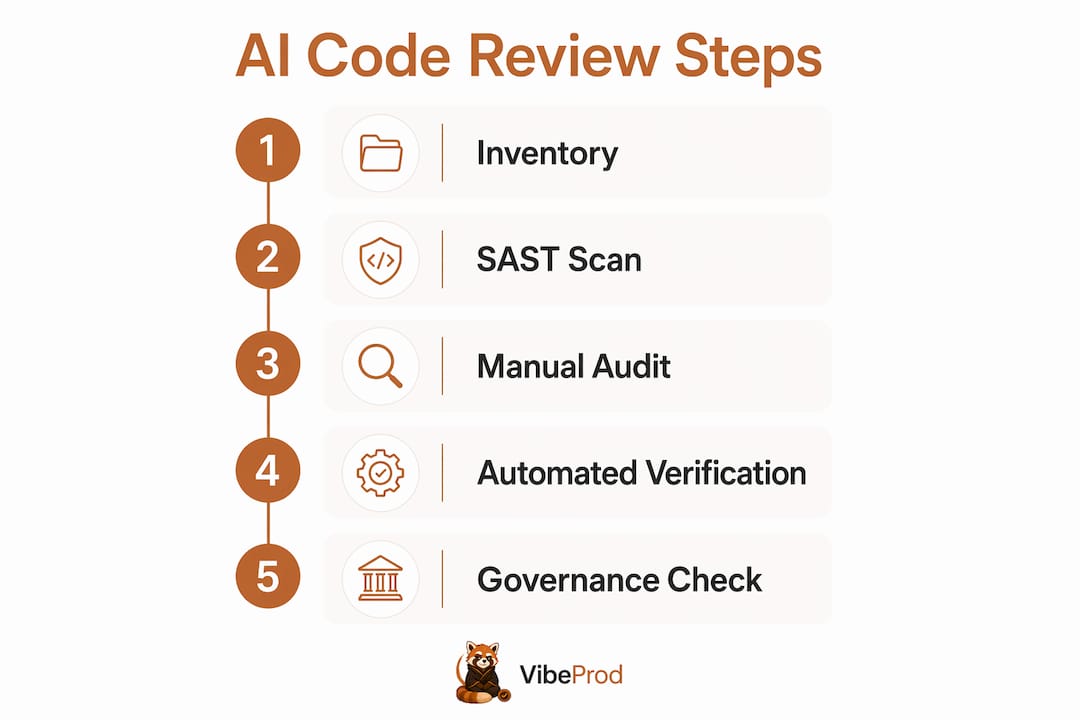
A structured workflow separates teams that catch bugs before launch from those who fix them under pressure at 2 AM. Follow this sequence every time AI-generated code moves toward production.
-
Inventory and architecture mapping. List every AI-generated module, its inputs, outputs, and the data it touches. Draw a simple data flow diagram. This step reveals where sensitive data moves and which components carry the most risk.
-
Run automated SAST with AI-aware configurations. Use your scanner with rules tuned for AI output patterns. Standard SAST rules miss AI-specific issues like verbose defensive code that looks suspicious but is harmless, or missing rate limiting on generated API endpoints.
-
Test business logic and authorization manually. AI models generate code that passes unit tests but fails real-world authorization checks. Walk through every user role and permission level. Test what happens when a standard user calls an admin endpoint directly.
-
Conduct a dependency and supply chain audit. AI assistants sometimes reference packages that do not exist or suggest outdated versions with known CVEs. Run your dependency manifest through a dedicated auditor. Remove anything unverified.
-
Senior developer manual review. A human with domain knowledge reads the AI-generated code with fresh eyes. This reviewer focuses on business logic correctness, not just syntax. Catching bugs at review stage costs one-hundredth of fixing them in production. That ratio alone justifies the time.
-
Severity reporting and sign-off. Document every finding with its severity level, the affected component, and the remediation applied. This log becomes your audit trail for compliance sign-off.
Pro Tip: Build a short checklist into your pull request template specifically for AI-generated code. Require the author to confirm that steps 1 through 4 are complete before requesting review.
| Review stage | Method | Output |
|---|---|---|
| Inventory | Manual mapping | Data flow diagram |
| SAST scan | Automated | Findings report |
| Logic and auth | Manual testing | Defect list |
| Dependency audit | Automated | CVE report |
| Senior review | Human | Annotated code |
| Sign-off | Documentation | Audit trail |
How to integrate automated verification into your CI/CD pipeline
Automation is what makes this process sustainable. A review you run manually once a sprint is not a review process. It is a hope.
Automated verification must run automatically in CI/CD to prevent human oversight failures. Manual triggers fail too often because developers forget, skip steps under deadline pressure, or assume someone else ran the check. Wiring verification directly into your pipeline removes that variable entirely.
Rick Hightower’s work on Claude Code verification describes a practical pattern using verification hooks called PostToolUse and Stop hooks. These hooks fire automatically after an AI tool writes or modifies code, triggering an independent review agent before the change can proceed. The key word is independent.
“AI self-review suffers from confirmation bias. The model that wrote the code is the worst reviewer of that code. Fresh context, whether from a separate agent or a human, catches what the original author cannot see.”
AI self-review suffers from confirmation bias, and independent verification layers consistently yield better audit outcomes. This is not a limitation of any specific model. It is a structural problem with any author reviewing their own work.
The practical setup for CI/CD integration:
- Pre-commit hooks: Run lightweight linting and secret detection before code even reaches the remote repository.
- Pull request gates: Trigger full SAST scans and dependency audits on every PR targeting your main branch.
- Merge blockers: Automatically block merges when critical findings appear, requiring human sign-off to override.
- Post-merge monitoring: Run behavioral checks in staging to catch logic errors that static analysis misses.
Pro Tip: Use separate review agents with isolated context windows for AI-generated code. An agent that has not seen the original code will flag assumptions the original model baked in without documenting them.
Common mistakes when evaluating AI programming output
Most teams make the same errors. Knowing them in advance saves you from learning them the hard way.
Overreliance on AI to self-verify. Asking the same AI assistant that wrote the code to review it produces confident-sounding but unreliable results. The model reinforces its own assumptions. Use a separate tool, agent, or human reviewer every time.
Ignoring hallucinated dependencies. AI models sometimes reference packages that do not exist or invent plausible-sounding library names. A package named in your requirements file that does not exist on PyPI or npm is an open door for supply chain attacks. Always verify every dependency against the official registry.
Treating verbose code as a vulnerability. Many AI-generated “security issues” are false positives caused by verbose defensive code. AI models often write extra null checks, redundant validations, and overly cautious error handlers. These look alarming in a scanner report but are not exploitable. Each finding requires proof of exploit before you spend time remediating it.
Applying a pentest mindset instead of a governance mindset. A penetration test looks for what an attacker can do right now. A governance audit looks at what your system allows structurally. AI-generated code needs governance review first: data flows, access policies, and dependency controls. The pentest comes after governance is confirmed.
Pro Tip: Apply a “prove it” loop to every scanner finding. Before assigning remediation work, confirm the finding is actually exploitable in your environment. This cuts wasted effort on false alarms by a significant margin.
Key Takeaways
Reviewing AI-generated code before launch requires a layered process combining governance controls, automated SAST scanning, dependency audits, and independent human review to catch what any single method misses.
| Point | Details |
|---|---|
| Governance comes first | Map data flows, access policies, and dependency controls before running any scanner. |
| Automate in CI/CD | Wire SAST scans and merge blockers into your pipeline so reviews run on every pull request. |
| Never use AI to self-review | Independent agents or human reviewers catch confirmation bias errors the original model cannot see. |
| Prove exploitability before acting | Treat scanner findings as unverified until you confirm they are exploitable in your environment. |
| Document every finding | A signed audit trail is required for compliance sign-off in fintech, healthcare, and regulated sectors. |
What I’ve learned from watching teams ship AI code too fast
The teams that get burned are not the ones who skipped security entirely. They are the ones who ran one scan, saw a green result, and shipped. They trusted the tool more than the process.
The uncomfortable truth about AI code review is that tooling is the easy part. Any team can install a SAST scanner in an afternoon. The hard part is building the discipline to treat AI-generated code as unverified by default, every single time, regardless of how clean it looks. AI assistants have collapsed the time from idea to working code. That speed is real and valuable. But a prototype that runs is not the same as a product that is safe to put in front of real users.
Governance is the foundation that tooling sits on. Without documented controls over data flows, access policies, and dependency usage, your scanner findings have no context. You cannot prioritize what you cannot categorize. Teams that build governance structures first, then layer in automation, ship faster in the long run because they spend less time firefighting production incidents.
The future of this space is AI-powered review workflows that run continuously, not just at merge time. Models will get better at catching their own class of errors as training data improves. But the structural problem of confirmation bias will not disappear. Independent verification, whether by a separate agent or a human, will remain the most reliable check you have. Build that into your process now, before the model you rely on changes and your assumptions break.
— Vibeprod
Vibeprod makes pre-launch code review practical for dev teams
Shipping AI-generated code confidently requires more than good intentions. Vibeprod scans your GitHub repository and identifies launch risks including exposed secrets, compliance gaps, and authorization issues, then generates reviewable pull requests with plain-English explanations for every finding. No existing features get altered.
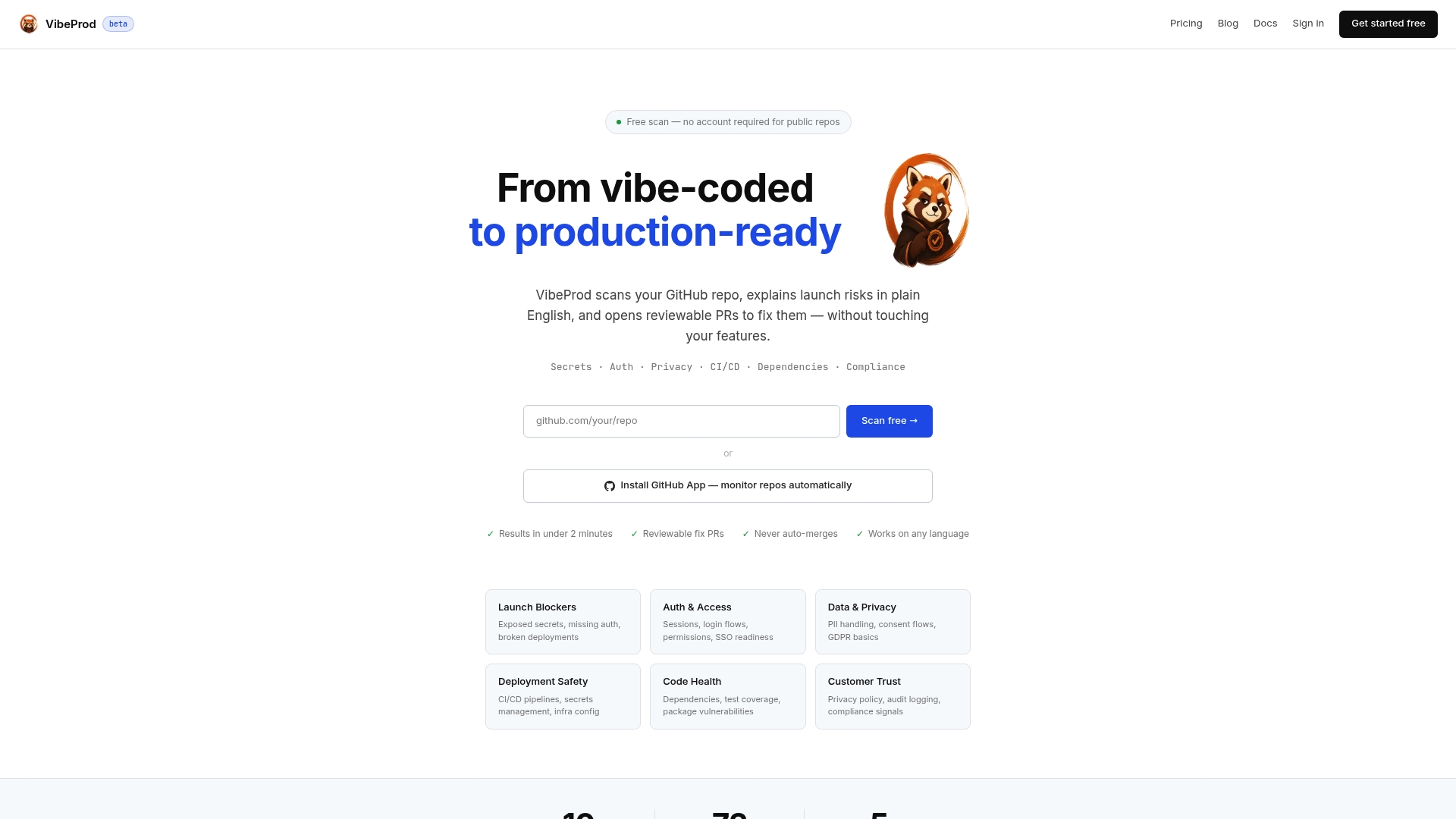
The entire process takes under two minutes to produce findings your team can act on immediately. For solopreneurs and small dev teams, that means you stay focused on building your product while Vibeprod handles the security and compliance layer that AI coding tools skip. If your codebase has gone from vibe-coded to almost-ready, Vibeprod gets it the rest of the way to production-ready.
FAQ
What does it mean to review AI written code before launch?
Pre-launch code review for AI-generated output means systematically auditing AI-produced code for security vulnerabilities, logic errors, dependency risks, and compliance gaps before the code reaches production. It combines automated scanning with human verification.
Why can’t AI just review its own code?
AI self-review produces confirmation bias, meaning the model reinforces its own assumptions and misses the errors it introduced. Independent agents or human reviewers with fresh context catch significantly more issues.
How do I check AI code quality in regulated industries?
Regulated industries require documented, independent audits of AI-generated code covering data flows, access controls, and policy compliance. Fintech, healthcare, and IRS-adjacent software sectors enforce these requirements before any AI code goes live.
What is the biggest risk of skipping a pre-launch audit?
The biggest risk is shipping exploitable vulnerabilities or compliance violations that were never caught because AI-generated code was assumed to be correct. Fixing a bug in production costs roughly one hundred times more than catching it at the review stage.
How often should teams audit AI-generated code?
Every pull request containing AI-generated code should trigger an automated scan. Manual governance reviews should run at least once per sprint, with a full audit before any major release or when your AI coding tool updates its underlying model.