HIPAA for SaaS: A Compliance Playbook for Developers
If your SaaS product creates, receives, maintains, or transmits protected health information, HIPAA applies to you as a business associate, full stop. That’s not a maybe. Your immediate to-do list: stop accepting live PHI until you have a signed Business Associate Agreement, map exactly where PHI touches your systems, and start a documented risk analysis. Business associates carry direct legal liability under HIPAA, and breach notification obligations kick in the moment you are in scope.
TL;DR:
- SaaS companies that handle any creation, receipt, or storage of PHI automatically fall under HIPAA as business associates, requiring signed BAAs and risk analysis.
- Handling PHI requires implementing specific technical safeguards like encryption, access controls, and audit logs, with “addressable” features properly documented if not fully implemented.
- Maintaining formal risk assessments, policies, workforce training, and contingency plans are essential for ongoing HIPAA compliance and must be regularly updated.
- Business associate agreements must clearly define permitted uses, safeguard responsibilities, breach reporting, and data return or destruction protocols, especially with cloud providers.
- Automated tools like Vibeprod help streamline compliance evidence collection and detect breaches or misconfigurations early, facilitating faster audit readiness for small teams.
Table of Contents
- What Counts as HIPAA for SaaS: Business Associate vs. Covered Entity
- The Four HIPAA Rules That Actually Affect Your SaaS
- Technical Safeguards Your Engineers Need to Build
- Administrative and Physical Safeguards Auditors Look For
- What Your Business Associate Agreements Need to Cover
- Your HIPAA Implementation Timeline: What to Build When
- Developer Playbook: Repo Hygiene and Audit Evidence
- Staying Compliant: Continuous Monitoring and Re-Assessment Triggers
- Why Vibeprod Thinks Speed and Compliance Aren’t Opposites
- Let Vibeprod Catch What Manual Reviews Miss
- Primary Sources Worth Bookmarking
- Sources
- FAQ
What Counts as HIPAA for SaaS: Business Associate vs. Covered Entity
HIPAA splits regulated organizations into two buckets: covered entities (providers, health plans, clearinghouses) and business associates (any vendor that handles PHI on a covered entity’s behalf). Most SaaS companies fall into the second bucket, and the definition is broader than founders expect.
You’re a business associate if your product does any of the following:
- Stores patient records, even encrypted ones, in a database you operate
- Runs analytics or logging that captures identifiers tied to health data
- Handles file uploads or support attachments containing clinical notes
- Backs up or archives data that includes PHI, even briefly
The practical scoping test is simple: do you create, receive, maintain, or transmit PHI? If yes, cloud services that touch PHI on behalf of a covered entity act as business associates under HHS guidance, regardless of how the data is technically stored.
Edge cases trip people up. A pass-through message queue that never persists PHI may qualify as a “conduit,” which carries lighter obligations than a data store. Properly de-identified data, stripped of the 18 HIPAA identifiers, falls outside PHI entirely. But don’t self-declare either exemption casually. Document the reasoning: what data moves through the system, whether it’s persisted, and why you classified it the way you did. That written record is what an auditor or a nervous enterprise customer will ask for first.
The Four HIPAA Rules That Actually Affect Your SaaS
Most engineering teams only need to internalize four rules, not the entire HIPAA statute.
The Privacy Rule governs permissible uses of PHI and the “minimum necessary” standard, meaning your product should only access the health data required for the feature at hand, not everything in the record. It also grants patients rights to access and amend their records, which matters if your platform is patient-facing.
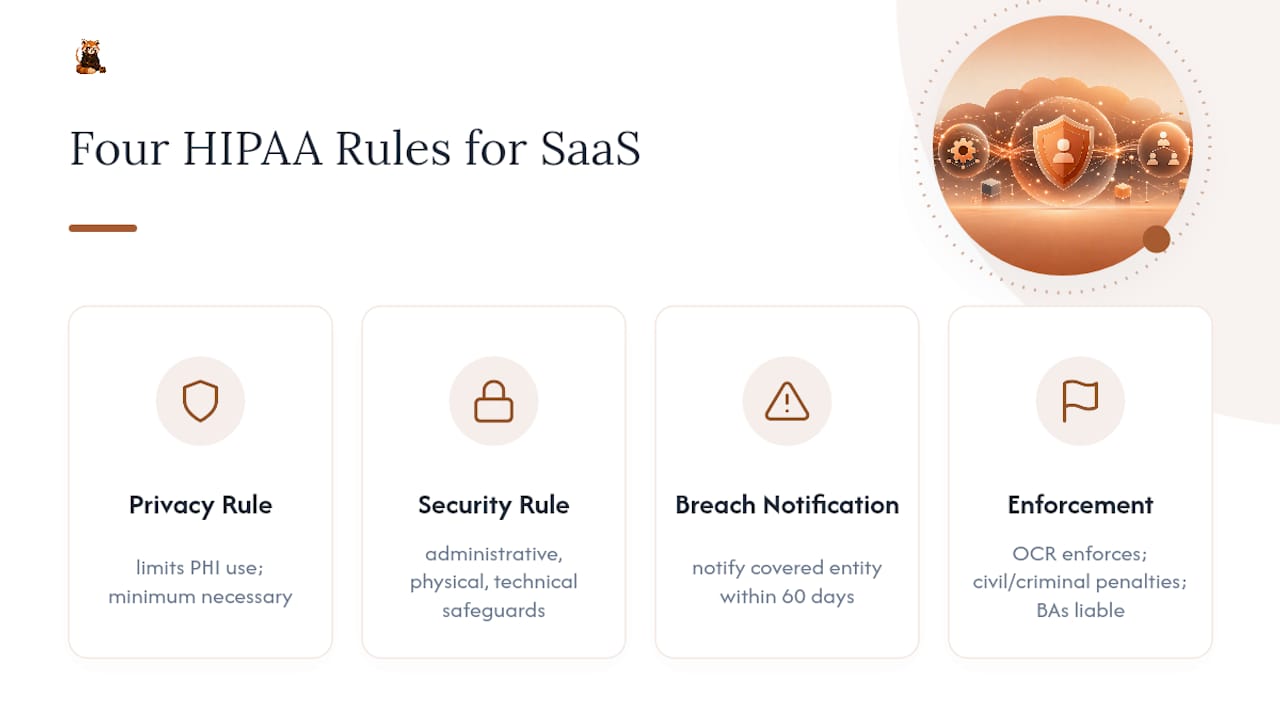
The Security Rule is where engineers spend the most time. It breaks safeguards into administrative, physical, and technical categories, and it’s technology-neutral by design, so HHS expects you to choose reasonable, appropriate controls rather than follow a rigid checklist.
The Breach Notification Rule sets hard deadlines. As a business associate, you must notify the covered entity “without unreasonable delay” and no later than 60 days after discovering a breach, so they can meet their own reporting obligations to affected individuals and to HHS.
Enforcement falls to the Office for Civil Rights (OCR), which investigates complaints and can levy civil penalties. In cases of willful neglect, HIPAA enforcement carries criminal liability too. The key detail founders miss: business associates are directly liable for Security Rule violations, not just the covered entities they serve.
Technical Safeguards Your Engineers Need to Build
Section 45 CFR §164.312 is the actual regulatory text engineers should bookmark, since it lists the specific technical safeguards the Security Rule requires. Some items are “required,” meaning non-negotiable. Others are “addressable,” meaning you must implement them or document a reasonable alternative. Here’s how to prioritize the work:
- Access control. Assign unique user IDs to every person and service account touching PHI. Enforce role-based access control and require multi-factor authentication for any admin console, support tool, or database client that can view patient data.
- Audit and integrity controls. Centralize logs in an append-only or tamper-evident store. HIPAA doesn’t specify a retention window in the regulation text, but compliance programs generally keep audit logs for an extended period to align with HIPAA’s general documentation retention requirement, and your policy should state the retention time explicitly.
- Encryption in transit and at rest. Use TLS 1.2 or higher for anything moving over a network, and AES-256 (or an equivalent approved cipher) for data at rest. Manage keys through a dedicated KMS or HSM, not environment variables, and rotate them on a documented schedule.
- Tenant separation. If you serve multiple healthcare customers from shared infrastructure, consider per-tenant encryption keys or, for customers that demand it, a bring-your-own-key (BYOK) model that keeps their PHI cryptographically separate from everyone else’s.
- Transmission integrity and automatic logoff. Verify that data isn’t altered in transit, and configure sessions to expire after inactivity, especially on any interface where clinical staff might walk away from an unlocked screen.
- Emergency access procedures. Document how an authorized user can retrieve PHI during a system failure or personnel emergency without bypassing your normal access controls entirely.
Pro Tip: When you mark a specification as “addressable” instead of implementing it exactly as written, write down why your alternative is reasonable and appropriate for your environment. Auditors don’t expect perfection. They expect a paper trail showing you thought it through.
HHS guidance on technical safeguards explicitly notes the Security Rule was written to be flexible and scalable, which is good news for a five-person startup that can’t afford enterprise-grade tooling on day one. The bad news: “flexible” doesn’t mean “optional.” You still need audit controls, you still need encryption, and you still need to justify every deviation in writing. A common mistake is treating “addressable” as a synonym for “skip it.” It isn’t. It means “implement it, or write down a defensible reason you didn’t.”

Administrative and Physical Safeguards Auditors Look For
Technical controls get the attention, but auditors spend just as much time on paperwork, because paperwork is how they verify your technical controls actually work as intended.
Start with a formal, written risk analysis, an assessment of where PHI lives, what threatens it, and how you’re mitigating those threats. This isn’t a one-time document. Update it whenever your architecture changes.
Build out a policy set covering:
- Access management (who gets provisioned, who gets deprovisioned, and how fast)
- Encryption standards for data at rest and in transit
- Incident response procedures with named roles
- Business associate management for your own vendors
- Data retention and secure disposal schedules
Workforce training needs a cadence, not a one-off slideshow during onboarding. Engineers need role-specific training on secure coding and PHI handling; support staff need training on what they can and can’t disclose over chat or email; ops teams need training on incident escalation. Keep dated training records for every employee, because “we trained everyone” without documentation is functionally the same as not training anyone in an audit.
Contingency planning rounds this out: encrypted backups, a documented disaster recovery plan with real recovery time and recovery point objectives, and periodic testing to confirm the plan actually works when you need it.
What Your Business Associate Agreements Need to Cover
A Business Associate Agreement is the contract that makes your handling of PHI legal, and HHS spells out the required elements pretty explicitly.
- Permitted uses and disclosures. The BAA should state exactly what you’re allowed to do with PHI and nothing broader.
- Safeguard commitments. You must agree to implement appropriate safeguards, which ties directly back to the Security Rule.
- Breach reporting obligations. The agreement needs a clear timeline and process for notifying the covered entity of any breach or unauthorized use.
- Subcontractor flow-down. If you use a subcontractor that also touches PHI, your BAA with them must include the same restrictions HHS requires business associates to pass down to their vendors.
- Return or destruction of PHI. When the relationship ends, the agreement must specify what happens to the data, typically return it or destroy it, and prove it.
- Audit rights. Many covered entities negotiate the right to review your compliance evidence directly.
Cloud infrastructure providers deserve special attention here. A provider is generally treated as a business associate if it has access to PHI, but as a “conduit” if it only transports encrypted data without the ability to view it, similar to how a postal carrier isn’t liable for the contents of a sealed envelope. Get a BAA in place with your cloud provider regardless. Every major U.S. cloud platform offers one, and skipping it because “they’re probably a conduit” is a bet you don’t want to lose. Auditors will ask to see signed BAAs on both sides of your business, upstream with your vendors and downstream with your customers, plus evidence you assessed vendor risk before signing.
Your HIPAA Implementation Timeline: What to Build When
Trying to become fully HIPAA-compliant in a single sprint is how teams either burn weeks on the wrong priorities or, more often, quietly give up. A staged rollout works better.
- Days 0 to 14: Scope and map. Inventory every system that touches PHI, and diagram the actual data flow from ingestion to storage to deletion. You cannot secure what you haven’t mapped.
- Weeks 1 to 6: Risk analysis. Produce a written risk analysis identifying threats to each system in scope, along with a remediation plan and rough timelines for closing gaps.
- Months 1 to 3: Core controls. Implement centralized audit logging, encryption at rest and in transit, access controls with MFA, and get BAAs signed with every vendor in the data path.
- Ongoing: Incident response readiness. Build an incident response plan, run at least one tabletop exercise with your team, and set up evidence collection so you can produce logs and timelines fast if something goes wrong.
- Recurring: Operational cadence. Review access permissions quarterly, reassess risk annually, and trigger an off-cycle reassessment whenever you ship a feature that changes how PHI moves through your systems.
Pro Tip: Narrow the scope of what’s “in HIPAA scope” to the specific service or database that actually touches PHI, rather than declaring your whole engineering org compliant on day one. A tightly scoped system is dramatically easier to secure, document, and audit than a company-wide program you can’t actually enforce.
Developer Playbook: Repo Hygiene and Audit Evidence
The gap between “we wrote a HIPAA policy” and “we can prove it in an audit” usually lives in your codebase, not your wiki.
Never commit real PHI to source control, test fixtures, or seed data. Use tokenized or synthetic data for local development and staging environments; a leaked fixture file is still a breach even if it was “just for testing.” Centralize secrets in a dedicated manager instead of .env files or hardcoded strings, rotate credentials on a schedule, and enforce pre-merge checks that block commits containing exposed keys.
Static and dynamic application security testing (SAST/DAST) and dependency scanning belong in your CI pipeline, not in a quarterly manual review. Every finding should generate a fix pull request with a human reviewer signing off before merge, so you get both remediation speed and an audit trail. Lock down CI/CD artifacts and require MFA or SSO for anyone with deploy privileges, since a compromised deployment pipeline is functionally the same risk as a compromised database.
- Tokenize or synthesize test data; never let PHI touch a fixture file
- Rotate secrets automatically and block hardcoded credentials at the commit level
- Wire SAST, DAST, and dependency scanning into every pull request
- Restrict deploy access behind MFA and log every production change
Pro Tip: Automated tools that flag exposed secrets or misconfigurations and open a reviewable fix PR with a plain-English explanation cut the time between “we found a problem” and “we fixed it and can prove it” from weeks to minutes, which is exactly the evidence trail an auditor wants to see.
Staying Compliant: Continuous Monitoring and Re-Assessment Triggers
Compliance isn’t a certificate you earn once. It’s an operational state you maintain, and HHS is explicit that no government body issues a HIPAA “seal of approval” for software. The proof is in your artifacts: system inventories, a current risk analysis, signed policies, dated training logs, executed BAAs, and monitoring reports showing your controls actually run.
Centralized logging with alerting on anomalous PHI access catches the incidents a quarterly review would miss entirely, someone querying far more records than their role justifies, or access spiking at 3 a.m. from an unfamiliar location. Pair that with a quarterly access review to prune permissions nobody uses anymore.
Certain events should automatically trigger a fresh risk analysis rather than waiting for your annual cycle: shipping a feature that changes how PHI flows, onboarding a new vendor that touches patient data, any security incident regardless of severity, or an acquisition that merges two codebases and two sets of assumptions about what’s actually in scope.
Why Vibeprod Thinks Speed and Compliance Aren’t Opposites
Most HIPAA advice assumes you have a compliance team and months to spare. Startups don’t. The teams that actually stay compliant scope tightly, one service, one database, one data flow, rather than declaring the whole company HIPAA-ready and hoping nobody checks the corners.
Automation is what makes that narrow scope sustainable. Repo-level scanning and fix-driven pull requests turn compliance from a quarterly fire drill into a background process that runs on every commit. Start with scoping, get your BAAs signed, and let a documented risk analysis drive what you build next, not the other way around.
— Vibeprod
Let Vibeprod Catch What Manual Reviews Miss
Vibeprod gives SaaS teams a faster path to audit-ready evidence than the alternative: hiring a compliance consultant to manually review your codebase months after launch, when fixing an exposed secret means untangling three sprints of dependent code. Vibeprod scans your GitHub repositories for exposed secrets, compliance-risk patterns, and CI/CD misconfigurations, then opens a reviewable pull request with a plain-English explanation of exactly what’s wrong and why it matters.
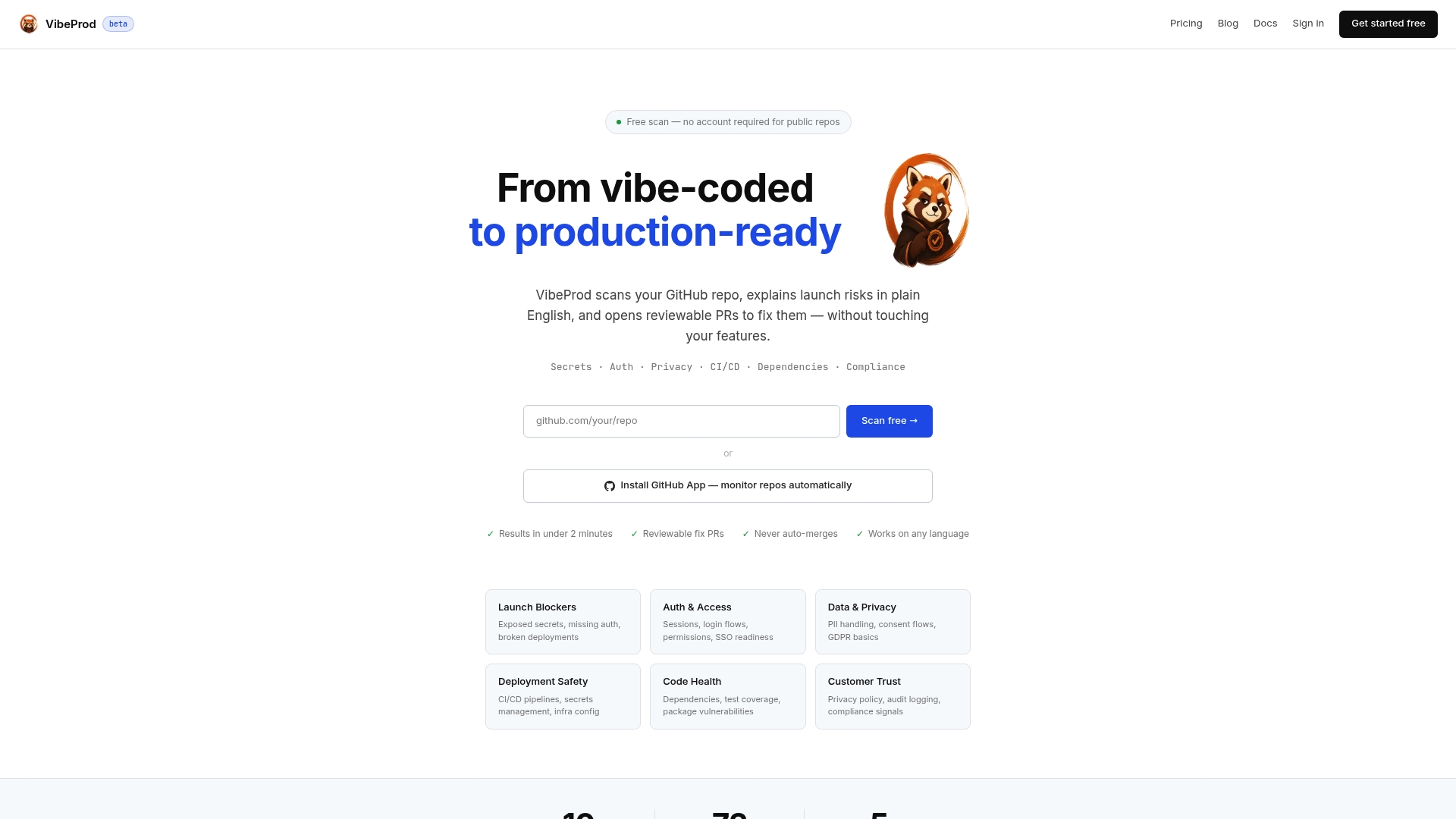
That workflow matters most in the exact scenario this article covers: a small team trying to reach HIPAA readiness without freezing product work for a quarter. Instead of a static checklist, you get continuous, automated detection tied directly to the technical safeguards auditors ask about, access control gaps, hardcoded credentials, missing encryption configs, mapped straight to a fix you can review and merge in minutes. For teams managing vendor risk as part of their broader compliance posture, resources like this cybersecurity and legal compliance guide round out the picture on where technical controls intersect with contractual liability.
Try the free tier at Vibeprod and run a scan against your production repo today. In under two minutes, you’ll have a concrete list of what’s standing between your codebase and audit-ready evidence.
Primary Sources Worth Bookmarking
Skip the secondhand summaries when you need the actual regulatory text. HHS publishes direct guidance on cloud computing and business associate responsibilities, which clarifies how cloud vendors fit into the compliance chain. For the legal text engineers reference most, 45 CFR §164.312 on technical safeguards lays out required and addressable specifications in plain regulatory language. HHS also publishes a companion PDF walking through implementation examples for each safeguard category, and its enforcement and agreements page explains how OCR investigates complaints and what penalties look like in practice.
This article is general information, not a substitute for advice from a qualified lawyer. Consult a qualified legal professional about your own circumstances before acting on anything here.
Sources
FAQ
Does HIPAA Apply to Tech Companies?
Yes, any tech company, including SaaS providers, that creates, receives, maintains, or transmits PHI on behalf of a covered entity qualifies as a business associate under HHS guidance and must comply with HIPAA’s Security and Privacy Rules directly.
What Is the New HIPAA Rule in 2026?
There is no single new nationwide HIPAA rule taking effect in 2026 that changes the core business associate framework; the existing Security Rule, Privacy Rule, and Breach Notification Rule described above remain the operative requirements, so teams should focus on solid fundamentals rather than waiting for a rule change.
Is ChatGPT HIPAA Compliant?
Standard consumer access to ChatGPT is not covered by a BAA and shouldn’t be used to process PHI; some enterprise AI offerings provide a BAA option, but you must confirm a signed BAA is in place before sending any PHI to any AI tool.
Is Google Cloud Storage HIPAA Compliant?
Google Cloud offers a BAA for eligible services, and a service only supports HIPAA compliance when that BAA is signed and the specific product is covered under it; simply using Google Cloud infrastructure without an executed BAA does not make your use of it compliant.
Does Encrypting Data Exempt My SaaS From HIPAA?
No. HHS guidance is explicit that encryption, including “zero-knowledge” architectures, does not remove business associate status if your system still creates, receives, maintains, or transmits PHI.