Make GDPR Auditable: 5 CI/CD Checks Developers Must Add
For developers, GDPR’s core demand is auditable, privacy-by-design systems. If you’re not sure your app meets that bar, stop nonessential data collection now, then build two things first: audit-ready consent logging and working DSAR endpoints. Everything else in this guide builds on that foundation.
TL;DR:
- Developers must implement audit-ready consent logging that records user consent details, timestamp, banner version, and purpose choices, stored as append-only records.
- Building and maintaining functional DSAR endpoints for data export, correction, deletion, restriction, and objection is critical for compliance and must include identity verification.
- GDPR applies if your users are in the EU, your app targets EU markets, or you process data for EU clients, regardless of your location or server origin.
- Encryption and pseudonymization are mandatory when handling special categories of data or doing analytics on identifiable behavior, with pseudonymization treated as essential in practice.
- Automated tools that scan repositories for security gaps and compliance issues can help catch GDPR risks before deployment, making fast shipping safer for small teams and solo developers.
Table of Contents
- What GDPR Means for Developers and When It Applies
- Personal Data in Your Schema: What to Protect and How
- Privacy by Design: Engineering Patterns That Hold Up
- How Do You Build Audit-Ready Consent Logging?
- What Endpoints Do You Need for Data Subject Rights?
- Managing Processors, DPAs, and Third-Party Data Flows
- Breach Response: What Your Logs Need to Support
- A Developer Checklist for Gating Releases
- VibeProd’s Take: Automating the GDPR Safety Net
- Primary Sources and Templates Worth Bookmarking
- Catch GDPR Risks Before They Ship
- Sources
- FAQ
What GDPR Means for Developers and When It Applies
GDPR is built on one principle that matters more to you than any single article number: accountability. You have to prove compliance, not just claim it. That means your code needs to generate evidence, not just enforce rules.
Whether you’re a controller or a processor changes what you’re on the hook for. If your app decides why data gets collected, you’re a controller. If you’re processing data on someone else’s behalf (think: a backend service handling data for a client’s app), you’re a processor working under their instructions, per the GDPR text itself.
Territorial scope trips up a lot of small teams. GDPR applies if you:
- Have users physically located in the EU, regardless of where your servers or company sit
- Target EU markets (translated pricing, EU currency, shipping to EU addresses)
- Process data for an EU-based client as a processor, even if you’re a solo developer in another country
Personal Data in Your Schema: What to Protect and How
Personal data isn’t just names and emails. It’s IP addresses, device IDs, session tokens tied to a person, location pings, even a hashed user ID if it can be re-linked to someone. Special categories (health data, biometric data, sexual orientation, religious belief) carry a much higher bar for both storage and access control.
Your lawful basis choice has direct engineering consequences:
- Consent-based processing requires you to log the consent event itself, tied to a timestamp and purpose, and be ready to prove it existed
- Legitimate interest requires a documented balancing test you can produce on request, but no consent log
- Contractual necessity (processing needed to deliver the service the user signed up for) needs no consent flag at all, just clear terms
Pseudonymization becomes mandatory in practice, not just recommended, once you’re storing anything in the special categories or doing analytics on identifiable behavior. Split identifying fields into a separate table with restricted access, and reference users by a rotating key everywhere else.
Privacy by Design: Engineering Patterns That Hold Up
CNIL’s developer guide is blunt about this: privacy by design isn’t a policy document, it’s a schema decision. Start by refusing to collect fields you can’t justify. Every optional field in a signup form is a liability with no upside.
A few patterns that actually work in production:
- Enforce schema validation that rejects unexpected personal-data fields at the API boundary
- Keep a separate pseudonym mapping table with its own access controls and audit trail
- Encrypt sensitive fields at the application layer using a managed KMS, not just relying on disk-level encryption
- For aggregate analytics, consider differential privacy, where documented epsilon values (a measure of how much noise you’re injecting) let you defend the tradeoff between data utility and reidentification risk under Article 25
Pro Tip: Treat your pseudonym mapping table like a secrets vault, not a regular database table. If an attacker gets your main database but not that mapping table, you’ve turned a breach into a much smaller incident.
How Do You Build Audit-Ready Consent Logging?
Consent logging is where most codebases fall apart under audit pressure. A checkbox that toggles a boolean isn’t evidence. Regulators expect a reconstructable record of what a specific user agreed to, when, and under what banner version, according to guidance on proof of consent.
A minimal consent-log schema needs:
| Field | Purpose |
|---|---|
user_id |
Ties the record to a specific person, pseudonymized where possible |
timestamp |
ISO 8601 format, capturing exactly when consent was given |
banner_version_id |
Snapshot reference to the exact banner text shown |
purpose_choices |
Per-purpose grants (analytics, marketing, etc.), not one blanket flag |
jurisdiction |
Where the user was located at time of consent |
collection_method |
Web banner, mobile SDK, API call, etc. |
propagation_status |
Whether downstream systems (ad networks, CRMs) received the update |
Store logs as append-only records, never overwrite a prior entry. Export in JSON, CSV, or Parquet so you can hand a regulator a clean file instead of a database dump. The EDPB’s guidance on accountability treats this kind of queryable record as the baseline expectation, not a bonus.
Retention matters too: keep consent logs at least as long as you keep the data they authorize, and make them searchable by user_id so a single DSAR doesn’t turn into an afternoon of manual log-grepping.
What Endpoints Do You Need for Data Subject Rights?
Articles 15 through 22 translate into concrete API work. Build these five, in roughly this priority order:
GET /users/{id}/export— returns all personal data tied to that user in a portable formatPATCH /users/{id}— allows rectification of incorrect fieldsDELETE /users/{id}— triggers cascading erasure, not a soft-delete flagPOST /users/{id}/restrict— flags data to be retained but not actively processedPOST /users/{id}/object— logs an objection to a specific processing purpose
Before fulfilling any of these, verify identity. A password reset flow or a two-factor confirmation code works better than just trusting an email address in a request body. Once verified, deletion has to cascade: your primary database, backups, log aggregators, and any processor you’ve handed data to. Log the completion timestamp and scope of every erasure so you have proof it happened. Practical developer guidance points to a one-month response window as the standard timeline to build toward.
Managing Processors, DPAs, and Third-Party Data Flows
Every vendor touching personal data needs a Data Processing Agreement, and as the developer, you’re often the one who has to verify the vendor’s technical claims match reality. A solid DPA template and checklist helps you confirm the paperwork covers what your code needs.
Check for, and test, these before integrating any third-party service:
- A working deletion API you can call, not just a promise in the contract
- An export API that returns data in a usable format
- Subprocessor notification terms, so you know if your vendor is handing data to someone else
- Logging granularity sufficient to prove when data left your systems
Tag personal-data flows at the code level, in HTTP middleware or message-queue headers, noting the transfer mechanism (Standard Contractual Clauses, an adequacy decision, or explicit consent) for every cross-border hop.
Breach Response: What Your Logs Need to Support
The 72-hour notification clock starts the moment you become aware of a breach, not when you finish investigating it. That means your detection and logging infrastructure has to do the heavy lifting before legal even gets involved.
Build these into your stack before you need them:
- Append-only audit logs on access to sensitive tables, isolated from your main application logs
- Automated alerts on anomalous access patterns (bulk exports, off-hours admin queries)
- A forensic export process that pulls evidence without touching or over-retaining unrelated personal data
Pro Tip: Draft your breach notification templates before an incident, not during one. Trying to write clear, accurate language to regulators and users while also fighting a live breach is how mistakes get made.
Notify your supervisory authority within 72 hours for anything posing risk to individuals; notify affected users directly only when the risk is high, per the operational guidance in IsMyCodeSafe’s practical guide.
A Developer Checklist for Gating Releases
Bake these checks into your CI/CD pipeline so GDPR risks surface before a merge, not after a launch:
- Confirm no nonessential tracking or analytics scripts fire before consent is captured
- Verify consent logs are being written and are queryable by
user_id - Run automated tests against your DSAR endpoints (export, delete, rectify)
- Confirm encryption is active on sensitive fields, not just configured
- Check that retention policies actually delete stale data on schedule, not just document an intention to
Pair this with automated pipeline checks: secret scanning, storage bucket policy checks, schema validators that flag new unencrypted personal-data fields, and smoke tests against your consent-log API.
Pro Tip: An automated scan that opens a reviewable pull request with a plain-English explanation cuts remediation time dramatically compared to finding the issue in a manual audit weeks after launch.
VibeProd’s Take: Automating the GDPR Safety Net
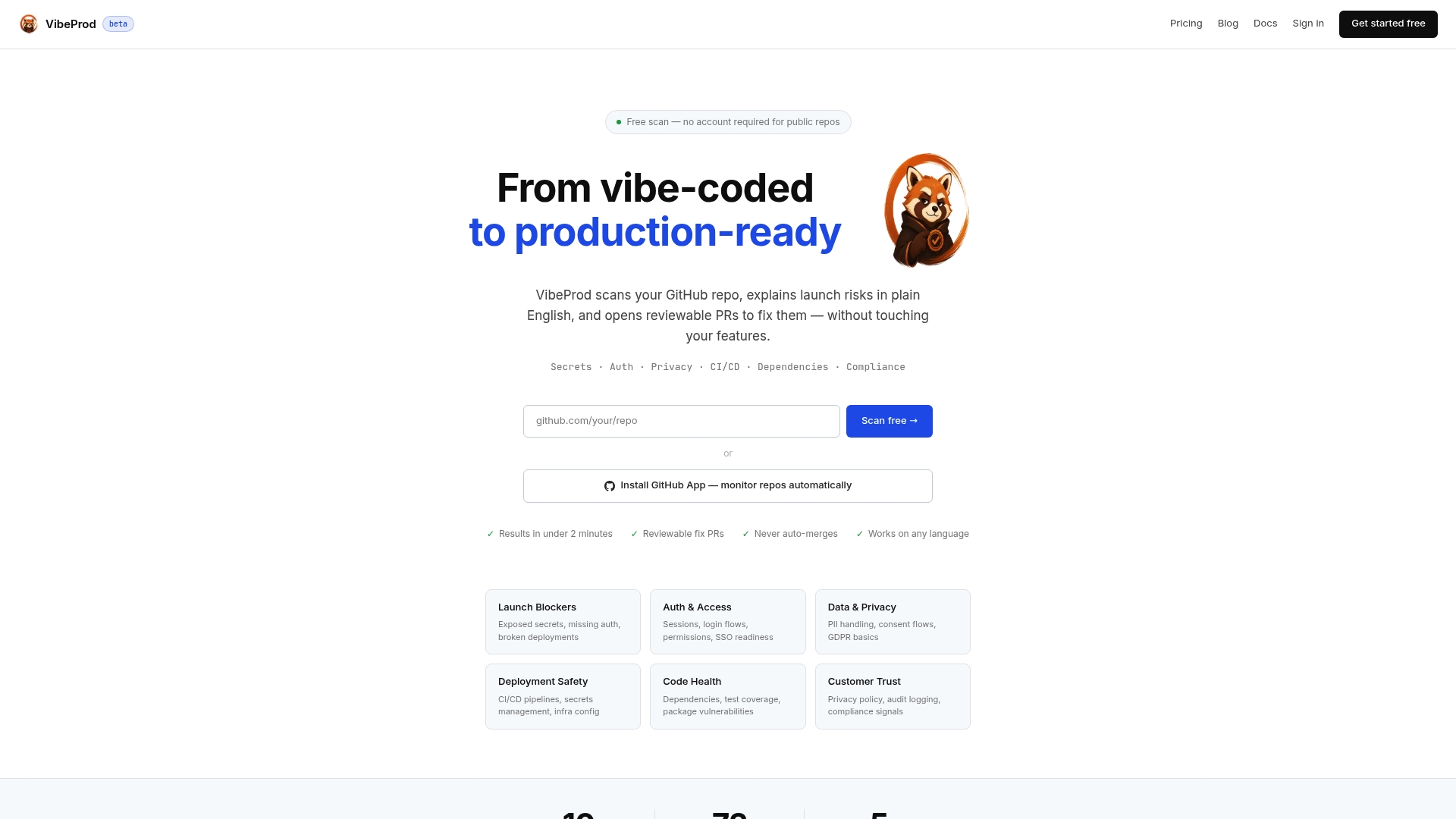
Most of what’s described above is exactly the kind of work that gets skipped when you’re shipping fast. A tool can scan your GitHub repository for exposed secrets, misconfigurations, and compliance gaps, then open a reviewable pull request with a plain-English explanation of what’s wrong and why.
It doesn’t auto-merge or touch your existing features. It surfaces the risk, explains it in terms you can act on immediately, and lets you decide. For a solo developer juggling product work and compliance obligations at the same time, quick turnaround matters more than a comprehensive audit that takes a week to schedule.
— Vibeprod
Primary Sources and Templates Worth Bookmarking
For the legal text itself, go to EUR-Lex’s full regulation. For engineering-specific guidance, CNIL’s developer guide and ENISA’s privacy-by-design resources are worth a permanent bookmark, alongside the EDPB’s guidance library and a solid DPA template for vendor contracts.
Catch GDPR Risks Before They Ship
Reading a checklist is one thing. Actually catching an exposed API key, a misconfigured storage bucket, or a missing encryption flag before your next deploy is another. A tool can scan your repository automatically and open a reviewable pull request the moment it finds a compliance or security gap, with a plain-English explanation of the risk and a suggested fix that doesn’t touch your existing features.
That’s the gap between knowing GDPR requirements and actually verifying your codebase meets them at 2 a.m. before a launch. If you’re an indie developer or a small team shipping fast, running a scan takes a couple of minutes and tells you exactly where your app stands. Check your repository now and see what surfaces before your users do.
This article is general information, not a substitute for advice from a qualified lawyer. Consult a qualified legal professional about your own circumstances before acting on anything here.
Sources
- EUR-Lex — Regulation (EU) 2016/679 (GDPR)
- CNIL — GDPR: a developer guide
- European Data Protection Board — Guidance and documents
- CookieBeam — Proof of Consent under GDPR: Records, Schema & Audit Documentation (2026)
- IsMyCodeSafe — GDPR for Developers Practical Guide
FAQ
What Are the 7 GDPR Requirements Developers Should Know?
The core obligations that touch code most directly are lawfulness and transparency, purpose limitation, data minimization, accuracy, storage limitation, integrity and confidentiality (security), and accountability, which requires you to document and prove compliance rather than just claim it.
Is GDPR Compliance Mandatory for US Companies?
GDPR applies based on whose data you’re processing, not where your company is registered. A US-based developer must comply if the app has EU users or targets EU markets, regardless of where the servers or business entity sit.
Is GDPR Stricter Than HIPAA?
They protect different things and aren’t directly comparable, but GDPR covers a much broader scope of personal data across all sectors, while HIPAA focuses specifically on health data within the US healthcare system. GDPR’s consent, DSAR, and breach notification requirements are generally more prescriptive for developers to implement in code.
Who Actually Needs to Be GDPR Compliant?
Any organization or developer processing personal data of people located in the EU needs to comply, whether they’re a controller deciding how data is used or a processor handling it under someone else’s instructions. Company size and location don’t create an exemption.
How Is CCPA Different From GDPR for Developers?
CCPA gives California residents rights to know, delete, and opt out of the sale of their data, while GDPR requires an affirmative lawful basis before processing begins at all. In practice, GDPR pushes you toward consent gating and audit logs earlier in the data flow, while CCPA compliance leans more on opt-out mechanisms and disclosure at the point of collection.