Automate 3 Data Retention Tasks Engineers Need: Logs, SBOMs, Backups
A data retention policy is a written set of rules for what data you keep, why you keep it, how long you keep it, and how you destroy it when the clock runs out. If you don’t have one, start today: build a retention schedule, name a policy owner (usually your CISO or head of engineering), and pair them with a legal co-owner. Anchor your first draft to HIPAA, SOX/IRS, and GDPR requirements, since those three cover most of what regulators will actually ask about.
TL;DR:
- Proper data retention schedules must cover a wide range of data, including structured, unstructured, logs, backups, and vendor data, with designated owners for each category.
- Retention periods should be based on multiple legal and regulatory standards, and in cases of conflicting rules, the longest required period must be followed.
- Automated classification, lifecycle management, and logging of destruction events are essential to enforce retention policies effectively, especially for SBOMs and backups.
- Regular review, trigger-driven updates, and a clear exception process are necessary to keep retention programs relevant and compliant over time.
- Legal hold procedures require formal, documented processes and must be tested regularly to prevent accidental data destruction during litigation or investigations.
Table of Contents
- What Is a Data Retention Policy, and What Does It Cover?
- Why Retention Policies Matter More Than Most Teams Assume
- What Goes Into a Data Retention Policy and Schedule?
- How Long Should You Actually Keep Different Types of Data?
- Legal and Regulatory Anchors You Need to Verify First
- Turning Policy Into Practice: Backups, Logs, Archives, and SBOMs
- Keeping the Policy Alive: Review, Exceptions, and Metrics
- Where Retention Programs Usually Break, and How to Fix It
- Author Perspective: Practical Guidance From an Engineering Standpoint
- Get Your Repository Audit Before You Finalize a Retention Policy
- Sources
- FAQ
What Is a Data Retention Policy, and What Does It Cover?
A data retention policy and a retention schedule are two different documents, and mixing them up is where most teams go wrong. The policy is short: it states your organization’s philosophy on retention, who owns decisions, and how exceptions get approved. The schedule is the working document: a row-by-row list of every data category, how long each one lives, and why.
Your schedule needs to cover more ground than most founders expect. It’s not just customer records in a database. A serious retention program touches:
- Structured data: customer records, transaction tables, billing history
- Unstructured data: support tickets, contracts, uploaded files, email
- System and security logs: authentication events, API access logs, error logs
- Backups and archives: full snapshots, incremental backups, cold storage exports
- Software bill of materials (SBOM) records and build artifacts
- Vendor-held data: anything a subprocessor stores on your behalf
Each category needs a named owner, not just a policy on paper. The ACC’s guidance on data retention recommends pairing a short overarching policy with a detailed schedule, and that structure only works if someone is accountable for each row. In practice, that means three roles: a policy owner (often your CISO or a senior engineer at a small company) who sets the framework, a legal co-owner who signs off on retention periods and litigation holds, and domain-specific data owners, such as an HR lead for personnel files or a backend engineer for logs, who actually execute deletion.
Skipping the domain-owner layer is the most common failure mode. Legal writes a beautiful policy, nobody on the engineering side implements it, and eighteen months later you discover three years of access logs sitting in an S3 bucket nobody remembers creating.
Why Retention Policies Matter More Than Most Teams Assume
Get retention wrong in either direction and it costs you. Delete too aggressively and you lose the paper trail regulators or courts demand during an audit or lawsuit. Keep too much and every extra gigabyte becomes a liability the moment you get breached.
The risk isn’t symmetrical, and that’s the part people miss. Under-retention creates compliance and litigation exposure: if the IRS or a court asks for financial records you were supposed to keep for seven years and you can’t produce them, you’re not just embarrassed, you’re exposed to penalties or an adverse inference in litigation. Over-retention creates a different, quieter risk: every old customer record you didn’t need to keep is one more record an attacker can steal in a breach.
Common consequences of poor retention practices:
- Inability to respond to legal discovery requests, resulting in sanctions or unfavorable rulings
- Larger breach footprints because stale data sits unprotected and unmonitored
- Rising storage and backup costs from data nobody actively uses
- Slower audits, because nobody can explain why a given record exists or when it should have been destroyed
Pro Tip: If you can’t explain in one sentence why a piece of data still exists, it’s probably past its retention date. That single question, asked during a quarterly review, catches more zombie data than any automated scan.
The upside of doing this well is easy to underestimate. A clean, documented retention program shortens due diligence during fundraising, speeds up SOC 2 or ISO audits, and gives your legal team something solid to point to when a regulator or opposing counsel comes asking. Intentional retention isn’t just risk reduction. It’s operational leverage you can point to when someone asks how mature your compliance program actually is.
What Goes Into a Data Retention Policy and Schedule?
A workable policy document is shorter than people expect, usually two to four pages. What matters is that it hits every one of these sections without leaving gaps a lawyer or auditor would flag:
- Purpose and scope: what the policy governs and which systems, teams, and data types it applies to
- Roles and responsibilities: policy owner, legal co-owner, and data owners by domain
- Retention schedule reference: a pointer to the living schedule document, not a copy of it
- Legal hold procedure: how holds get issued, acknowledged, and lifted
- Exception process: who can approve a deviation, and for how long
- Review cadence: when the whole policy gets reassessed
The schedule itself is where the real work lives. Every row needs the same fields, or your audit team will spend hours reconciling inconsistent formats. At minimum:
| Field | What it captures |
|---|---|
| Data category | The specific type of data (e.g., “customer payment records”) |
| Owner | The team or role accountable for that category |
| Minimum retention | The shortest period a law or regulation requires |
| Recommended retention | Your organization’s chosen period, at or above the minimum |
| Legal basis | The statute, regulation, or contract clause driving the period |
| Trigger event | What starts the clock (contract end, employee termination, transaction date) |
| Destruction method | How the data gets destroyed when the period ends |
Templates like the one from ComplyJet’s retention guide offer starting rows for categories like customer PII, employee records, and security logs, which saves you from drafting every field from scratch.
Destruction methods deserve their own line of thinking, because “delete the file” isn’t actually specific enough for an audit. The accepted technical standard is NIST 800-88 for media sanitization, which defines clear, verifiable methods for wiping storage depending on whether the media will be reused, resold, or physically destroyed. For cloud-native teams, cryptographic erasure is often the practical equivalent: destroy the encryption key and the data becomes permanently unreadable, even though the encrypted bytes might still technically exist on a disk somewhere.
Whatever method you pick, log it. Every destruction event needs a timestamp, the data category, the method used, and who authorized it. That log is the artifact an auditor actually wants to see, not your policy PDF.
How Long Should You Actually Keep Different Types of Data?
This is the question everyone actually wants answered, and the honest response is: it depends on the category, but here are defensible starting points.
| Data category | Recommended retention | Why |
|---|---|---|
| Financial records (invoices, tax filings) | multiple years | Common minimum under IRS and SOX-adjacent recordkeeping expectations |
| Health records (PHI) | multiple years | HIPAA baseline retention for covered documentation |
| HR / employment records | Employment duration plus several years | Covers most wage, benefits, and dispute-related claims |
| Contracts | Contract term + statute of limitations (often 4 to 7 years) | Needed to defend against breach-of-contract claims |
| Security and access logs | a period of months to two years | Long enough for incident investigation, short enough to limit exposure |
| Backups | a rolling period of a few months | Operational recovery window, not a compliance record |
| SBOMs and build artifacts | Life of the deployed software + incident response window | Needed to map a vulnerability back to an exact release |
Those financial, health, and HR figures line up with the baselines in Columbia University’s HIPAA retention policy, which are a reasonable default if your own counsel hasn’t specified something stricter.
The tricky part comes when a single dataset falls under more than one rule. A customer’s payment history might be subject to a tax retention rule, a contractual retention clause, and a state privacy law that wants you to delete data once it’s no longer needed, all at once. When that happens, apply the high-water mark approach: retain for the longest period any applicable rule requires, then delete. You don’t get to average the requirements or pick the convenient one.
Anonymization is your escape hatch when deletion isn’t practical but a specific rule wants data minimized. If you need aggregate usage patterns for product analytics but don’t need to know which customer generated them, stripping identifiers can satisfy privacy expectations while preserving business value. The UK’s ICO guidance on storage limitation treats anonymization as an acceptable alternative to outright erasure, provided the anonymization is genuinely irreversible.
Legal and Regulatory Anchors You Need to Verify First
Before you write a single retention period into your schedule, check it against the regulatory frameworks that actually apply to your business. Three come up constantly:
- HIPAA: if you handle protected health information, expect a baseline retention period around six years for most documentation, with some state laws extending that further.
- SOX and IRS rules: publicly traded companies face Sarbanes-Oxley recordkeeping obligations, and the IRS generally expects financial records kept for seven years to cover audit and statute-of-limitations windows.
- GDPR’s storage limitation principle: if you handle EU resident data, you can’t keep personal data “just in case.” You need a documented reason and period for every category, and you have to be able to show a regulator that reasoning on request.
Here’s the part that trips people up: recordkeeping minima almost always win when they conflict with a privacy deletion request. If a customer in the EU asks you to erase their data under GDPR, but you’re contractually or legally required to keep their transaction records for tax purposes, the tax retention obligation controls for that specific record. You explain the conflict to the customer, document the legal basis, and keep the financial record while deleting whatever else isn’t covered by that requirement.
That’s exactly why documenting the legal basis for every schedule row matters so much. It’s not paperwork for its own sake. It’s your defense the day someone challenges a retention decision.
Legal holds add another layer entirely. The moment litigation is reasonably anticipated, a regulator opens an inquiry, or you receive a subpoena, standard deletion rules for the affected data get suspended immediately, regardless of what your schedule says. According to Everlaw’s guide to eDiscovery and legal holds, courts expect a formal, written, and testable hold process, not an informal email to “stop deleting stuff.” A defensible hold process includes:
- A written hold notice sent to every custodian who might have relevant data
- Documented acknowledgment from each custodian
- A technical or procedural mechanism that actually suspends automated deletion for the affected data
- A formal lift notice once the hold is no longer needed, with its own timestamp and sign-off
Skip any of those steps and you’ve created exactly the kind of gap opposing counsel loves to find.
Turning Policy Into Practice: Backups, Logs, Archives, and SBOMs
Writing the policy is the easy part. Enforcing it reliably, especially for a small team without a dedicated compliance department, comes down to automation.
- Classify and tag data at creation. Every new dataset, log stream, or storage bucket should get a retention tag the moment it’s created, not months later when someone finally audits it.
- Use object storage lifecycle rules. Most cloud storage providers support automated lifecycle policies that move data to cheaper cold storage after a set period and delete it automatically once retention expires. Set these once and they enforce your schedule without anyone remembering to check.
- Integrate retention into CI/CD pipelines. Build artifacts, container images, and deployment logs should have their retention rules defined as code, right alongside your pipeline configuration, so nobody has to manually clean up old builds.
- Separate backup retention from archive retention. Backups exist for operational recovery, typically 30 to 90 days on a rolling basis. Archives exist for compliance and historical reference, and often need immutability, meaning nobody, including administrators, can alter or delete them before the retention period ends.
- Generate SBOMs at build time, every time. Following CISA’s minimum elements guidance for SBOMs, use a standard machine-processable format like CycloneDX or SPDX, sign each SBOM, and version it alongside the release it describes.
- Store SBOMs in your artifact registry, not a shared drive. Treating SBOMs as sensitive artifacts, as Sonatype recommends, means they get the same access controls and retention discipline as your actual source code.
- Log every destruction event automatically. Whatever system deletes data on schedule should write a log entry with the timestamp, category, method, and triggering rule, without requiring a human to remember.
SBOM retention deserves special attention for startups specifically. When a new CVE drops for a library you use, the only fast way to know which deployed versions are affected is by matching it against historical SBOMs tied to each release. Guidance on software supply chain security for startups treats SBOMs as something to retain and version like source code, precisely so incident response can map a vulnerability to an exact artifact instead of guessing.
Pro Tip: *Don’t wait until you have a dedicated compliance hire to automate this.
Manual retention doesn’t scale past a handful of engineers checking spreadsheets. The moment you’re relying on someone’s memory to delete data on time, you’ve already lost the thread.
Keeping the Policy Alive: Review, Exceptions, and Metrics
A retention policy written once and never revisited is functionally useless within two years, because your data footprint, your regulatory obligations, and your business itself will have changed by then. Build review into the process from day one, not as an afterthought.
- Annual review at minimum. Set a calendar trigger, not a hope that someone remembers.
- Trigger-driven reviews on top of that. A breach, a new regulatory requirement, expansion into a new market, or the addition of a new data type should each force an immediate schedule reassessment, regardless of where you are in the annual cycle.
- A defined exception process. Sometimes a team genuinely needs to retain something past its scheduled date. Require a written justification, an expiration date on the exception itself, and a compensating control, like tighter access restrictions, for the interim.
- Track completion metrics, not just intentions. The percentage of your data inventory actually mapped to a schedule row, the completeness of your destruction logs, and how quickly you could produce an audit trail on request all tell you whether the policy is working or just sitting in a shared drive.
Updating your schedule every 12 to 24 months, or immediately after a regulatory shift, keeps it from drifting into irrelevance, as ComplyJet’s guidance on review cadence points out. Skip this and you’ll eventually find yourself defending retention periods that no longer match the law they were built around.
Where Retention Programs Usually Break, and How to Fix It
Most retention failures aren’t dramatic. They’re quiet, and they accumulate. Watch for these three patterns specifically:
- Set-and-forget policies. A schedule gets written once, filed away, and never touched again while the business, its vendors, and the regulatory environment all keep moving. Fix it with the trigger-driven review cadence above, not just an annual checkbox.
- Inconsistent retention across vendors. Your internal schedule says customer records get deleted after two years, but your email marketing vendor, your analytics tool, and your payment processor are all running on their own defaults. Fix it by adding retention requirements directly into vendor contracts and SLAs, and auditing vendor-held copies at least once a year.
- Missing or untested legal-hold workflows. Teams often write a beautiful legal-hold policy and never once test whether it actually works end to end. Fix it by running a tabletop exercise: issue a mock hold, confirm custodians acknowledge it, verify deletion actually pauses in the affected systems, then lift it and document the whole cycle.
If you’re starting from a gap rather than a tune-up, prioritize in this order: inventory what data you actually have before writing a single retention period, automate deletion and archival wherever the tooling already exists rather than building custom scripts, and lock vendor retention obligations into contract renewals so you’re not relying on goodwill.
Author Perspective: Practical Guidance From an Engineering Standpoint
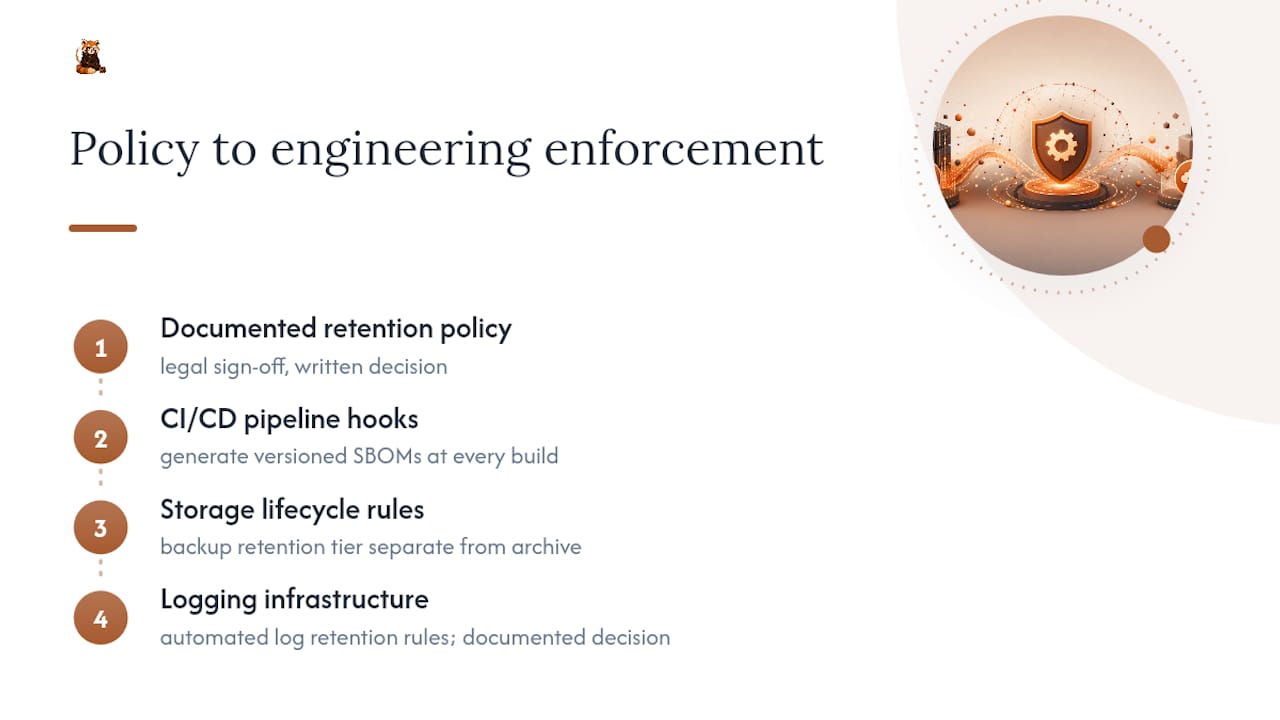
Retention policy conversations tend to happen in legal’s conference room, but the actual enforcement lives entirely in engineering: your CI/CD pipeline, your storage lifecycle rules, your logging infrastructure. That gap is where most policies quietly fail. A document legal signed off on means nothing if no pipeline hook ever enforces it.
The real trade-off engineering teams face isn’t compliance versus speed. It’s observability versus retention risk. Every log stream you keep “just in case it’s useful for debugging” is also a dataset an attacker can steal and a liability you have to defend during an audit. The teams that get this right treat logging retention as a deliberate, documented decision, not a default setting nobody revisited since the project started.
If you’re a small team with no dedicated compliance function, don’t try to build the whole program at once. Start with three things: automated log retention rules, versioned SBOMs generated at every build, and a backup retention tier separate from your archive tier. Those three alone cover the categories most likely to surface in an audit or an incident, and they’re the easiest to automate with tools you probably already have.
A tool like this can help by scanning your repository for compliance gaps, such as exposed secrets or missing SBOM generation, that undermine a retention policy before you even get to enforcing it.
— Vibeprod
Get Your Repository Audit Before You Finalize a Retention Policy
A retention schedule only protects you if the systems underneath it are actually secure. Exposed secrets, missing authentication checks, or unpatched dependencies can turn a well-documented retention program into a breach report, regardless of how carefully you wrote your legal-hold process.
Vibeprod scans your GitHub repository for exactly the kinds of launch risks that retention policies alone can’t catch: exposed secrets, compliance gaps, and CI/CD misconfigurations that put your retained data at risk in the first place. It generates reviewable pull requests with plain-English explanations, so you can fix what’s broken without touching your existing features, and get a clear read on your repository’s production readiness in under two minutes.
If you’re a solo founder or a small engineering team drafting your first retention policy, pair that policy work with a repository scan. The paperwork only matters if the systems behind it hold up.
Sources
For legal citations, the HIPAA retention policy from Columbia University and the ICO’s storage limitation guidance offer direct language you can cite when justifying schedule rows. For a ready-made template, the ComplyJet retention guide includes sample schedule rows you can adapt. For SBOM specifics, CISA’s minimum elements guidance is the primary technical reference auditors expect you to know. If you handle sensitive vendor data storage, BabyLoveRaise’s guide to secure data rooms walks through practical storage safeguards worth pairing with your schedule.
- CISA: Minimum elements for SBOMs (2026)
- HIPAA privacy record retention policy (Columbia University)
- Creating a Data Retention Policy That Meets Privacy Requirements (ACC Guide)
- Data Retention Policy: Definitive Guide + Free PDF Template (ComplyJet, 2026)
FAQ
What Is the Best Practice for a Data Retention Policy?
Pair a short overarching policy with a detailed retention schedule that lists every data category, its legal basis, and its destruction method, and back it with a written, testable legal-hold process. Review the whole program annually and after major triggers like a breach or regulatory change.
What Are the Legal Requirements for Data Retention?
Requirements vary by data type and jurisdiction, but common anchors include HIPAA for health records, SOX and IRS rules for financial records, and GDPR’s storage limitation principle for personal data tied to EU residents. Always document the specific legal basis behind each retention period you set.
How Long Should Data Be Retained For?
It depends on the category: common minima are around seven years for many financial records, six years for health records, and employment duration plus seven years for HR records. When multiple rules apply to the same dataset, retain for the longest period any single requirement demands.
What Is the GAAP Record Retention Policy?
Generally Accepted Accounting Principles don’t set a single fixed retention period on their own; retention timing for financial records is typically driven by IRS and SOX-related recordkeeping expectations, most commonly around seven years for supporting documentation and tax filings.