Compliance Risk in Codebases Explained for Dev Teams
Compliance risk in codebases is the likelihood that your software contains unauthorized, insecure, or noncompliant components that expose your organization to legal penalties, security breaches, and regulatory violations. It is not a theoretical concern. An audit of enterprise codebases found that 83% contained previously undetected open source license violations or high-risk security vulnerabilities, and most teams have no idea until an audit or acquisition surfaces the damage.
The risk breaks down across three dimensions:
- Legal exposure: Open source licenses like GPL, AGPL, and LGPL impose obligations on distribution and network service delivery. Violating them constitutes copyright infringement under 17 U.S.C. § 501.
- Security vulnerabilities: Third-party and open source components carry CVEs catalogued in the National Vulnerability Database (NVD). Your code inherits every flaw in every dependency.
- Regulatory nonconformity: Frameworks like PCI DSS, HIPAA, and CMMC hold you accountable for the security properties of all code running in scope, regardless of whether you wrote it.
Compliance is not a one-time audit. It is ongoing governance woven into every phase of development.
What compliance risks are hiding in your codebase right now?
Modern software is assembled, not written from scratch. That assembly creates exposure at every layer.
96% of commercial codebases contain open source components, with 54% showing license conflicts and 31% including components with no discoverable license at all. The most common failure points:
- Transitive dependency blindness: A single
npm installof a mid-sized framework can pull in 400+ transitive packages, most of which go unscanned. Your direct dependencies may all be MIT-licensed while a third-level dependency carries AGPL. - Copied code snippets: Developers copy functions from Stack Overflow or GitHub gists without tracking license obligations. These embedded snippets are completely invisible to standard dependency scanners.
- AGPL in SaaS codebases: AGPL v3’s network clause means running modified AGPL software as a service triggers source disclosure obligations, even without distributing anything. Most legal teams treat it as a blocker requiring explicit clearance.
- License conflicts: GPL combined with proprietary code creates a viral obligation to open-source your entire product.
- Regulatory scope creep: PCI DSS v4.0 Requirement 6.3 mandates vulnerability management covering all software components, including open source. HIPAA’s Security Rule (45 C.F.R. § 164.308) requires risk assessment across all ePHI-handling systems.
A 2025 audit found that 83% of enterprise codebases contained significant, previously undetected open source license violations or high-risk security vulnerabilities.
The scope of third-party code risk spans security posture, license compliance, and regulatory alignment simultaneously. Treating any one dimension in isolation leaves the other two exposed.

How to manage compliance risks throughout the SDLC
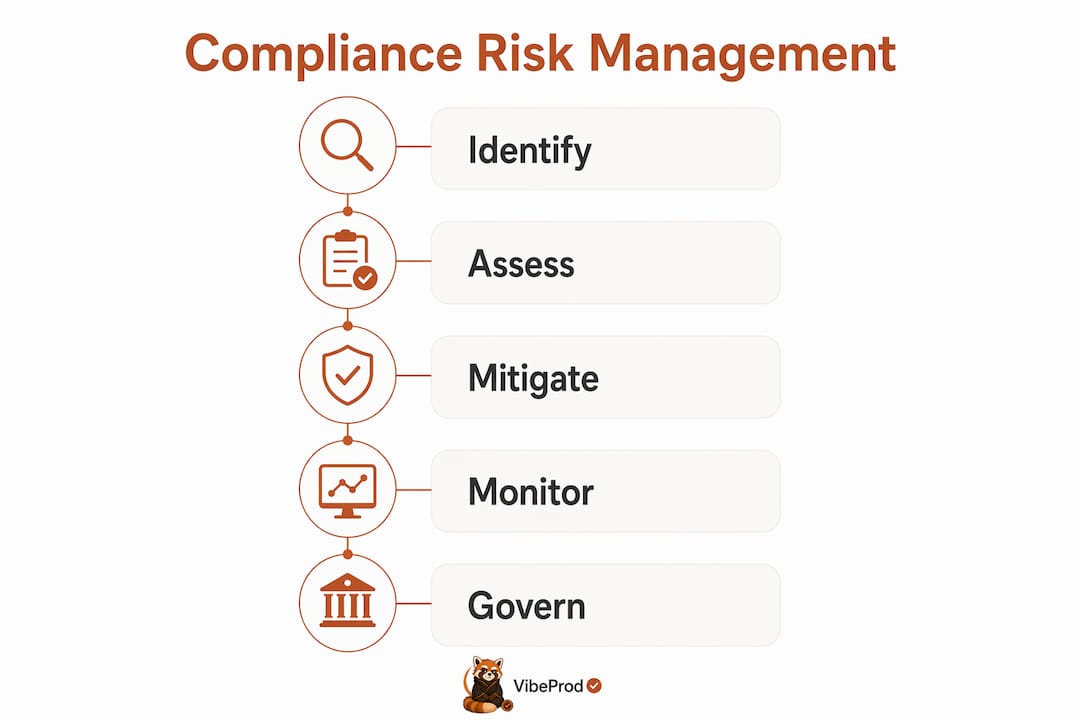
The NIST Secure Software Development Framework (SSDF), documented in NIST SP 800-218, is the clearest published guidance on where compliance governance belongs: integrated throughout every SDLC phase, not bolted on at deployment. SEI Carnegie Mellon’s Security Engineering Framework reinforces the same principle, identifying third-party component risk management as a discrete engineering goal starting at requirements definition.
Shifting compliance left reduces both cost and remediation complexity. Key practices by phase:
- Design: Define an OSS license policy with approved, conditionally approved, and prohibited tiers before a single dependency is added.
- Implementation: Run Software Composition Analysis (SCA) in the IDE so developers see license flags as they type
importorrequire. - CI/CD: Deep-scan every pull request diff, including full dependency tree resolution and code similarity checks for snippet provenance.
- Release: Generate a Software Bill of Materials (SBOM) as a release artifact. SPDX and CycloneDX are the two dominant machine-readable formats.
- Operations: Schedule recurring scans of production artifacts. Licenses change without announcement; what was Apache 2.0 in 2021 may carry different terms now.
Roles matter too. Compliance awareness cannot live only in a legal team. Developers need to understand why a GPL dependency in a distributed product is a legal event, not just a policy violation. Training that shows real court cases, like the 2024 Vizio settlement requiring source code release, lands differently than abstract policy documents.
Pro Tip: Combine automated SCA tooling with contractual controls. Vendor security questionnaires, signed penetration test attestations, and patch response SLAs in contracts address the risk that automated scanning alone cannot catch, particularly for commercial off-the-shelf components.
Legacy codebases present a specific challenge. Assumptions baked in years ago often predate modern transitive dependency complexity. A multi-layered scan of legacy code frequently surfaces AGPL or GPL contamination that has been in production for years. Treat legacy compliance as a discovery project before any acquisition, major release, or regulatory audit.
Effective strategies for reducing compliance risk in your code
Risk mitigation beats avoidance. Banning all external code is not a realistic option; managing it with rigor is.
- Generate and maintain an SBOM: Every build should produce a current inventory. Executive Order 14028 made SBOM a requirement for federal software suppliers, and it is becoming standard due diligence in M&A.
- Block builds on policy violations: Configure CI/CD to fail builds that introduce AGPL, GPL, or other blocked licenses, or that add dependencies with CVSS scores above your defined threshold. Make compliance a technical constraint, not a paperwork exercise.
- Triage by risk: Prioritize copyleft licenses in distributed products first, then critical CVEs, then license incompatibilities in internal tooling.
- Track snippet provenance: When copying more than a few lines from an external source, add a
// Source:comment with the URL and license. Run a scanner to find existing violations. - Scan containers and infrastructure-as-code: License obligations do not stop at application source. Base images and vendored binaries inside containers carry their own terms.
- Monitor license changes: A dependency can change its license without publishing a new version. Archive SBOM snapshots per release so you know exactly when a license changed relative to your deployment history. Tools like Renovate and Dependabot surface version bumps but not license changes, so a separate license-change check is needed.
Pro Tip: Assign compliance as a technical constraint at the architecture stage. An automated accessibility testing mindset applies here too: catching issues in the pipeline costs minutes; catching them post-deployment costs months.
Ongoing triage keeps the backlog manageable. Not every finding requires immediate remediation. A GPL conflict in an internal tool used by three people carries different urgency than the same conflict in a customer-facing SaaS product.
How Vibeprod helps you catch compliance gaps before they ship
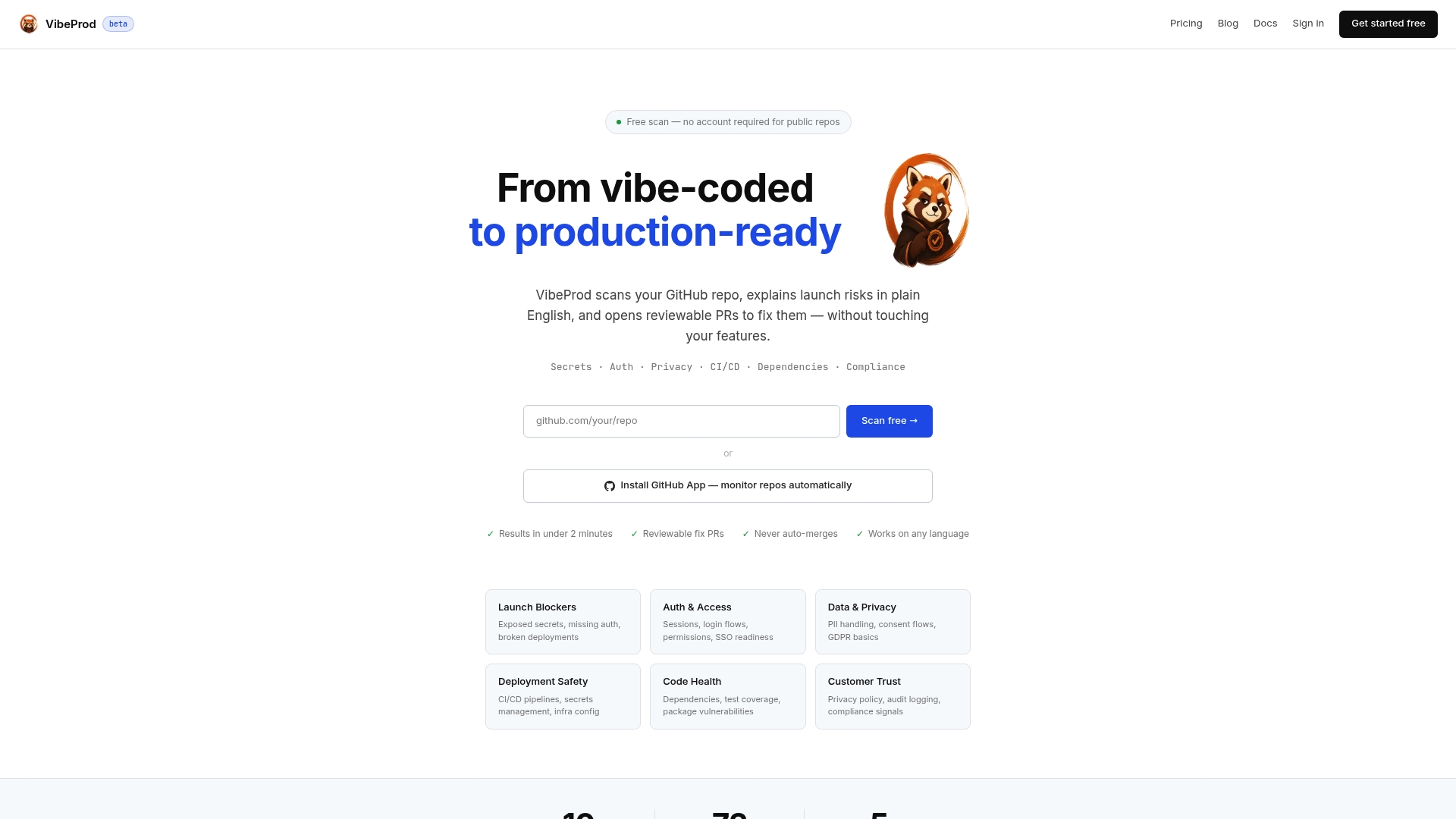
Vibeprod was built for exactly the gap between “it works” and “it’s production-ready.” By scanning your GitHub repositories, Vibeprod identifies compliance risks, exposed secrets, and security issues, then generates reviewable pull requests with plain-English explanations for each finding. You see what the problem is, why it matters, and what to fix, without touching your existing features.
Key capabilities:
- Multi-layered dependency scanning: Vibeprod goes beyond direct dependencies to surface transitive risks buried several levels deep in the dependency graph.
- Snippet provenance detection: Copied code with undeclared licenses gets flagged, not just package manifest entries.
- Continuous SBOM generation: Every scan produces an up-to-date inventory, so your compliance posture reflects the current state of the codebase.
- CI/CD integration: License policy enforcement and vulnerability blocking happen in real time, at the pull request stage, before anything merges.
- Results in under two minutes: Fast enough to fit into any development workflow without slowing your team down.
For solopreneurs and small dev teams, Vibeprod removes the need for a dedicated compliance function. You stay focused on core business logic while the production readiness checks run automatically.
Key Takeaways
Compliance risk in codebases requires continuous governance across license, security, and regulatory dimensions, not a single end-of-sprint checklist.
| Point | Details |
|---|---|
| — | 83% of enterprise codebases contain undetected license violations or security vulnerabilities. |
| Transitive dependencies are the main blind spot | A single package install can pull in 400+ transitive packages, most of which go unscanned. |
| AGPL is a SaaS-specific blocker | AGPL’s network clause triggers source disclosure for SaaS deployments; treat it as requiring legal clearance. |
| SBOM is the foundation | Generate a Software Bill of Materials on every build to maintain continuous visibility into your software supply chain. |
| Shift compliance left | NIST SSDF and SEI Carnegie Mellon both recommend integrating compliance governance throughout the SDLC, not after deployment. |
FAQ
What is compliance risk in a codebase?
Compliance risk in a codebase is the threat that software contains components with license violations, security vulnerabilities, or regulatory nonconformities that expose the organization to legal penalties or operational disruption.
Why do transitive dependencies create hidden compliance risks?
Transitive dependencies are packages pulled in by your direct dependencies, not by you directly. A single install can introduce hundreds of packages, some carrying AGPL or GPL licenses that your direct dependency manifest never shows.
Which regulations apply to open source components in software?
PCI DSS v4.0 Requirement 6.3, HIPAA’s Security Rule (45 C.F.R. § 164.308), and CMMC all hold organizations accountable for the security and compliance properties of all code in scope, including open source and third-party components.
Is automated scanning enough to manage compliance risk?
Automated scanning is necessary but not sufficient. Contractual and procedural controls, including vendor security questionnaires and penetration test attestations, are also required to cover risks that tooling cannot detect.
How does an SBOM help with ongoing compliance?
A Software Bill of Materials gives you a current, machine-readable inventory of every component and its license. Archiving SBOM snapshots per release lets you pinpoint exactly when a license changed relative to your deployment history, which is critical during audits and cloud compliance reviews.