Codex Generated Code Security Review: 2026 Guide
TL;DR:
- A security review of AI-generated code identifies vulnerabilities, dependencies, and architectural issues before deployment. Roughly 45% of such code contains exploitable flaws, requiring comprehensive automated and manual verification. Implementing layered, isolated reviews ensures safer transition from prototype to production.
A codex generated code security review is the systematic process of identifying exploitable vulnerabilities, architectural flaws, and compliance gaps in AI-produced code before it reaches production. Roughly 45% of AI-generated code introduces known security flaws including SQL injection, cross-site scripting, and broken access control. That number means functional code is not the same as safe code. The review process combines automated scanning, threat modeling, and human-in-the-loop validation to close that gap. Industry standards like OWASP Top 10 and NIST SP 800-218 (Secure Software Development Framework) define the baseline criteria every review should satisfy.
What are the primary security risks in Codex-generated code?
Codex outputs carry a distinct set of risks that differ from bugs a human developer typically introduces. The model generates code that compiles and runs correctly, which creates a false sense of security. The actual threat profile runs deeper.
Common vulnerability patterns in Codex outputs include:
- SQL injection and XSS. Codex frequently produces database queries and HTML rendering logic without parameterized inputs or output encoding.
- Broken access control. Auth flow logic generated by Codex often lacks role checks on middleware routes, leaving endpoints exposed.
- Cryptographic misuse. The model defaults to deprecated algorithms like MD5 or generates hardcoded keys when context is ambiguous.
- Insecure deserialization. Codex-produced parsers for JSON or YAML inputs rarely include type validation or size limits.
Beyond these standard CVE categories, Codex introduces AI-specific risks that traditional static analysis tools miss entirely. Hallucinated packages are one example: Codex sometimes references npm or PyPI packages that do not exist. An attacker can register that package name and inject malicious code into your dependency tree. Architectural drift is another: Codex generates code that works in isolation but violates the trust boundaries of your existing system, such as calling internal services directly instead of routing through an API gateway.
Contextual poisoning is the most underappreciated risk. When the Codex agent processes untrusted repository content, such as malicious READMEs, issue descriptions, or log files, those inputs can function as executable instructions. The agent then produces code that reflects the attacker’s intent rather than yours.

Pro Tip: Run threat modeling on your Codex outputs before automated scanning. Map the trust boundaries in your architecture first, then evaluate whether the generated code respects them.
What tools and environments support effective code security assessment?
The right environment is as important as the right tool. Running a security review inside your main development environment defeats the purpose: a compromised agent can read credentials, write files, or make outbound network calls before you catch it.
Agentic security tools achieve a 70% detection rate for seeded and historical vulnerabilities, outperforming traditional static tools on complex issues like SSRF and CORS misconfigurations. That detection rate reflects a meaningful advance over rule-based SAST scanners, which miss context-dependent flaws. The key differentiator is that agentic tools explore codebase architecture and trust boundaries from first principles rather than matching patterns against a fixed rule set.
Best practice is to run Codex agents within isolated, ephemeral sandboxes or containers. This prevents unauthorized file access and blocks outbound network requests that could exfiltrate data. File-path restrictions alone are not sufficient.
| Review layer | What it covers | When to apply |
|---|---|---|
| Secret detection | Hardcoded API keys, tokens, credentials | Before every commit |
| Dependency validation | Package existence, known CVEs, license compliance | At PR creation |
| Static analysis (SAST) | Injection flaws, logic errors, insecure patterns | Automated in CI/CD |
| Dynamic analysis (DAST) | Runtime behavior, auth bypass, input handling | Pre-staging environment |
| Manual diff review | Architectural consistency, trust boundary violations | Final human sign-off |
Advanced agentic tools use project-specific threat modeling and sandbox validation to reduce false positives, with high-severity findings confirmed below 0.1% of scanned commits. That precision matters because alert fatigue is a real risk: developers who see too many false positives start ignoring warnings.
Pro Tip: Never give your security review agent write access to your production repository. Use a read-only clone in an ephemeral container, then apply confirmed fixes manually or through a reviewed pull request.
How to perform a step-by-step security review of Codex-generated code
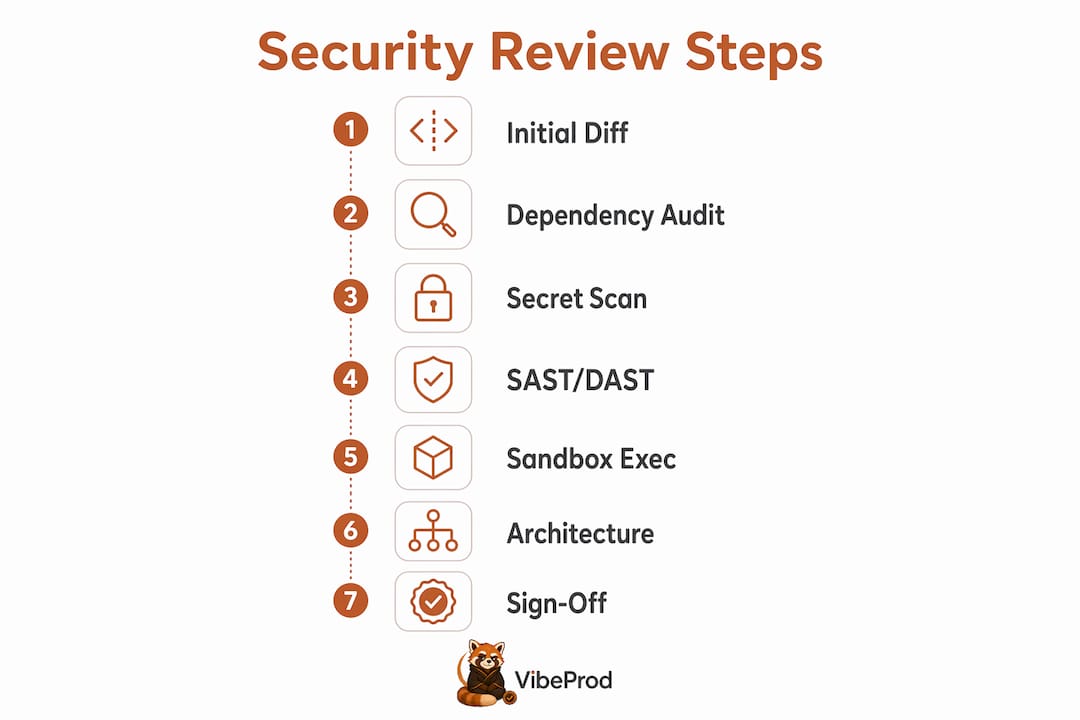
A structured review process removes guesswork and creates an auditable record. The following sequence applies whether you are reviewing a single function or an entire feature branch.
1. Initial code diff inspection. Pull the exact diff Codex generated. Read every line before running any tool. Look for unexpected imports, hardcoded values, and any logic that touches auth, payments, or data storage. This step takes ten minutes and catches the most obvious issues immediately.
2. Dependency audit. Run your package manager’s audit command (npm audit, pip-audit, or bundler-audit) against the updated dependency list. Cross-reference any new packages against the PyPI or npm registry to confirm they exist and are maintained. Flag any package Codex introduced that has fewer than 500 weekly downloads or no public repository.
3. Secret and credential scan. Use a dedicated secret detection tool to scan the diff for API keys, tokens, database connection strings, and private keys. Human-in-the-loop review remains critical here because automated tools miss context-dependent patterns, such as a key embedded inside a base64-encoded string.
4. Automated SAST and DAST scan. Run your SAST tool against the changed files. Then deploy the code to a sandboxed staging environment and run DAST against live endpoints. Codex Security surfaces high-confidence, evidence-based vulnerabilities after sandbox validation, which reduces false positives and focuses your attention on verified critical issues.
5. Sandbox execution and threat model validation. Execute the code in an isolated container with network egress blocked. Simulate the threat scenarios you identified in your threat model: unauthenticated requests, oversized inputs, malformed JSON, and privilege escalation attempts. Document every test case and its result.
6. Architectural consistency check. Confirm the generated code respects your system’s trust boundaries. Verify that internal service calls route through the correct middleware, that new database queries use parameterized statements, and that any new API endpoints enforce the same auth policy as existing ones.
7. Human sign-off and traceability. A senior developer or security engineer reviews the full audit trail before merging. The sign-off should be logged with the specific checklist items confirmed. This creates the traceability record that compliance frameworks like SOC 2 and ISO 27001 require.
Practitioners recommend operationalizing these reviews within shift-left security programs that integrate SAST, DAST, and SCA tooling for comprehensive coverage. Shift-left means catching issues at the PR stage, not after deployment.
What common mistakes should developers avoid when reviewing Codex code?
The most expensive mistake is treating a passing test suite as a security clearance. Codex code can be functionally correct and still carry a critical vulnerability. Zero-trust toward AI outputs is not paranoia. It is the only defensible posture given the 45%–55% vulnerability rate in AI-generated code samples.
Mistakes that undermine review effectiveness:
- Skipping the dependency check. Hallucinated packages are a real attack vector. If you do not verify every new dependency, you are trusting the model’s memory over the actual registry.
- Giving the review agent network access. An agent that can make outbound calls during review can exfiltrate code, credentials, or internal architecture details.
- Mixing code generation and code review in the same session. The context window from generation bleeds into review. Use separate sessions and separate environments for each task.
- Ignoring low-severity findings. Codex-generated code often chains low-severity issues into exploitable attack paths. A missing input validation combined with an overly permissive CORS policy becomes a serious problem.
Treat every Codex agent as an untrusted user operating inside your codebase. Adopt sandbox and ephemeral container environments to isolate it and prevent exfiltration risks. Directory restrictions alone are not a sufficient boundary. The agent’s access scope should be the minimum required to complete the task, nothing more.
The prompt injection risk deserves special attention. If your Codex agent reads from a repository that includes user-generated content, such as issue comments or pull request descriptions, an attacker can embed instructions in that content. Those instructions can redirect the agent’s behavior without your knowledge. Audit every input source the agent touches, not just the code files.
Key Takeaways
A structured, layered security review is the only reliable method for moving Codex-generated code from prototype to production without introducing exploitable vulnerabilities.
| Point | Details |
|---|---|
| Vulnerability rate is high | Roughly 45% of AI-generated code contains known security flaws, so manual verification is non-negotiable. |
| Isolate the review environment | Run security agents in ephemeral containers with no network egress to prevent credential or code exfiltration. |
| Agentic tools outperform SAST | Agentic scanners achieve a 70% detection rate on complex vulnerabilities that rule-based static tools miss. |
| Human sign-off closes the gap | Automated tools reduce noise, but human-in-the-loop review catches context-dependent flaws and ensures traceability. |
| Zero-trust is the baseline | Treat every Codex output as untrusted until it passes dependency audit, secret scan, SAST, DAST, and architectural review. |
The review step that most developers skip
After working with AI-assisted development pipelines, the pattern that stands out most is not the vulnerability types. It is the confidence gap. Developers who use Codex ship faster than ever, and that speed creates a psychological bias: if the code works, it must be fine. That assumption is wrong, and the data confirms it.
The step most developers skip is architectural consistency review. They run a SAST scan, check for secrets, and call it done. But Codex does not understand your system’s trust model. It generates code that solves the immediate problem without knowing that your internal billing service should never be called directly from a public-facing route. That kind of structural flaw does not show up in a CVE database. It shows up in a post-incident review after a breach.
The other lesson worth sharing: agentic security tools are genuinely useful, but they are not a replacement for a developer who understands the codebase. The 70% detection rate is impressive. The 30% miss rate is the part that should keep you careful. Build your review process so that the human step happens after the automated step, not instead of it.
Integrating Codex security review into your SDLC with traceability, policy enforcement, and documented sign-off is not overhead. It is the difference between a prototype and a product you can stand behind. The path from vibe-coded to production-ready requires that discipline, and the teams that build it early spend far less time on incident response later.
— Vibeprod
Vibeprod makes Codex code production-ready
Shipping AI-generated code fast is only half the job. The other half is knowing what you are actually deploying.
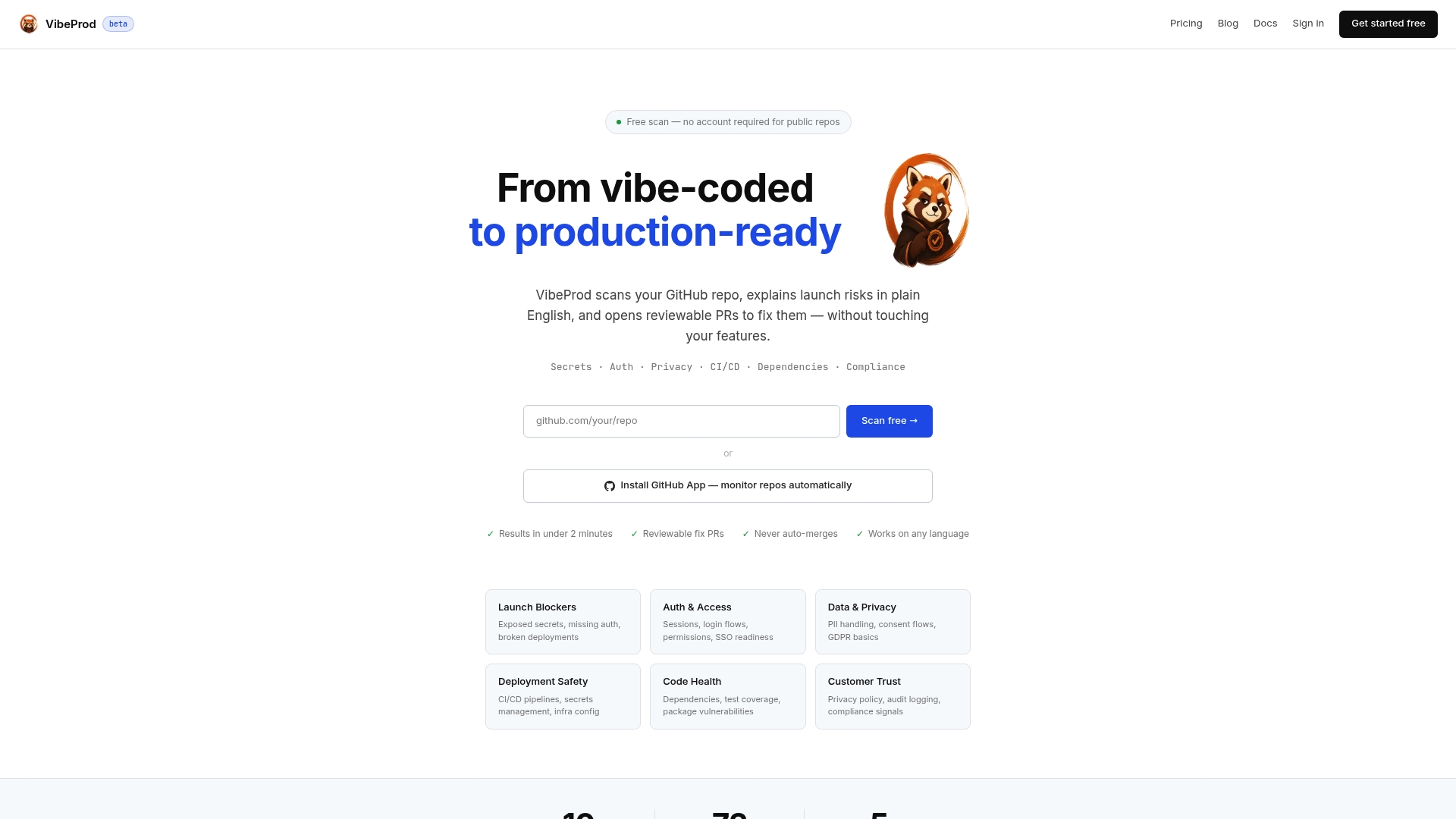
Vibeprod scans your GitHub repository and surfaces launch risks, including exposed secrets, broken access control, and compliance gaps, in under two minutes. It generates reviewable pull requests with plain-English explanations for every issue it finds, so you understand the problem before you fix it. No existing features get altered. You stay focused on your core product while Vibeprod handles the security layer that AI code generation tools skip. For developers moving from prototype to production-ready software, that coverage is the gap between shipping confidently and shipping blind.
FAQ
What is a Codex generated code security review?
A Codex generated code security review is a structured process that identifies vulnerabilities, dependency risks, and architectural flaws in AI-produced code before deployment. It combines automated scanning, sandbox validation, and human-in-the-loop verification.
Why does Codex-generated code need a separate security review?
Roughly 45% of AI-generated code contains exploitable security flaws despite being functionally correct. Codex does not understand your system’s trust boundaries, so it can generate code that passes tests but violates your security model.
What is prompt injection in the context of Codex agents?
Prompt injection occurs when the Codex agent processes untrusted content, such as malicious READMEs or issue comments, and treats those inputs as instructions. This can redirect the agent’s behavior and introduce vulnerabilities without the developer’s awareness.
How effective are agentic security tools at finding Codex vulnerabilities?
Agentic security tools achieve a 70% detection rate on complex vulnerabilities like SSRF and CORS misconfigurations, outperforming traditional static analysis tools. They work by exploring codebase architecture from first principles rather than matching fixed rule patterns.
What is the minimum review checklist for Codex-generated code?
Every Codex output should pass dependency validation, secret detection, SAST scanning, sandboxed execution, and a manual architectural consistency check before merging. Human sign-off with a documented audit trail satisfies most compliance framework requirements.