Code Security After AI Generation Explained for Developers

TL;DR:
- AI-generated code contains many security flaws, with nearly 32% being fully exploitable. Developers must implement automated gates, human review, and dependency scans to secure code before deployment. Vibeprod helps by quickly analyzing repositories and providing actionable fix reports within minutes.
Code security after AI generation is defined as the practice of identifying and fixing vulnerabilities introduced by AI-generated code before that code reaches a production environment. Roughly 31.6% of AI-generated code samples contain fully exploitable security flaws. That number means nearly one in three code samples your AI tool produces could be weaponized by an attacker the moment you ship it. The industry term for this discipline is AI code security validation, and it sits at the intersection of static analysis, supply chain security, and governance policy. Developers and technical founders who treat AI output as trusted, production-ready code are taking on risk they cannot see.
What are the common security risks in AI-generated code?
AI-generated code fails in predictable patterns. Knowing those patterns is the first step toward protecting AI-generated code before it causes real damage.
The most frequent vulnerability types include:
- Injection flaws. SQL injection (SQLi) and cross-site scripting (XSS) appear regularly in AI output because AI models optimize for functional correctness, not input sanitization. A model that produces a working database query often skips parameterization entirely.
- Hardcoded credentials. AI-assisted commits expose hardcoded credentials at more than twice the rate of human-only commits, at 3.2% versus 1.5%. That gap contributed to a 34% year-over-year increase in public GitHub credential leaks in 2025.
- Missing authorization checks. AI models generate auth flows that look complete but skip ownership validation, role checks, or tenant isolation. The code compiles and runs. The security hole is invisible until someone exploits it.
- OWASP Top 10 patterns. Broken access control, security misconfiguration, and insecure deserialization all appear with high frequency in AI output. These are not exotic bugs. They are the same vulnerabilities that have topped security charts for a decade.
- Hallucinated dependencies. AI tools sometimes suggest package names that do not exist in any registry. Malicious actors register those names and inject harmful code that developers unknowingly download.
Pro Tip: Run a dependency audit with a tool like npm audit or pip-audit immediately after any AI-generated code adds new packages to your project. Do not wait for CI/CD to catch it.
The number of CVEs attributed to AI-generated code rose from 6 in january 2026 to 35 by march 2026. That acceleration reflects how fast AI code is moving into production without adequate review.

How do AI-generated code vulnerabilities compare to human-written code?
AI code is not simply “as risky as human code.” The risk profile is different in structure and scale.
Average AI models produce secure code only 59.8% of the time, while the best-performing models reach 83.9% secure output. That still leaves a meaningful gap even at the top end. Human developers, by contrast, benefit from contextual awareness: they know the business logic, the threat model, and the edge cases that a model trained on generic code cannot infer.
The table below compares key characteristics of AI-generated versus human-written code from a security standpoint.
| Characteristic | AI-generated code | Human-written code |
|---|---|---|
| Credential exposure rate | 3.2% of commits | 1.5% of commits |
| Secure output consistency | 59.8% average across models | Varies by developer skill |
| Authorization check completeness | Frequently missing | Typically present with review |
| Dependency accuracy | Risk of hallucinated packages | Generally verified manually |
| Review speed | Fast generation, slow fix time | Slower generation, familiar review |
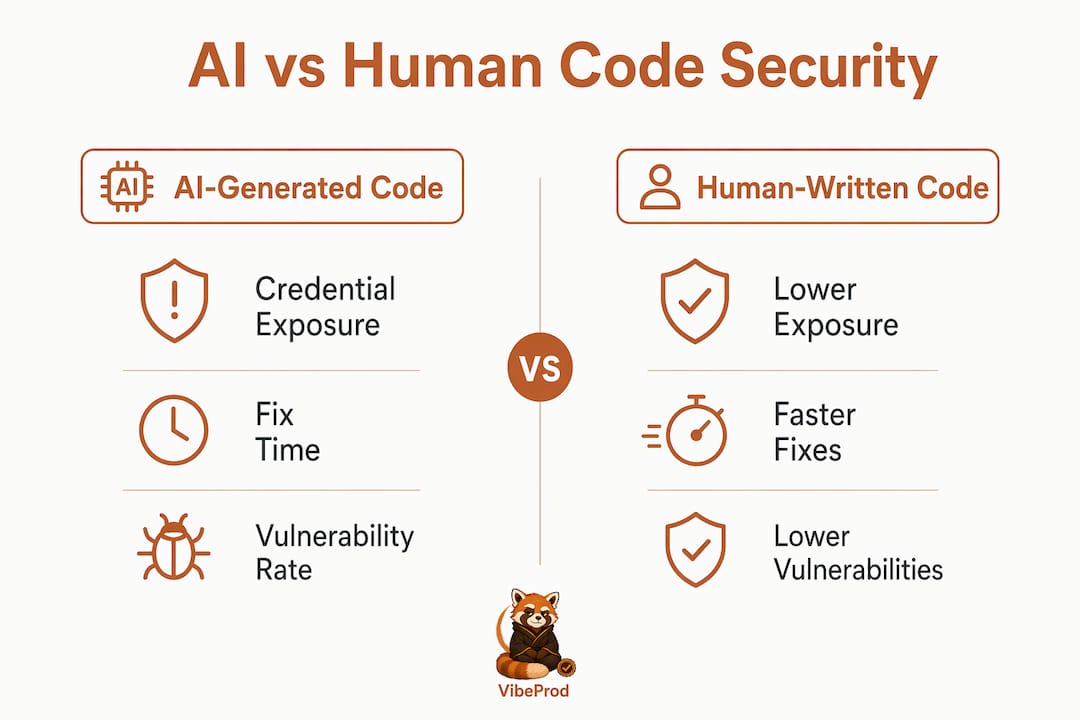
66% of developers report increased fix time for AI-generated code compared to code they wrote themselves. The “almost right” problem is real: AI code looks correct, passes a quick read, and then breaks in production under edge conditions a human reviewer would have caught.
AI also accelerates commit velocity. More code merges faster, which means human reviewers have less time per line. That dynamic compounds the risk. Security-focused prompt engineering can improve model output, but AI models never refuse to generate code, so a poorly framed prompt always produces something, and that something may be dangerous.
What governance and pipeline practices effectively secure AI-generated code?
Securing AI code requires process changes, not just tool additions. The following steps form a practical governance framework for developers and technical founders.
-
Add blocking SAST gates to your CI/CD pipeline. Static application security testing (SAST) must run on every pull request and block merges when critical issues appear. AI-aware CI/CD pipelines that include SAST, software composition analysis (SCA), and secret scanning are the baseline for any team shipping AI-assisted code.
-
Automate secret detection pre-commit. Automated secrets detection pre-commit gates catch hardcoded credentials before they ever reach a remote repository. Tools like git-secrets or Gitleaks integrate directly into your local workflow.
-
Enforce policy-as-code at merge boundaries. Define what “secure enough to merge” means in machine-readable policy files. Open Policy Agent (OPA) and similar frameworks let you codify rules like “no merge if secrets detected” or “no merge without SCA passing.”
-
Maintain human review for architecture and logic. Automated gates catch syntactic and known-pattern issues. Human reviewers catch business logic errors, missing authorization flows, and architectural decisions that no scanner understands. Focus your reviewers on those layers, not on formatting.
-
Track AI code provenance. Log which code blocks were AI-generated, which model produced them, and what prompt was used. This audit trail matters for compliance and for post-incident analysis when something goes wrong.
-
Run dynamic analysis before production. Dynamic application security testing (DAST) exercises running code against attack patterns. SAST finds what the code says. DAST finds what the code does under pressure.
Pro Tip: Treat every AI-generated pull request as untrusted input by default. Require the same review depth you would apply to a contractor’s first submission. Trust is earned through a track record, not assumed from a tool.
Banning AI coding tools leads to shadow IT, where developers use them anyway without any oversight. The correct response is a clear policy that allows controlled use with defined security gates.
How do you handle semantic flaws and malicious dependencies in AI code?
Semantic flaws are the hardest AI code integrity issues to catch. They are not syntax errors. They are logic errors that look correct to a scanner and to a rushed reviewer.
Traditional SAST tools miss authorization and cross-service logic flaws introduced by AI code because those tools analyze code structure, not intent. A missing ownership check on a database query is syntactically valid. The query runs. The wrong user reads the wrong data. No linter flags it.
The mitigation steps for semantic flaws and supply chain risks include:
- Manual review of auth flows and multi-tenant logic. Any code that touches user identity, permissions, or data isolation deserves a dedicated review pass focused on “who can access what.”
- Dependency scanning with suspicious package detection. AI tools sometimes suggest hallucinated package names that do not exist in official registries. Malicious actors register those names to inject harmful code. Tools like Socket.dev or Snyk flag newly registered or suspicious packages before you install them.
- Microservice boundary reviews. AI-generated middleware often assumes trust between services. Explicitly verify that each service validates tokens and enforces its own authorization, rather than relying on an upstream service to have done it.
- Sandbox and isolate in production. For workloads that run AI-generated code at runtime, container isolation is not enough.
MicroVM technology provides hardware virtualization and kernel separation that containers cannot reliably deliver. MicroVMs protect multi-tenant workloads from kernel escape risks, making them the correct isolation boundary for any production environment running externally generated or agent-driven code.
Semantic flaws require you to think like an attacker, not a compiler. Ask “what happens if a malicious user calls this endpoint directly?” for every AI-generated route or API handler. That question surfaces gaps that no automated tool will find on its own.
Key Takeaways
Securing AI-generated code requires automated gates, human review of logic and authorization, and dependency scanning, applied before any AI-assisted code reaches production.
| Point | Details |
|---|---|
| AI code has high vulnerability rates | Roughly 31.6% of AI-generated samples contain fully exploitable flaws, requiring mandatory validation. |
| Credential leaks are a top risk | AI commits expose hardcoded secrets at twice the rate of human commits; use pre-commit secret scanning. |
| Semantic flaws evade scanners | SAST tools miss missing authorization and tenant isolation checks; human review of auth flows is required. |
| CI/CD gates are the baseline | Blocking SAST, SCA, and secret detection in every pipeline are non-negotiable before merge. |
| MicroVMs beat containers for isolation | Running AI-generated code in production requires microVM-level isolation to prevent kernel escape. |
What I’ve learned about AI code security in real-world shipping
The most dangerous assumption I see developers make is that a passing test suite means secure code. Tests verify behavior. They do not verify that the right user is allowed to trigger that behavior.
Security of AI-generated code improves meaningfully with security-focused prompts, guided human review, and automated CI/CD gates. That combination raises the floor. It does not eliminate the ceiling of what a determined attacker can find. The gap between “works” and “safe to ship” is where most incidents originate.
Treating AI output as untrusted input is not pessimism. It is the same discipline you apply to any third-party code. You would not merge a stranger’s pull request without review. AI output deserves the same skepticism, applied consistently, not just when something feels off.
The developers who ship safely with AI are not the ones who use it less. They are the ones who built a process around it before they needed one.
— Vibeprod
Vibeprod scans your AI code before it becomes a production problem
Shipping fast with AI is the goal. Shipping with exposed secrets, missing auth checks, and hallucinated dependencies is the risk you take without a validation layer between generation and deployment.
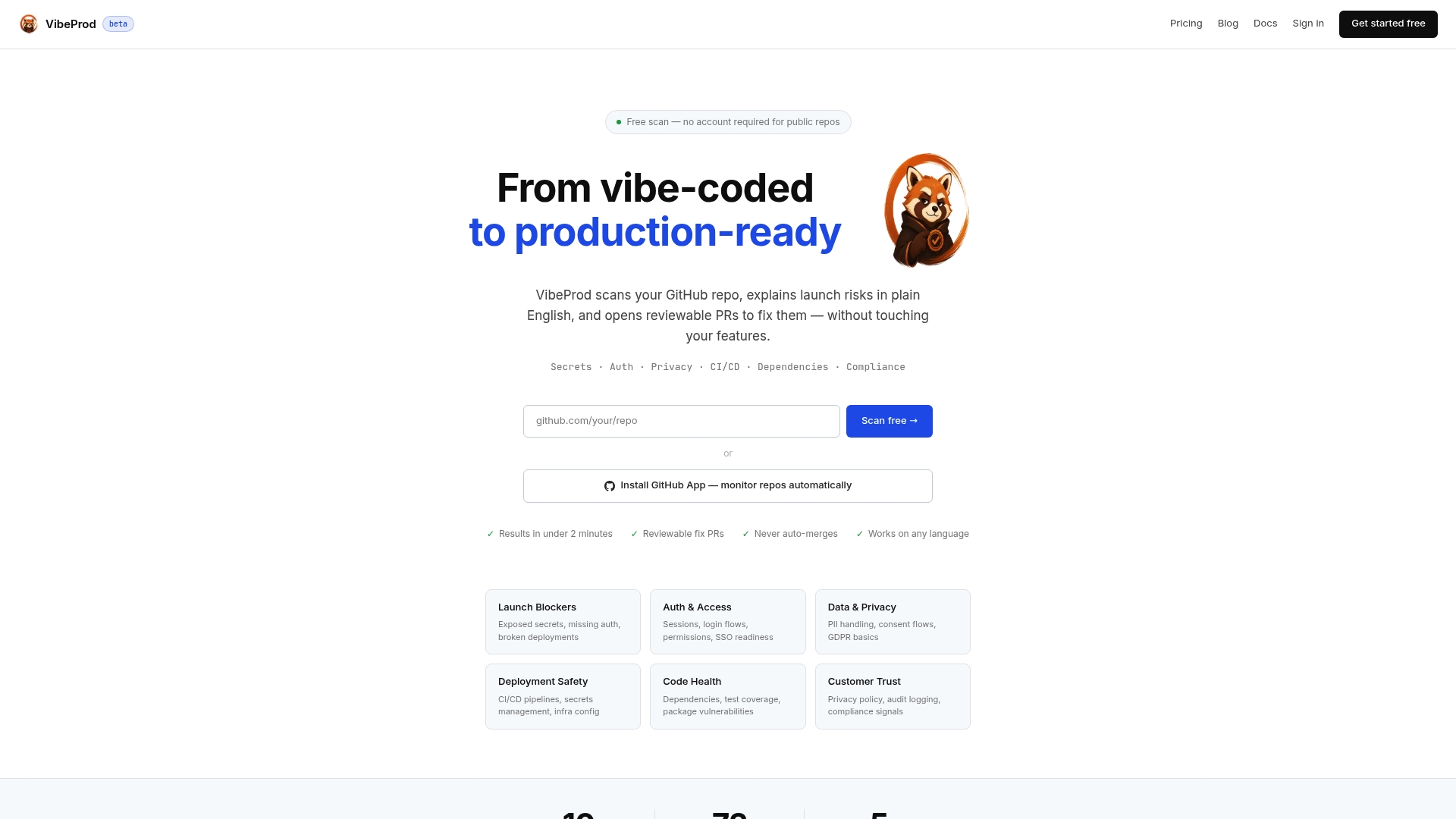
Vibeprod scans your GitHub repository, identifies launch risks like exposed credentials and compliance gaps, and generates reviewable pull requests with plain-English explanations for every issue it finds. It does not touch your existing features. It gives you a clear picture of what needs fixing before real users hit your app. The full scan takes under two minutes. For solopreneurs and small teams shipping AI-assisted code daily, that speed is the difference between a prototype and a product you can stand behind.
FAQ
What percentage of AI-generated code contains security vulnerabilities?
Roughly 31.6% of AI-generated code samples contain fully exploitable security flaws. Even the best-performing AI models leave nearly a 16% gap from a fully secure output rate.
Why do AI-generated code commits leak more credentials than human commits?
AI models optimize for functional output and do not apply the same contextual judgment a developer uses when handling sensitive values. AI-assisted commits expose hardcoded credentials at 3.2%, compared to 1.5% for human-only commits.
Can SAST tools catch all AI code vulnerabilities?
SAST tools miss semantic flaws like missing authorization checks and tenant isolation errors because those tools analyze code structure, not business logic. Human review of auth flows and cross-service logic remains necessary.
What is a hallucinated dependency in AI-generated code?
A hallucinated dependency is a package name suggested by an AI model that does not exist in any official registry. Malicious actors register those names to distribute harmful code that developers unknowingly install.
How does Vibeprod help secure AI-generated code?
Vibeprod scans GitHub repositories for exposed secrets, compliance issues, and launch risks, then generates pull requests with fixes and plain-English explanations, delivering results in under two minutes without altering existing features.