Code Review Benefits for Solo Projects: 2026 Guide

Code review is defined as a systematic examination of source code to find defects, security gaps, and maintainability issues before they reach production. Research shows code reviews reduce defects by up to 82%, making this practice as critical for solo developers as it is for large engineering teams. If you ship alone, you have no teammate to catch what you miss. That gap is exactly where code review earns its place in your workflow. Tools like GitHub, GitLab, Claude, and GPT-4 now make structured review feasible for a single developer, with no team required.
1. What are the measurable quality benefits of code review for solo projects?
Code review delivers concrete, trackable improvements to code quality. Peer review catches roughly 60–65% of defects before they reach production. That number alone justifies the time investment for any solo developer shipping real software.

Readability is another measurable gain. Code readability improves 15–20% when review is applied consistently. Readable code is easier to debug six months later, which matters when you are the only person maintaining it.
The most useful metric for solo developers is the post-merge defect escape rate: bugs found within 30 days after a merge. Tracking defect escape rates by configuration helps you avoid false assumptions about code quality. Without this number, you cannot tell whether your review process is actually working.
- Defect reduction: Up to 82% fewer defects with systematic review
- Readability gain: 15–20% improvement in code clarity
- Maintainability: Fewer undocumented edge cases and overlooked logic paths
- Escape rate tracking: 30-day post-merge defect counts validate your process
Maintainability compounds over time. Every issue you catch during review is one less piece of technical debt you carry into the next feature cycle.
2. How does code review improve security and reliability in solo projects?
Security review is not a one-time audit. It is a continuous quality gate embedded in every merge. NIST’s Secure Software Development Framework advises embedding secure coding and dependency management directly into your workflow rather than treating security as a separate process.
For solo developers, the highest-risk areas to review are:
- Authentication and authorization: Broken auth flows are the most common CVE category in solo-built web apps
- Input validation: Unvalidated user input creates SQL injection and XSS exposure
- Dependency management: Outdated packages with known vulnerabilities slip in fast when no one is watching
- Build controls: Hardcoded secrets and misconfigured environment variables are frequent launch blockers
Catching a vulnerability before deployment costs a fraction of what it costs to patch a live system. The NIST SSDF framework makes this concrete: integrating secure development practices into your usual CI/CD workflow is more effective than bolting on security checks at the end.
Pro Tip: Add a security-focused checklist item to every pull request, even when you are the only reviewer. Covering auth, input validation, and exposed secrets takes under five minutes and catches the issues that cost the most to fix later.
3. What role does AI-assisted code review play for solo developers?
AI tools have changed what is possible for solo developers reviewing their own code. AI tools like Claude and GPT-4 excel at spotting undefined variables, missing error handling, and logic errors. These are the mechanical checks that a tired solo developer is most likely to miss at 11 PM before a release.
The limitation is real, though. AI has trouble with architectural judgment and contextual decisions. Solo developers should keep architectural decisions human-centered while using AI for fast, mechanical issue detection. Trusting AI to approve a structural change is where defect rates climb.
A structured workflow prevents that mistake. Workflows with Scope, Generate, Verify, Review, and Release stages with merge-blocking checks improve reliability significantly. Here is how each stage works in practice:
- Scope: Define exactly what the change is supposed to do before writing a line
- Generate: Write or generate the code with your AI assistant
- Verify: Run linting, type checks, and unit tests automatically
- Review: Apply AI review plus your own human pass for architectural issues
- Release: Merge only after all checklist items pass
Pro Tip: Build a personal taxonomy of real findings from your AI reviews. Over time, refine your prompts to match your project’s specific context. Generic prompts produce generic feedback. Specific prompts catch real bugs.
4. What practical approaches can solo developers use for effective code review?
The biggest obstacle for solo developers is not skill. It is discipline. Experienced solo developers write documentation and review code as if it will be examined by someone else later. That mental shift changes how carefully you read your own work.
These approaches work in practice:
- Use pull requests even when working alone. Opening a PR forces you to write a description, which surfaces assumptions you did not know you were making.
- Wait before reviewing. Review code at least a few hours after writing it. Fresh eyes catch more than tired ones.
- Build an explicit checklist. Focus on high-risk areas: auth, input handling, error paths, and exposed secrets. A checklist removes the guesswork from what to look for.
- Add automated gates. Linting, type checks, and smoke tests run before human review. They handle the mechanical layer so your attention goes to logic and architecture.
- Set merge-blocking criteria. Explicit review gates and merge-blocking improve systematic quality over motivation-dependent random reviews. If the checklist is not complete, the merge does not happen.
Periodic external reviews add another layer. Even one session with a trusted developer every quarter catches blind spots that self-review cannot. You do not need a full team to get the benefit of a second set of eyes.
5. How do manual, AI-assisted, and hybrid code review methods compare?
Not every project needs the same review setup. The right method depends on your project’s complexity, risk level, and how much time you can spend per merge.
| Method | Strengths | Weaknesses | Best for |
|---|---|---|---|
| Manual solo review | Catches architectural and contextual issues | Slower, subject to fatigue and bias | Complex logic, auth flows, data models |
| AI-assisted review | Fast, consistent mechanical checks | Misses structural and contextual problems | Syntax, undefined variables, error handling |
| Hybrid strict mode | Combines speed with human judgment | Requires process discipline | Production-grade solo projects |
AI-only review configurations without human oversight can increase defect escape and incident rates. That finding is the clearest argument for hybrid setups. AI handles the mechanical layer fast. You handle the judgment calls.
For most solo developers shipping real products, hybrid strict mode is the right default. It reduces review time compared to manual-only review, while catching more than AI alone. The tradeoff is that it requires you to actually follow the process every time, not just when you feel like it.
Pairing AI review with linting, type checks, tests, and smoke tests creates verification gates that prevent false confidence. Without those gates, fast AI review can mask a degrading defect rate.
Key takeaways
Code review benefits solo projects most when it combines structured human judgment with AI-assisted mechanical checks and explicit merge-blocking criteria.
| Point | Details |
|---|---|
| Defect reduction is measurable | Peer review catches 60–65% of defects before production, with up to 82% reduction overall. |
| Security review must be continuous | Embed auth, input validation, and dependency checks into every merge, not just at launch. |
| AI handles mechanics, not architecture | Use Claude or GPT-4 for syntax and logic checks. Keep structural decisions human. |
| Track your escape rate | Measure bugs found within 30 days post-merge to validate whether your process works. |
| Hybrid strict mode outperforms both extremes | AI-only review increases defect escapes. Manual-only review is too slow. Hybrid wins. |
Vibeprod’s take on code review discipline for solo developers
The solo developer who skips code review is not saving time. They are borrowing it from their future self, at a high interest rate. Every bug that escapes to production costs more to fix than it would have cost to catch during review. That math does not change based on team size.
What I have seen consistently is that the developers who treat code review as optional are the same ones who spend weekends patching production incidents. The ones who build review into their process, even imperfectly, ship more reliably over time. The discipline compounds.
AI tools are genuinely useful here, but they require realistic expectations. Claude and GPT-4 are excellent at catching the mechanical issues you are most likely to miss when you are moving fast. They are not equipped to tell you whether your middleware architecture will hold up under real user load. That judgment is yours, and no tool replaces it.
The metric that matters most is the 30-day defect escape rate. Without tracking it, you cannot tell whether your review process is improving or just giving you the feeling of safety. Feelings are not a quality gate. Numbers are.
Build the habit before you need it. A review checklist costs you ten minutes per merge. A production security incident costs you days.
— Vibeprod
Vibeprod makes production readiness faster for solo developers
Solo developers ship fast. The gap between a working prototype and a production-ready product is where the real risks hide: exposed secrets, broken auth flows, missing input validation, and compliance issues that surface only after real users arrive.
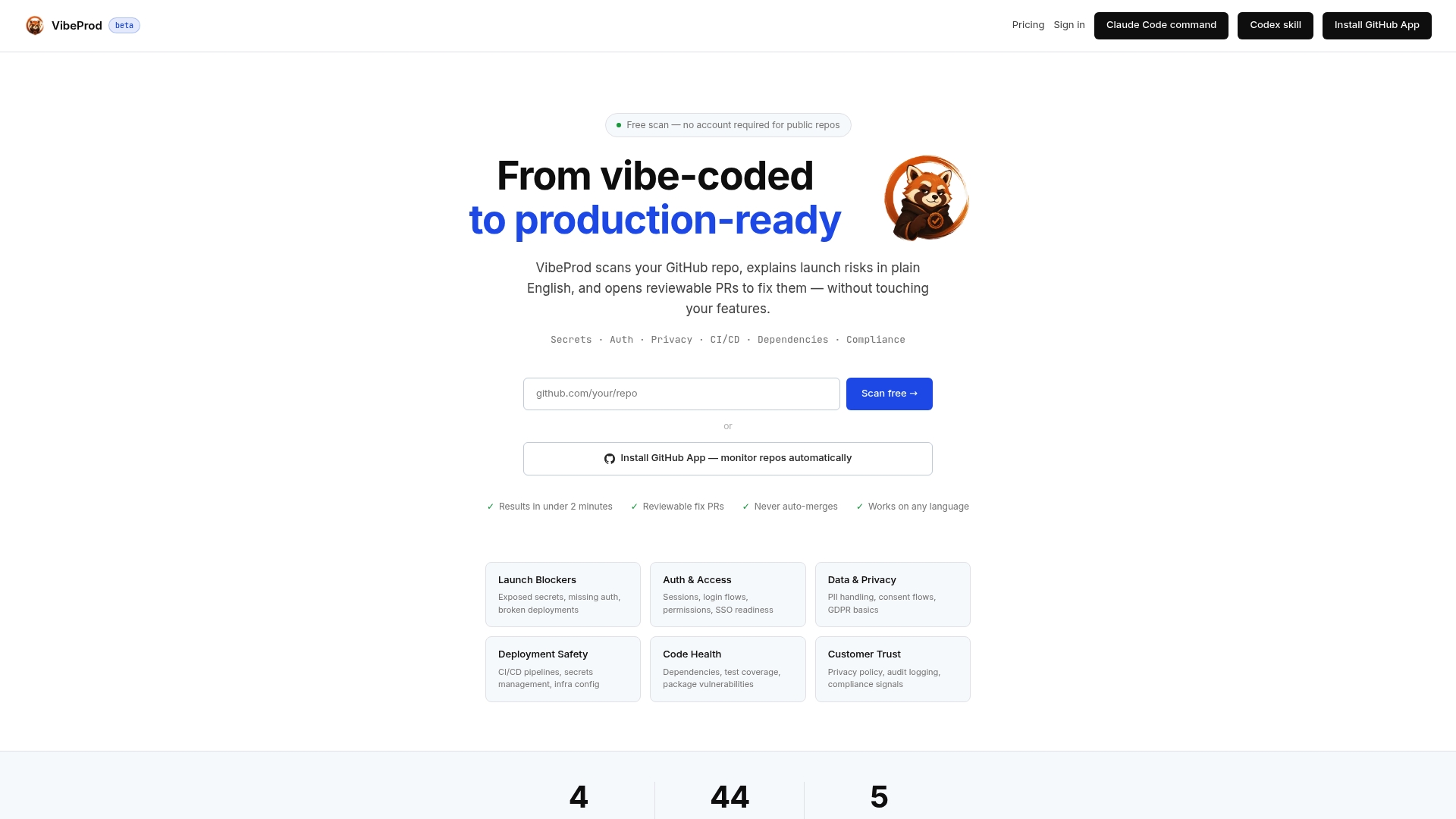
Vibeprod scans your GitHub repository, identifies those launch risks, and generates reviewable pull requests with plain-English explanations for every issue found. The process takes under two minutes and does not touch your existing features. You stay focused on your core product. Vibeprod handles the review layer that AI coding assistants consistently overlook. If you are shipping solo and want production-grade reliability without slowing down, Vibeprod is built for exactly that workflow.
FAQ
What are the main code review benefits for solo projects?
Code review reduces defects by up to 82% and improves code readability by 15–20%. For solo developers, it also catches security vulnerabilities before they reach production.
How can solo developers review their own code effectively?
Use pull requests even when working alone, wait a few hours before reviewing your own code, and apply an explicit checklist covering auth, input validation, and error handling.
Is AI-assisted code review reliable for solo developers?
AI tools like Claude and GPT-4 reliably catch mechanical issues such as undefined variables and missing error handling. They are not reliable for architectural or contextual decisions, so human review remains necessary.
What is a defect escape rate and why does it matter?
The defect escape rate measures bugs found within 30 days after a merge. Tracking it tells you whether your code review process is actually reducing defects or just creating the appearance of quality control.
How does the NIST SSDF apply to solo developer workflows?
The NIST Secure Software Development Framework advises embedding security practices like input validation and dependency management directly into your CI/CD workflow, making security a continuous part of development rather than a final check.