Code Evaluator for Indie Developers: Pre-Launch GitHub Scans
TL;DR:
- A code evaluator scans repositories for security and compliance risks, then provides plain-English findings and reviewable fixes. It checks for exposed secrets, vulnerabilities, misconfigurations, and data exposure while supporting fast, controlled integration with GitHub. The tool prioritizes reviewable pull requests over auto-merging to give teams full control before deployment.
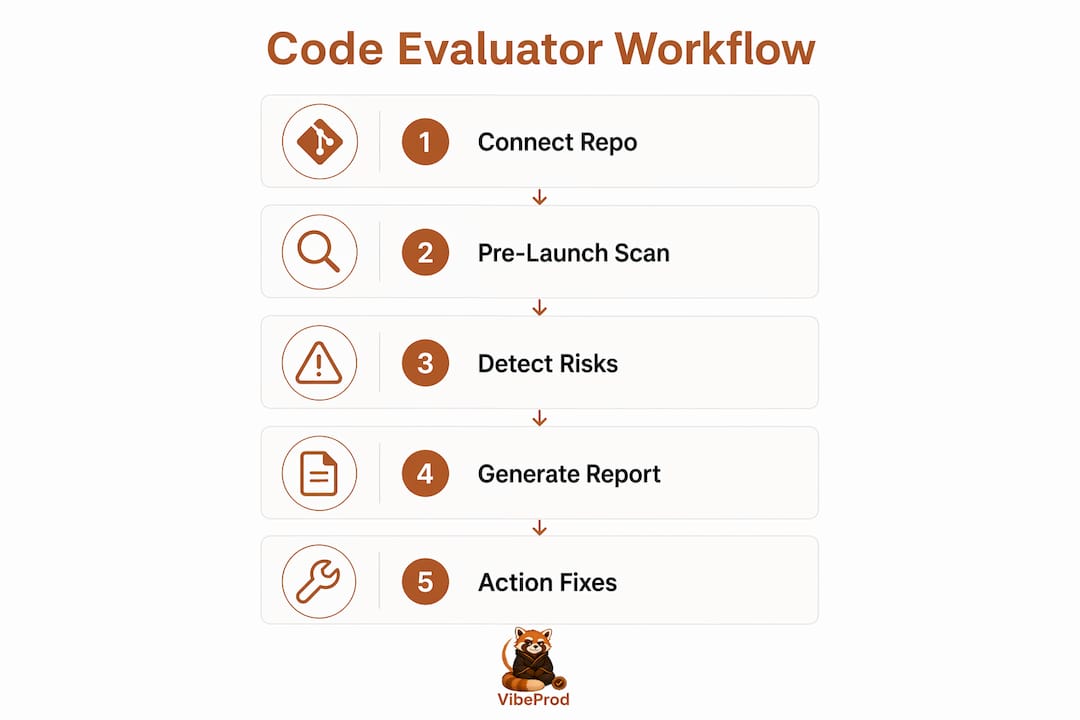
A code evaluator is an automated tool that scans your GitHub repository for launch risks — secrets, dependency vulnerabilities, CI/CD misconfigurations, PII exposure, and compliance gaps — and returns plain-English findings plus reviewable fix pull requests. For indie developers and small teams, the right approach is a GitHub-native app that opens non-destructive PRs you control, never auto-merges, and delivers results in under two minutes, so you can scan before every pull request without blocking your release flow.
What it checks:
- Exposed secrets (API keys, tokens, credentials), dependency CVEs, CI/CD and infrastructure misconfigurations, auth and permission gaps, PII exposure, and insecure hard-coded values
- Compliance mapping against OWASP Top 10 and CIS Benchmarks
The fastest path from prototype to production-ready: connect a GitHub App, run an on-demand scan, and get your first findings in under two minutes. Vibeprod does exactly this — scanning your repo, explaining each issue in plain English, and opening reviewable fix PRs without touching your existing features.
Table of Contents
- What does a code evaluator actually check?
- How does a code evaluator integrate with GitHub?
- How do you choose the right code evaluator?
- How to run your first repo scan in five minutes
- What does a code evaluator cost for a small team?
- Key Takeaways
- The gap between “it works” and “it’s ready”
- Vibeprod catches what you miss before you ship
- FAQ
What does a code evaluator actually check?
A pre-launch scan covers six concrete risk categories. Each one maps to a real class of production incident.
| Check | Evidence produced | Common false-positive sources |
|---|---|---|
| Exposed secrets | Matched pattern + file/line reference | Test fixtures, example .env files |
| Dependency CVEs | CVE ID, severity, affected version | Transitive deps already patched upstream |
| CI/CD misconfiguration | Config diff + policy reference | Non-default runner environments |
| Auth/permission gaps | Code path + missing guard evidence | Feature-flagged routes not yet active |
| PII exposure | Data field + storage/log reference | Anonymized test data that resembles PII |
| OWASP/CIS mapping | Finding linked to standard control | Overlapping controls counted twice |
Vibeprod scans for all six categories, reporting each finding with a plain-English description and an evidence snippet so you know exactly what triggered it. Modern code analysis software also surfaces hints, edge-case suggestions, and refactor ideas beyond a simple pass/fail, which speeds up remediation considerably.
What a code evaluator does not catch: runtime logic bugs, business-logic vulnerabilities that only appear under specific user flows, and issues that require dynamic fuzzing or a manual penetration test. Sandbox-based runtime checks increase coverage for exposure and config issues, but they cannot fully replace a pen test for complex auth flows. Think of a static scan as your first line of defense, not your last.
How does a code evaluator integrate with GitHub?
Integration comes in two forms: a GitHub App (recommended) or a token-based setup. The App model uses least-privilege OAuth scopes, which means it reads only what it needs and never writes to your repo without your explicit approval. Token-based integration is simpler to configure but harder to audit and revoke cleanly.
Scan triggers to configure:
- On pull request open or update (catches issues before they merge)
- On push to a protected branch (last gate before staging)
- On-demand, manually triggered before a release (the most important one for pre-launch)
For indie teams, the practical default is PR-triggered scans plus one manual on-demand scan the day before you ship. That combination catches regressions early and gives you a clean compliance snapshot at release time.
Non-destructive remediation is the design principle that matters most. Vibeprod generates reviewable pull requests for fixes rather than auto-merging changes, so you stay in control of every line that goes into production.
Audit logs and compliance reports are generated per scan, giving you an exportable record for stakeholders or compliance reviews. Analytics and reporting are standard features on platforms built for teams that need to justify remediation work — not just find issues, but document that they were resolved.
For teams that need deeper coverage beyond static analysis, pairing your code evaluator with an API contract validator catches integration-point risks that static scans can miss.
How do you choose the right code evaluator?
The selection criteria that actually matter for a small team are different from what enterprise buyers care about. You need speed, GitHub-native UX, and a tool that respects your release process.
Selection checklist:
- Coverage: Does it check secrets, dependency CVEs, infra config, auth gaps, and PII in one scan?
- GitHub integration depth: GitHub App (not just token), private repo support, and PR-based output
- Scan speed: Under two minutes to first findings — anything slower breaks your pre-launch flow
- False-positive controls: Can you mark a finding as a known exception without suppressing the whole rule?
- Remediation format: Reviewable fix PRs only. Auto-merge is a red flag.
- Compliance mapping: OWASP Top 10 and CIS Benchmarks support for exportable audit logs
Questions to ask before committing:
- What is the data retention policy for scanned code? Is your source code stored, and for how long?
- Does the scan run in an isolated sandbox, or does it execute code on shared infrastructure?
- Are audit logs exportable in a format your compliance process accepts?
- What are the private repo limits on the free tier?
Red flags: any tool that auto-merges fixes without review, has no stated data retention policy, lacks private repo support on paid plans, or returns findings with no plain-English explanation. Opaque scan turnaround (no SLA, no progress indicator) is also a warning sign for teams with tight release windows.
Pro Tip: Ask specifically whether the tool maps findings to OWASP Top 10 controls. Tools that support OWASP and CIS Benchmarks let you generate compliance-ready reports without manual cross-referencing — a significant time saver at audit time.
Trust signals to prioritize: non-destructive reviewable PRs, plain-English issue text, under-2-minute time-to-action, OWASP/CIS mapping, and exportable audit logs. These five signals separate production-ready tools from prototype-grade scanners.
How to run your first repo scan in five minutes
This runbook assumes you are using a GitHub App-based code evaluator. The steps apply directly to Vibeprod.
- Install the GitHub App on your target repository using least-privilege scopes (read access to code, write access to pull requests only). Do not grant org-wide access for a first scan.
- Trigger an on-demand scan from the app dashboard or via a repository dispatch event. Do not wait for a PR to trigger it.
- Review the findings list. Each finding shows the check type, the file and line, a plain-English explanation, and a severity level. Start with High and Critical findings.
- Open reviewable fix PRs for the findings you want to address. Review the diff, confirm the fix does not alter business logic, then merge manually.
- Mark false positives using the app’s exception workflow. This trains the tool’s context for your repo without suppressing the underlying rule globally.
For your first scan, expect a mix of real findings and a handful of false positives, especially around test fixtures that resemble secrets or anonymized PII. Triage by severity first, then by exploitability.
Pro Tip: Enable the pre-built OWASP/CIS mapping before your first scan. It adds zero setup time and means your findings report is already compliance-formatted — useful if you ever need to show a security posture summary to a customer or investor.

What does a code evaluator cost for a small team?
Most code quality checkers follow a free tier plus tiered subscription model, where limits are set by private repo scans, monthly scan credits, or seats.
- Free tier: typically covers public repos and a limited number of private repo scans per month, with basic findings but no remediation PR credits
- Paid plans: unlock private repo access, higher scan volumes, fix PR generation, and exportable audit logs
- What to budget for: once you move past a single staging repo, you will need a paid plan for private repo support and remediation credits
Time-to-value is fast. Your first scan returns findings quickly, and a single prevented secret exposure or patched high-severity CVE can justify the cost of a monthly subscription many times over. The measurable value shows up in three places: secrets caught before they reach production, high-CVE dependencies flagged before a public launch, and audit-ready compliance reports that do not require manual assembly.
Vibeprod offers a free tier to get started, with paid plans that scale as your team and repo count grow.
Key Takeaways
A code evaluator catches the security and compliance gaps that ship silently when you move fast — run one on every PR and before every release.
| Point | Details |
|---|---|
| What it checks | Secrets, dependency CVEs, CI/CD misconfigs, auth gaps, PII, and OWASP/CIS-mapped compliance risks |
| Non-destructive fixes | Choose a tool that opens reviewable PRs only — auto-merge is a red flag that costs you release control |
| Speed matters | Under two minutes to first findings keeps the tool in your flow rather than blocking it |
| Pricing shape | Free tier covers basics; private repo support and fix PR credits require a paid plan |
| Vibeprod | Scans GitHub repos, explains findings in plain English, and opens reviewable fix PRs in under two minutes |
The gap between “it works” and “it’s ready”
Shipping fast used to mean skipping the security review. AI coding tools have made that gap wider, not narrower. You can go from idea to working prototype in an afternoon now, but the prototype carries the same auth gaps, exposed tokens, and misconfigured CI pipelines it always did. The speed changed. The risk surface did not.
What most developers underestimate is how many of these issues are invisible to the naked eye. A hardcoded token buried in a utility file, a dependency with a known CVE that was never flagged, a CI config that grants write access to a branch it should only read. None of these break your app in development. All of them can break your reputation in production.
The case for automated code evaluation is not that it replaces your judgment. It is that it handles the systematic, pattern-based checks so your judgment can focus on the things that actually require it: business logic, user experience, and the decisions that no scanner can make for you.
Vibeprod catches what you miss before you ship
Pre-launch security reviews used to require a dedicated security engineer or an expensive audit. Vibeprod gives indie developers and small teams the same coverage in under two minutes, without the overhead.
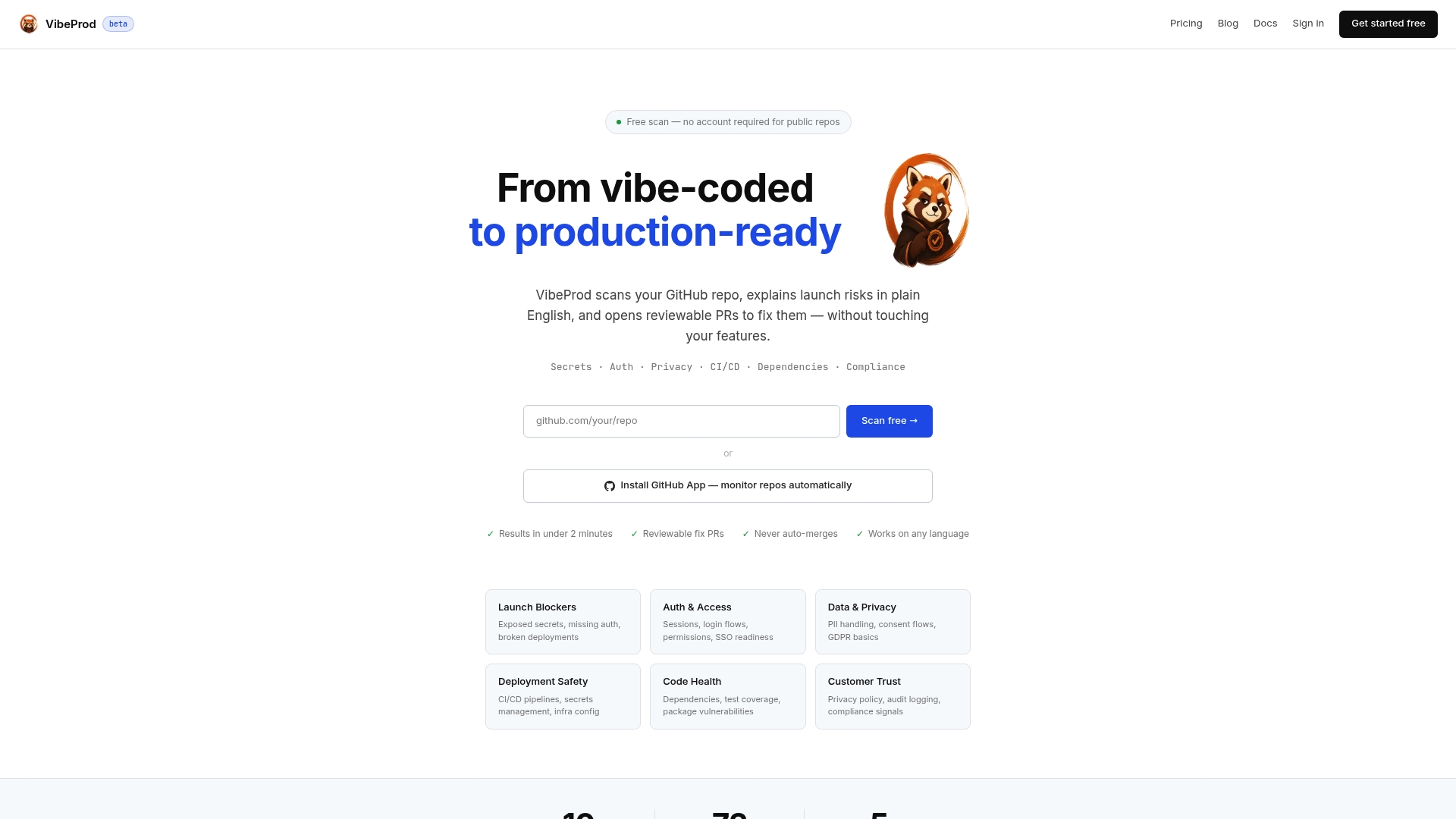
Connect Vibeprod to your GitHub repository and get your first scan in under two minutes. It checks for exposed secrets, dependency CVEs, CI/CD misconfigurations, auth gaps, and PII exposure, then opens plain-English, reviewable fix PRs you approve before anything merges. Private repo support, OWASP/CIS compliance mapping, and exportable audit logs are included on paid plans. The free tier is enough to run a full scan on your staging repo right now.
Start your first scan and see exactly what is standing between your current build and a production-ready release.
FAQ
What is a code evaluator for GitHub repos?
A code evaluator is an automated tool that scans your repository for security and compliance risks — secrets, CVEs, misconfigurations, and PII exposure — and returns plain-English findings with reviewable fix pull requests.
How long does a pre-launch scan take?
Vibeprod delivers actionable insights in under two minutes, making it fast enough to run on every pull request and before every release without blocking your workflow.
Does a code evaluator support private repositories?
Private repo support is standard on paid plans. Free tiers typically limit private repo scans, so check the plan limits before relying on a tool for confidential codebases.
What standards do code evaluators map findings to?
Most production-grade tools map findings to OWASP Top 10 and CIS Benchmarks, which lets you generate compliance-ready reports without manual cross-referencing.
Will a code evaluator auto-merge fixes into my repo?
Vibeprod does not auto-merge. It opens reviewable pull requests that you inspect and approve, preserving full control over every change that enters your production codebase.