Best Security Scanners for Claude-Generated Code in 2026
TL;DR:
- A layered, AI-first scanner stack with human-reviewed fix pull requests effectively reduces security risks in Claude-generated code. Small teams should combine write-time pattern checks, pull request diffs, and supply-chain scans, using tools like Vibeprod for quick, reviewable fix PRs. This approach emphasizes review over rule coverage, addressing AI-specific risks like prompt injection and hallucinated dependencies.
The best defense for Claude-generated code is a layered, AI-first scanner stack: run write-time pattern checks, PR/diff scans, and a repository-wide supply-chain audit, then gate every fix behind a human-reviewed pull request. That combination catches what any single tool misses.
Three checks you can run right now:
- Write-time pattern check: Enable a SAST plugin or editor hook that flags
yaml.loadon untrusted input,innerHTMLassignments, and hardcoded secrets before the code ever leaves your editor. - PR/diff scan: Trigger an LLM-aware diff review on every open pull request to catch prompt-injection vectors and over-broad agent permissions introduced in the latest generation turn.
- Supply-chain scan: Run an SCA/SBOM tool against your dependency manifest to verify every package actually exists — Claude and other LLMs occasionally hallucinate package names that attackers can register.
For small teams, the fastest path to production readiness is pairing a Claude-aware scanner with Vibeprod, which converts scan findings into reviewable fix PRs with plain-English explanations so nothing gets auto-merged without your sign-off.
Table of Contents
- Why does Claude-generated code need its own scanning approach?
- Which scanner categories actually matter for AI-generated code?
- What does a practical CI/PR workflow look like?
- How do you score and choose the right scanner for your stack?
- Where do scanners typically fail on AI-generated code?
- How Vibeprod fits this stack for small teams
- Key Takeaways
- The gap most teams skip
- Ready to scan your first Claude-generated PR?
- Useful sources for deeper reading
- FAQ
Why does Claude-generated code need its own scanning approach?
Claude collapsed the time from idea to working code. That speed is real, but it introduces risk classes that traditional SAST tools were not designed to catch.
The core problem is context loss. Claude generates code one session at a time, without full awareness of your repository’s data flow, existing auth patterns, or dependency constraints. The result is code that looks correct in isolation but introduces gaps when it lands in a real codebase.
The primary AI-specific risk classes to watch for:
- Prompt injection: — Generated code that processes user input or external data can embed instructions that hijack downstream LLM calls or agent actions.
Vulnerable patterns to watch for in generated output: yaml.load() on untrusted input, unsafe deserialization, innerHTML assignments with unescaped data, and hardcoded API keys or tokens in config files.
Statistic: The agent-security-scanner-mcp project validates package references against a corpus of 4.3M+ packages to detect hallucinated dependencies before they reach your manifest.
Pro Tip: Treat .claude/ and equivalent agent session directories the same way you treat .env files: scan them before cloning or executing any generated code, and never commit them to a public repository.
Which scanner categories actually matter for AI-generated code?
No single tool covers every AI-specific risk. OWASP’s guidance on source-code analysis is explicit: layered approaches combining SAST, SCA, secrets scanning, and manual review outperform any single-tool strategy. Here is how the categories map to the threats Claude-generated code introduces.
| Scanner Category | Typical Detections | Best Run At |
|---|---|---|
| Write-time / IDE checks | Hardcoded secrets, obvious injection patterns, insecure function calls | Write-time (editor plugin) |
| SAST (pattern/AST rules) | Injection flaws, insecure deserialization, auth gaps, cross-file data flow | PR diff, CI |
| SCA / SBOM | Known CVEs in dependencies, hallucinated packages, license issues | PR, CI, pre-deploy |
| Secrets scanner | API keys, tokens, credentials in code and history | Pre-commit, CI |
| Prompt-injection detector / MCP-aware | Prompt injection in user-facing strings, agent config misuse, tool permission abuse | Write-time, PR |
| Semantic / agentic commit reviewer | Cross-file data-flow vulnerabilities, architecture-level threat modeling | PR, CI, nightly |
A few practical notes on false positives and latency. Write-time checks are fast but noisy: pattern-heavy rules fire on benign code regularly, so keep the write-time ruleset tight. SAST tools like Semgrep, which use AST-based and semantic rules rather than regex, reduce false positives by tracing data flow across file boundaries rather than matching surface patterns. SCA tools such as Trivy cover containers, repos, and IaC in a single pass, making them efficient for supply-chain checks without adding a separate pipeline step. MCP-aware scanners add prompt-injection detection and A–F health grading, but they send diff context to model endpoints, so review your data-sharing posture before enabling them on proprietary code.
Medusa (v2026.7) takes an AI-first approach with 40,000+ patterns, Claude Code compromise detection, secrets purge tooling, and repo-poisoning detection built in. For teams generating most of their code with Claude, that pattern depth covers vectors that generic SAST rulesets simply do not include.
What does a practical CI/PR workflow look like?
Here is a step-by-step workflow you can adopt today. Each step maps to a specific scanner category and a specific trigger.
- PR/diff scan (on pull request open or update): — Trigger an LLM diff review and a prompt-injection detector on the changed files. This is where MCP-aware scanners add the most value for Claude-generated code.
- Pre-release repository audit: — Run a deep scan covering architecture, threat modeling, and supply-chain verification. Vibeprod’s automated GitHub repo scan fits here, surfacing findings as reviewable fix PRs before you tag a release.
For scan timing, run fast checks (write-time, pre-commit) on every change and reserve deep scans (full SAST, SCA, agentic commit review) for PR merges and nightly runs on release branches. Scanning diffs on PRs keeps latency low; full-repo scans nightly catch issues that accumulate across multiple PRs.
On autofix: allow automated dependency updates only for patch-level bumps with no breaking changes. For anything touching auth flow, middleware, or data handling, require a reviewable PR with a plain-English explanation of what changed and why.
Pro Tip: Limit autofix to low-risk dependency upgrades. For every other finding, surface the fix as a reviewable PR with a human-readable rationale. A fix that gets merged without review is just another unreviewed AI-generated change.
How do you score and choose the right scanner for your stack?
Use this rubric to evaluate any candidate scanner. Score each dimension 1–3 and weight by your team’s priorities.
| Evaluation Dimension | What to Look For | Minimum for Small Teams |
|---|---|---|
| AI-specific coverage | Prompt injection, MCP/tool config scanning, package hallucination detection | At least one dedicated AI-vector check |
| Cross-file / data-flow analysis | Agentic commit review, semantic AST rules | Semantic rules or agentic reviewer |
| Integration points | Write-time plugin, PR diff, CI, SARIF/GitHub Security tab | SARIF export + GitHub PR integration |
| Autofix / reviewable PR support | Reviewable PRs with plain-English rationale, no auto-merge | Reviewable PR (not silent auto-merge) |
| Precision / configurability | Tunable thresholds, per-rule suppression, baseline noise level | Configurable false-positive suppression |
| Performance / latency | Scan time on a typical PR diff, API cost per scan | Under 2 minutes for a diff scan |
| Export and audit | SARIF, grading (A–F), audit trail | SARIF export |
| Pricing / licensing | Free tier, per-scan cost, private repo support | Free tier or low per-scan cost |
Key vendor questions to ask before committing:
- Does the scanner process code locally or send it to a cloud endpoint? Can you run it in private-only mode?
- Does it export SARIF compatible with the GitHub Security tab?
- What is the per-scan API cost for a 500-file repository?
- Does it support reviewable PRs, or does it auto-apply fixes?
- How are rules updated for new AI-specific attack patterns?
NIST SP 500-326 provides the authoritative framework for secure software development practices, and it is worth referencing when building your scanning policy and audit expectations, especially if your team is subject to compliance requirements.
Where do scanners typically fail on AI-generated code?
Knowing the failure modes is as important as knowing the capabilities. Scanners miss things, and with AI-generated code, the blind spots are specific.
- Prompt injection in documentation or prose: — Injection payloads embedded in comments, README files, or string literals often bypass pattern-based detectors that focus on executable code paths.
Mitigation is straightforward in principle: combine semantic/agentic review with deterministic SAST and SCA, increase context windows for diff reviews when budget allows, and require human sign-off on any fix touching security-sensitive code paths. Tune thresholds by sampling a week of alerts and suppressing rules with a false-positive rate above your team’s tolerance. LLM monitoring practices can complement this by surfacing runtime anomalies that static scanners never see.
How Vibeprod fits this stack for small teams
Most of the scanner categories above require configuration, pipeline integration, and ongoing rule maintenance. For a solo founder or a two-person team, that overhead competes directly with shipping.
Vibeprod fills the gap between “I ran a scan” and “I have a fix I can actually review and merge.” It scans your GitHub repository automatically, identifies launch risks including exposed secrets, authentication gaps, privacy and compliance issues, CI/CD misconfigurations, and dependency vulnerabilities, then opens reviewable fix PRs with plain-English explanations for each finding. Nothing gets auto-merged. You review, you decide, you merge.
Key integration points for the workflow described above:
- GitHub Actions / Apps support: — Vibeprod connects directly to your GitHub repository, fitting into the PR and CI layers of the recommended workflow without a separate pipeline configuration.
Time-to-value: Vibeprod’s scan-to-PR feedback targets under two minutes for small repos, which means you get findings before a PR review stalls.
The recommended entry point for small teams: connect your GitHub repo, run a scan on your current open pull request, and review the fix PRs before merging. That single step covers the PR/diff layer and the pre-release audit layer simultaneously.
Key Takeaways
A layered, AI-first scanner stack combined with human-reviewed fix PRs is the most effective way to reduce security risk in Claude-generated code before it reaches production.
| Point | Details |
|---|---|
| Layer your scanners | Combine SAST, SCA, secrets detection, and a prompt-injection detector — no single tool covers all AI-specific risks. |
| Scan at every stage | Run write-time checks locally, diff scans on every PR, and full SAST/SCA in CI to catch issues at the lowest cost. |
| Gate fixes behind human review | Never auto-merge security fixes; require reviewable PRs with plain-English rationale for every finding. |
| Validate package existence | Use a scanner that checks hallucinated dependencies against a real package corpus, not just known CVE databases. |
| Vibeprod for small teams | Vibeprod scans your GitHub repo and opens reviewable fix PRs in under two minutes, covering the PR and pre-release audit layers. |
The gap most teams skip
The conversation around AI-generated code security tends to focus on which scanner has the most rules. That framing misses the real problem.
The real problem is the review gap. Claude generates code faster than most teams can review it. Scanners surface findings faster than most teams can act on them. The result is a queue of unreviewed alerts that developers learn to ignore, which is functionally worse than no scanner at all.
The tools that actually move the needle are not the ones with the longest rule lists. They are the ones that convert findings into something a developer can act on in under five minutes: a pull request, a plain-English explanation, a clear yes/no decision. That is why the shift from “scan and report” to “scan and open a reviewable PR” matters more than marginal improvements in pattern coverage.
Scanners are assistive. They are not guarantees. A finding that sits in a dashboard unreviewed provides zero protection. A finding that lands as a reviewable PR with a human-readable rationale gets acted on. Build your workflow around that reality, and the specific scanner you choose matters much less than whether your team actually reviews and merges the fixes.
Ready to scan your first Claude-generated PR?
Shipping fast with Claude is the point. Shipping with exposed secrets or a hallucinated dependency in your manifest is the gap Vibeprod closes.
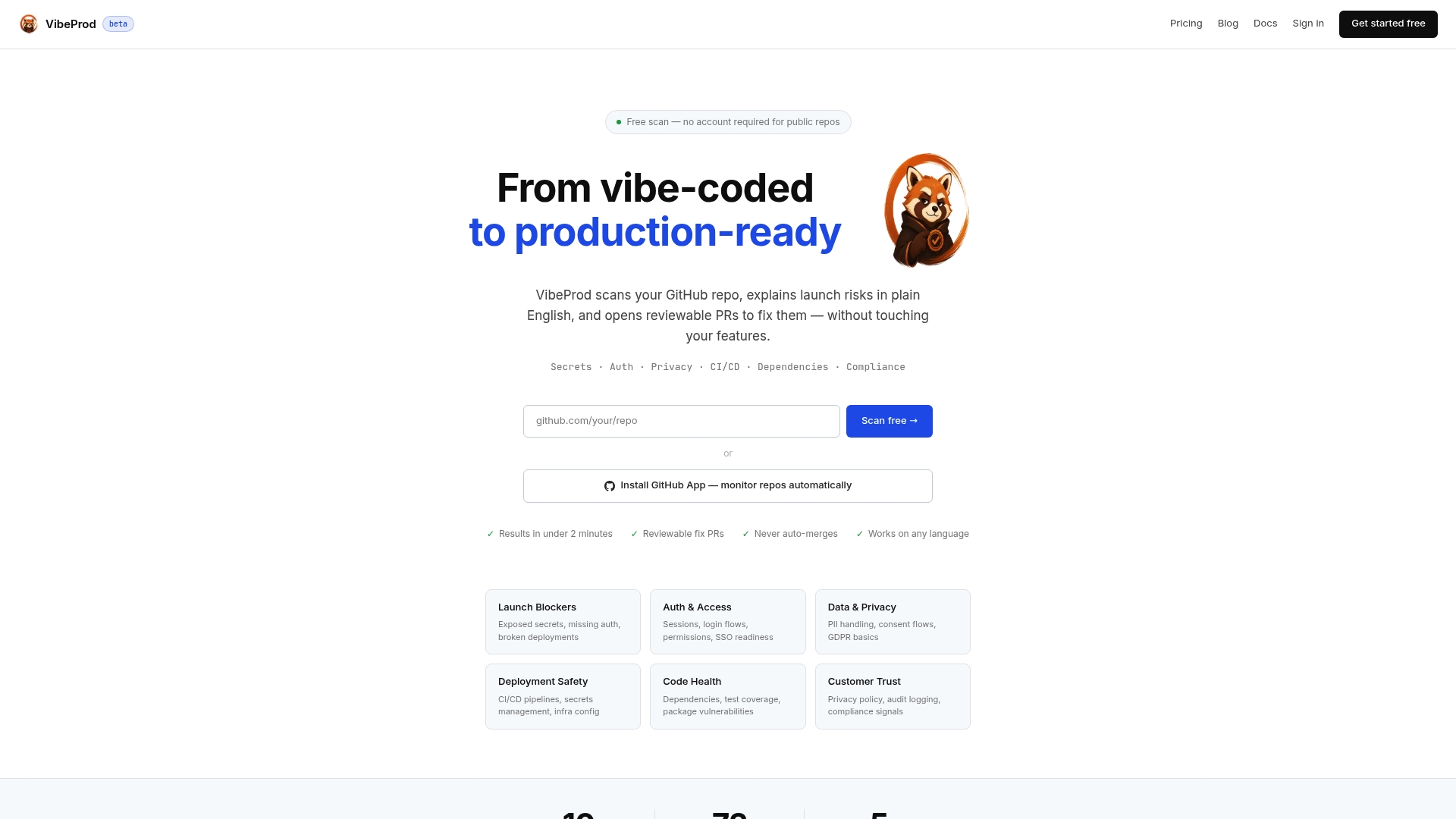
Connect your GitHub repository and Vibeprod scans it in under two minutes, then opens reviewable fix PRs for every finding it surfaces: exposed secrets, auth gaps, dependency vulnerabilities, CI/CD misconfigurations, and compliance issues. Plain-English explanations come with every PR so you know exactly what you are merging and why. No auto-merge, no silent changes to your codebase.
The free tier covers public repositories and gives you a full scan with fix PRs on your first repo. Start with your current open pull request: connect your repo at vibeprod.ai, run the scan, and review what comes back before you merge.
Useful sources for deeper reading
These references cover the technical foundations behind the recommended workflow.
- claude-security
- claude-plugins-official/plugins/security-guidance at main · anthropics/claude-plugins-official · GitHub
- sinewaveai/agent-security-scanner-mcp
- amitvishw/mimir-scan
- Pantheon-Security/medusa
- semgrep/semgrep
- nvlpubs.nist.gov
- OWASP Source Code Analysis Tools
FAQ
What makes Claude-generated code harder to scan than hand-written code?
Claude generates code without full awareness of your repository’s data flow, which means vulnerabilities often span multiple files in ways single-file SAST rules miss. Package hallucination and prompt-injection vectors are also AI-specific risks that traditional scanners were not built to detect.
Which scanner types should a small team prioritize first?
Start with a secrets scanner on pre-commit hooks, a SAST tool with semantic rules on PRs, and an SCA scanner in CI to catch hallucinated or vulnerable dependencies. Add a prompt-injection detector once those three layers are stable.
Does Vibeprod replace a dedicated SAST tool?
Vibeprod complements SAST tools rather than replacing them. It focuses on converting repository scan findings into reviewable fix PRs with plain-English explanations, covering the PR and pre-release audit layers of the recommended workflow.
What is SARIF and why does it matter for AI code scanning?
SARIF (Static Analysis Results Interchange Format) is a standard export format that lets scan results appear directly in the GitHub Security tab, enabling consistent triage and audit trails across multiple scanner tools.
How do I reduce false positives from pattern-heavy scanners?
Tune thresholds by sampling a week of alerts, suppress rules with consistently high false-positive rates, and prefer semantic or AST-based rules over pure regex patterns. Combining a tight write-time ruleset with a more thorough CI scan keeps noise low at the point where developers are most likely to act on findings.