Top No-Ops Security Tools for AI Coders in 2026
TL;DR:
- Vibeprod scans GitHub repositories for launch risks and opens reviewable fix pull requests in under two minutes without requiring security expertise. It is ideal for small teams and solo developers aiming for fast, reliable pre-launch security checks. Other tools like Semgrep, Snyk, and Prisma AIRS extend security coverage into code analysis, dependency management, and enterprise AI governance.
For most AI coders and small engineering teams, Vibeprod is the recommended starting point: it scans your GitHub repo, finds launch risks like exposed secrets and broken auth flows, and opens reviewable fix PRs with plain-English explanations in under two minutes. No security expertise required. No noisy dashboard to triage.
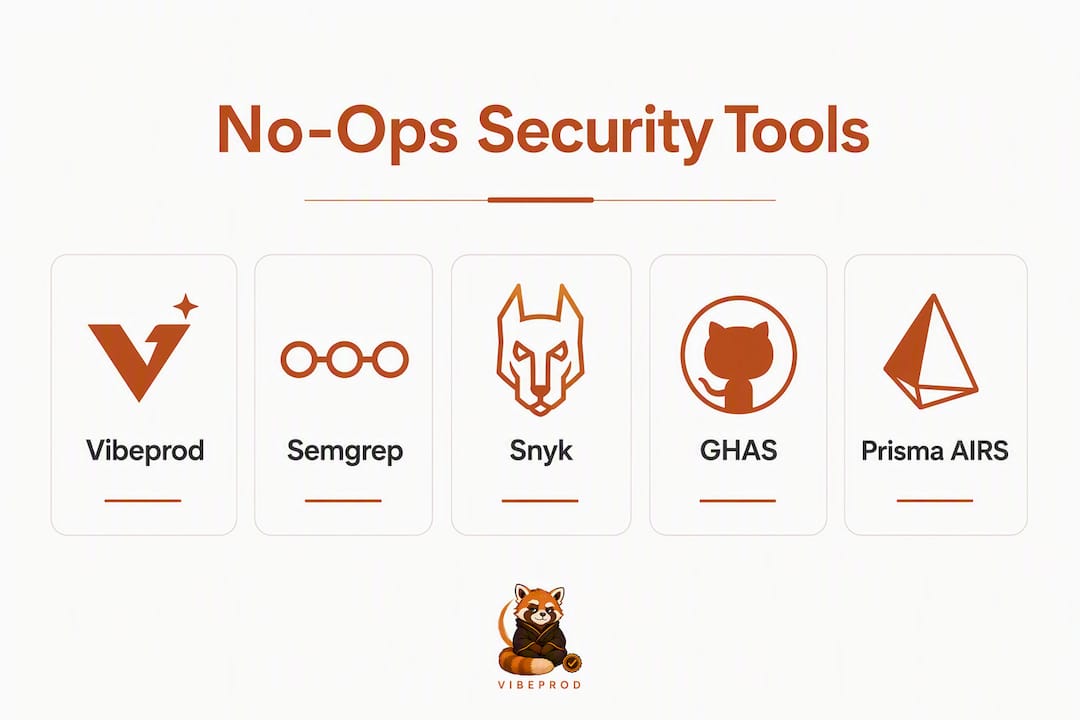
Beyond Vibeprod, the best no-ops security tools for AI coders in 2026 fall into a few clear categories. Here is the curated shortlist:
- Vibeprod — Best for solopreneurs and small teams doing pre-launch GitHub scans with zero-friction remediation via reviewable PRs.
- Semgrep — Best for developer teams that want fast, customizable code pattern scanning embedded in CI/CD without heavy configuration.
- Snyk — Best for teams prioritizing dependency (SCA) and IaC scanning with strong IDE integrations.
- GitHub Advanced Security (GHAS) — Best for organizations already on GitHub that want native secret detection and code scanning baked into their PR workflow.
- Palo Alto Networks Prisma AIRS — Best for large enterprises needing end-to-end AI lifecycle governance with runtime guardrails.
- ZeroPath — Best for developer teams wanting IDE-embedded local-diff scanning with an explain-and-fix loop that can open verified PRs.
- Aikido Security — Best for small-to-mid teams wanting an all-in-one SAST, SCA, and IaC scanner with a low-friction SaaS setup.
All tools listed are available in the US market. Vibeprod and Aikido Security suit solopreneurs through small teams; Semgrep, Snyk, and GHAS scale from startup to mid-market; Prisma AIRS and enterprise platforms like Checkmarx One, Cycode, and Wiz target larger organizations with dedicated security teams.
Table of Contents
- How do these no-ops security tools compare at a glance?
- Top picks: what each tool does and who should use it
- How do you choose the right no-ops security tool for your team?
- What does “no-ops” actually mean for AI-generated code security?
- Why agent-native and MCP integrations are the decisive shift
- How do you onboard your team to AI code security tools?
- What support and community resources should you evaluate?
- What compliance and regulatory requirements apply to AI-generated code?
- Key Takeaways
- Why a no-ops-first approach is the right call for AI coders
- Your fastest path to production-ready code starts here
- Useful sources for deeper technical exploration
- FAQ
How do these no-ops security tools compare at a glance?
The table below maps each shortlisted tool across the dimensions that matter most for AI-generated code security. “IDE agent” means the tool runs checks inside your editor or chat interface before you push. “Runtime guardrail” means it monitors live model or API calls in production. “CI/CD plugin” means it hooks into your pipeline on push or PR open.
| Tool | Best for | Deployment model | Coverage | AI-specific features | Remediation workflow | Pricing signal | Enterprise readiness |
|---|---|---|---|---|---|---|---|
| Vibeprod | Solopreneurs, indie devs, small teams | CI/CD plugin, GitHub SaaS | SAST, secrets, auth gaps, IaC, deps | AI-code risk detection, plain-English explanations | Reviewable fix PRs, no auto-merge | Free tier; paid plans | Low; fast setup |
| Semgrep | Dev teams, custom rule authors | IDE agent, CI/CD plugin | SAST, secrets, custom patterns | AI-generated code pattern rules | IDE inline fixes, CI annotations | Free OSS; paid tiers | Medium–high |
| Snyk | Dev teams prioritizing SCA/IaC | IDE agent, CI/CD plugin | SCA, IaC, SAST, containers | Dependency risk in AI-generated code | IDE fixes, PR comments, auto-fix | Free tier; per-repo paid | Medium–high |
| GitHub Advanced Security | GitHub-native orgs | CI/CD plugin, native GitHub | SAST, secrets, SCA (Dependabot) | Push-to-PR secret detection | PR annotations, auto-dismiss | Per-committer enterprise | Medium–high |
| Prisma AIRS | Large enterprises | Runtime guardrail, cloud SaaS | Runtime, model governance, posture | Prompt injection, model scanning, AI lifecycle | Remediation guidance, policy enforcement | Enterprise contract | High |
| ZeroPath | Dev teams, IDE-first workflows | IDE agent, CI/CD plugin | SAST, local diff | Explainable fix proposals, PR opening | Local diff scan, verified fix PRs | Contact for pricing | Medium |
| Aikido Security | Small-to-mid teams, all-in-one | Cloud SaaS, CI/CD plugin | SAST, SCA, IaC, secrets, containers | AI-generated code detection | PR comments, remediation guidance | Free tier; paid plans | Medium |
| Checkmarx One | Enterprise SAST/SCA | CI/CD plugin, cloud SaaS | SAST, SCA, IaC, API security | AI-generated code risk flags | Remediation guidance, IDE plugin | Enterprise contract | High |
| Cycode | Supply-chain security | CI/CD plugin, cloud SaaS | SAST, SCA, secrets, IaC | Supply-chain risk in AI pipelines | Developer prevention workflows | Enterprise contract | High |
| Wiz / Wiz Code | Cloud-native teams | Cloud SaaS, runtime | Cloud posture, code, containers | Cloud + code context correlation | Remediation guidance | Enterprise contract | High |
| Endor Labs | Dependency reachability | CI/CD plugin, cloud SaaS | SCA, reachability analysis | Reachable dependency risk in AI code | PR comments, remediation | Contact for pricing | Medium–high |
| Apiiro | Risk-based SDLC | CI/CD plugin, cloud SaaS | SAST, SCA, IaC, risk scoring | AI code risk scoring | Risk-based PR gates | Enterprise contract | High |
Pro Tip: If your team lives in the IDE and ships AI-generated code daily, weight the “Deployment model” and “Remediation workflow” columns first. A tool that catches a CVE in CI but requires a separate dashboard to fix it adds friction that slows you down. Prefer tools that surface findings and propose fixes inside the workflow you already use.
Top picks: what each tool does and who should use it
Vibeprod
Vibeprod is purpose-built for the gap that AI coding tools create: you ship fast, but the repo quietly accumulates exposed secrets, missing auth checks, and dependency vulnerabilities that no one reviewed. Vibeprod scans your GitHub repository, identifies those risks, and opens a reviewable pull request with a plain-English explanation of each issue. It does not auto-merge anything. You stay in control.

Pros: Sub-two-minute scan time; plain-English explanations reduce the need for security expertise; fix PRs are reviewable, not forced; free tier available; covers secrets, auth gaps, CI/CD misconfigs, and dependency vulnerabilities.
Cons: Optimized for GitHub-hosted repos; best suited for pre-launch checks rather than continuous enterprise-scale runtime monitoring.
Ideal for: Indie developers, solo founders, and small teams who need to confirm their app is production-ready before real users arrive.
Semgrep
Semgrep is a fast, language-agnostic static analysis tool with a large open-source rule library and strong developer adoption. Its real strength is custom rule authoring: if your team has specific patterns to catch in AI-generated code (insecure prompt construction, hardcoded credentials, unsafe deserialization), you can write and share rules in minutes. Semgrep’s G2 reviews consistently praise its scan speed and CI integration.
Pros: Open-source core; fast scan times; highly customizable; strong IDE and CI/CD integration.
Cons: Rule quality varies; custom rules require maintenance; false-positive rates depend on rule precision.
Ideal for: Teams that want to enforce specific coding patterns across AI-generated code and need a tool that fits naturally into GitHub Actions or GitLab CI.
Snyk
Snyk focuses on software composition analysis (SCA) and IaC security, with IDE plugins for VS Code, JetBrains, and others. When your AI coding assistant pulls in a dependency you did not explicitly choose, Snyk catches the CVE before it ships. Snyk’s G2 reviews highlight its developer-friendly UX and the quality of its fix suggestions.

Pros: Strong SCA coverage; IaC scanning for Terraform and Kubernetes; good IDE integrations; free tier for open-source projects.
Cons: Paid tiers required for private repos at scale; can generate noise on transitive dependencies without reachability filtering.
Ideal for: Developer teams where AI-generated code frequently introduces new dependencies and IaC templates.
GitHub Advanced Security (GHAS)
GHAS is the native choice for GitHub-standardized organizations. Code scanning (powered by CodeQL), secret scanning, and Dependabot alerts all run inside the GitHub PR workflow with no external tool to configure. Push protection blocks commits containing secrets before they land in the repo.
Pros: Zero additional toolchain setup for GitHub users; push-to-PR secret detection; CodeQL covers a wide language set.
Cons: Per-committer enterprise pricing; CodeQL scan times can be slow on large repos; limited outside the GitHub ecosystem.
Ideal for: Engineering organizations already on GitHub Enterprise that want security checks without adding another vendor.
Palo Alto Networks Prisma AIRS
Prisma AIRS covers the full AI lifecycle: model scanning, runtime guardrails, and governance for agents and unmanaged “shadow AI” across the organization. It integrates with existing Palo Alto threat intelligence and targets enterprises that need to govern AI models the same way they govern network traffic.
Pros: End-to-end AI lifecycle coverage; runtime prompt-injection protection; integrates with enterprise security architecture.
Cons: Enterprise contract required; significant setup and integration effort; overkill for teams without a dedicated security function.
Ideal for: Large enterprises running multiple AI models in production who need centralized governance and runtime protection.
ZeroPath
ZeroPath’s agent plugin runs local-diff scans inside your IDE or chat interface. The /zeropath:scan and /zeropath:fix commands analyze only the code you just changed, explain the finding, and can open a verified fix PR. This local-diff approach means findings arrive in seconds rather than waiting for a CI run to complete.
Pros: Local-diff scanning is fast; explainable fix proposals reduce remediation time; IDE/chat-native workflow.
Cons: Newer entrant; enterprise scalability and support documentation are still maturing.
Ideal for: Developer teams that want security feedback at the moment of writing, not after a CI pipeline finishes.
Aikido Security
Aikido Security combines SAST, SCA, IaC scanning, secret detection, and container scanning in a single SaaS platform with a clean UI. Its free tier covers small teams, and setup typically takes under 30 minutes. G2 reviewers note its low false-positive rate relative to its coverage breadth.
Pros: All-in-one coverage; low false-positive rate; fast setup; free tier available.
Cons: Less customizable than Semgrep for bespoke rule authoring; enterprise features require paid plans.
Ideal for: Small-to-mid engineering teams that want broad coverage without managing multiple tools.
The broader field: enterprise and specialist tools
Several tools serve specific niches or enterprise-scale needs that the shortlist above does not fully address.
- Orca Security offers agentless cloud security posture management; Orca’s G2 reviews highlight its broad cloud asset coverage.
For AI-model-layer protection specifically, a separate set of tools addresses prompt injection, model provenance, and adversarial testing:
- Pillar Security maps agents, models, and MCP servers into a RedGraph attack graph and simulates multi-step agent attacks.
- TrueFoundry provides an infrastructure-first AI gateway with per-model RBAC and VPC-native audit controls.
Pro Tip: Model-layer tools (HiddenLayer, Lakera Guard, Pillar) and infrastructure gateway tools (TrueFoundry, Prisma AIRS) solve different problems. If your team is shipping AI-generated application code, start with code-layer tools. Add model-layer protection once you are running your own LLM endpoints or agentic pipelines.
How do you choose the right no-ops security tool for your team?
The right tool depends on where your biggest risk lives and how your team actually works. Use this checklist to narrow your options.
Start with your workflow:
- Do your developers use VS Code, JetBrains, or a chat-based AI coding assistant? Prefer tools with IDE agent plugins (ZeroPath, Semgrep, Snyk).
- Is your repo on GitHub? Vibeprod and GHAS integrate natively without additional CI configuration.
- Do you run agentic AI pipelines or call external LLM APIs in production? Add a model-layer or gateway tool (Lakera Guard, TrueFoundry, Prisma AIRS) on top of your code-layer scanner.
Map your coverage gaps:
- Exposed secrets and auth gaps: Vibeprod, GHAS, GitGuardian.
- Dependency vulnerabilities in AI-generated code: Snyk, Endor Labs, Mend SCA.
- IaC misconfigurations: Snyk, Checkmarx One, TFLint, KICS.
- Container and Kubernetes risk: Trivy, Aqua Security, Wiz.
- Runtime prompt injection: Lakera Guard, Prisma AIRS, Google Cloud Model Armor.
Questions to ask vendors during a trial:
- Does the tool explain why a finding is exploitable, or just flag it? Plain-English context cuts remediation time.
- Can it open a fix PR, or does it only create a ticket? A closed fix-and-verify loop keeps work inside the developer workflow.
- Does it support schema enforcement for AI-generated outputs and policy-as-code configurations?
- What is the data residency model? Does scan data leave your VPC?
- Does it support MCP or agent-plugin workflows if you use agentic coding tools?
Red flags to watch for:
- Tools that generate hundreds of findings with no exploitability context will slow your team down, not speed it up.
- Platforms that require a dedicated security engineer to configure and maintain are not no-ops for a small team.
- Any tool that auto-merges fixes without a human review step introduces its own risk.
Typical adoption timeline: A free-tier or trial setup for Vibeprod, Aikido Security, or Semgrep takes under an hour. A pilot covering one or two repos should run for two to four weeks before expanding org-wide. Enterprise platforms like Checkmarx One or Prisma AIRS typically require a proof-of-concept phase of four to eight weeks before rollout.
What does “no-ops” actually mean for AI-generated code security?
“No-ops” in this context does not mean zero operations. It means security checks that run automatically inside your existing workflow with no manual triage step required. The developer writes code, the tool scans it, and a fix lands in the PR or IDE without anyone opening a separate security dashboard.
This matters more for AI-generated code than for hand-written code because AI coding assistants produce large volumes of code quickly, often pulling in dependencies, generating auth flows, and scaffolding middleware that no human reviewed line by line. The risk surface grows faster than a traditional security review cycle can keep up with.
The table below maps the main risk categories to the DevSecOps capability that addresses them.
| Risk category | DevSecOps capability | Example features |
|---|---|---|
| Exposed secrets and credentials | Secret scanning | Push protection, git history scanning |
| Vulnerable dependencies (phantom or direct) | SCA / semantic analysis | Reachability analysis, CVE matching, license checks |
| Insecure auth flows and logic bypasses | SAST | Taint analysis, data-flow analysis, IDOR detection |
| IaC misconfigurations | IaC scanning | Terraform and Kubernetes policy checks |
| Container vulnerabilities | Container scanning | Image scanning, runtime policy enforcement |
| Prompt injection and model abuse | Runtime guardrails / model-layer | Prompt filtering, model provenance, output validation |
| Multi-step agent attacks | Agent attack-graph mapping | RedGraph-style taint analysis, blast-radius scoring |
AI-centric security also requires semantic analysis beyond signature-based CVE checks. Logic bypasses, insecure direct object references (IDORs), and phantom dependencies that AI tools introduce often do not match any known CVE signature. Tools that only check against a CVE database will miss them.
Pro Tip: Alert fatigue is the silent killer of DevSecOps programs. Prefer tools that include exploitability context or reachability analysis (Endor Labs, Pillar Security) so your team spends time on findings that can actually be exploited, not theoretical risks buried in transitive dependencies.
Why agent-native and MCP integrations are the decisive shift
The industry is moving away from CI-only scanning toward agent-native and MCP-aware security tooling. The reason is timing: a CI scan catches a vulnerability after the code is written and pushed. An IDE agent or local-diff scanner catches it at the moment of writing, when fixing it takes seconds rather than a context-switch back to a stale branch.
ZeroPath’s agent plugin demonstrates this pattern clearly. Its /zeropath:scan command runs against only the local diff, not the entire codebase, so results arrive in seconds. The /zeropath:fix command proposes a verified fix and can open a PR directly. That closed loop, from writing code to reviewing a fix PR, happens without leaving the IDE.
Pillar Security’s RedGraph takes a different angle: it maps agents, models, MCP servers, and tools into an attack graph and simulates multi-step exploitation paths. This is particularly relevant for teams running agentic pipelines where a compromised tool call can cascade across multiple agent interactions. Taint analysis and blast-radius scoring reduce false positives by adding business context to each finding.
TrueFoundry’s gateway approach addresses the infrastructure layer: OAuth identity injection, per-model RBAC, and VPC-native audit logging mean that model calls are governed the same way API calls are governed in a mature microservices architecture.
Gartner’s AI security and anomaly detection category now includes discovery, governance, runtime protection, and AI posture management as distinct vendor capabilities. For most engineering teams, the practical implication is that you need at least two layers: a code-layer scanner for the application code your AI assistant writes, and a runtime or gateway layer for the model calls your application makes.
What a quick pilot should measure: scan latency (does it fit in your PR workflow?), false-positive rate (how many findings require no action?), and remediation closure rate (what percentage of flagged issues get fixed before merge?).
How do you onboard your team to AI code security tools?
Onboarding is where most DevSecOps programs stall. A tool that generates 200 findings on day one, with no context about which ones matter, will be ignored by day three.
The most effective onboarding sequence for AI code security tools follows three steps. First, start with a single repo and a narrow rule set. For Vibeprod, that means running the initial scan on your most active repo and reviewing the fix PRs it opens before expanding to the full organization. For Semgrep, it means enabling a curated rule pack (the p/security-audit pack is a reasonable starting point) rather than all available rules.
Second, establish a triage baseline. Run the tool for one sprint without requiring developers to fix everything. The goal is to understand the signal-to-noise ratio before you gate PRs on findings. Tools with exploitability context (Endor Labs, Pillar Security) make this step faster because they pre-filter findings by reachability.
Third, close the loop with fix workflows. The tools that stick are the ones that propose fixes, not just findings. Vibeprod opens a reviewable PR. ZeroPath proposes a verified fix in the IDE. Snyk suggests a dependency upgrade inline. When fixing a finding takes one click rather than a manual code change, adoption rates climb.
For developer sandbox environments, security tool onboarding is also a good time to validate that your sandbox configuration matches your production security policies. A finding that only appears in production but not in the sandbox is a configuration gap, not a tool limitation.
Training guidance: most code-layer tools (Semgrep, Snyk, Aikido Security) provide interactive tutorials and documentation that a developer can work through in under two hours. Model-layer tools (Lakera Guard, HiddenLayer) require more context about your AI architecture before training is meaningful.
What support and community resources should you evaluate?
Support quality separates tools that work in a demo from tools that work in production. When evaluating support and community resources, check these dimensions:
Documentation depth: Can a developer integrate the tool without filing a support ticket? Semgrep’s documentation and rule registry are extensive. Snyk’s developer hub covers most integration scenarios. Vibeprod’s plain-English explanations are built into the product itself, reducing the need for external documentation.
Community activity: Open-source tools like Semgrep, Trivy, and Garak have active GitHub communities where you can find custom rules, bug reports, and integration examples. Commercial tools like Snyk and Aikido Security maintain community Slack channels and user forums.
Response time for paid tiers: For enterprise tools (Checkmarx One, Veracode, Prisma AIRS), SLA-backed support is a procurement requirement, not a nice-to-have. Ask for documented SLA terms during the evaluation.
Changelog transparency: Tools that publish detailed changelogs and deprecation notices are easier to maintain long-term. GHAS, Semgrep, and Snyk all maintain public changelogs. For newer entrants like ZeroPath and Pillar Security, check the GitHub release history.
Vendor responsiveness to AI-specific issues: The model-layer and agent-native categories are moving fast. A vendor that ships MCP support or prompt-injection rule updates on a monthly cadence is more useful than one that releases quarterly.
What compliance and regulatory requirements apply to AI-generated code?
AI-generated code does not get a compliance exemption. The same frameworks that govern hand-written code apply, and in some cases AI-generated code creates new compliance surface area.
SOC 2 and ISO 27001: Secret exposure, insecure auth flows, and unpatched dependencies are audit findings under both frameworks. Tools like Vibeprod, GHAS, and GitGuardian directly address the secret management and access control controls these audits check.
NIST AI RMF: The National Institute of Standards and Technology’s AI Risk Management Framework covers model governance, transparency, and accountability for AI systems. Runtime governance tools like Prisma AIRS and TrueFoundry align with NIST AI RMF’s “Govern” and “Manage” functions.
Executive Order 14110 and subsequent federal AI guidance: Federal contractors and agencies face specific requirements around AI system documentation, testing, and security. Model provenance tracking (HiddenLayer, Pillar Security) and audit logging (TrueFoundry) are relevant controls here.
SBOM requirements: The US government’s software bill of materials (SBOM) requirements, driven by Executive Order 14028, apply to software sold to federal agencies. SCA tools like Snyk, Endor Labs, Black Duck, and Mend SCA can generate SBOM outputs in CycloneDX or SPDX format.
GDPR and CCPA for AI outputs: If your AI-generated code processes personal data, the output itself may be subject to privacy regulations. Prompt injection attacks that exfiltrate user data are a compliance risk, not just a security risk. Lakera Guard and Google Cloud Model Armor address this at the model interaction layer.
This is general information, not legal or compliance advice. Confirm current requirements with a qualified compliance professional or the relevant regulatory body for your specific situation.
Key Takeaways
The most effective no-ops security approach for AI coders combines a code-layer scanner for pre-launch checks with a runtime or gateway layer for production model calls, prioritizing tools that surface fixes inside the developer workflow rather than in a separate dashboard.
| Point | Details |
|---|---|
| Start with code-layer scanning | Catch secrets, auth gaps, and dependency CVEs before launch using Vibeprod, Semgrep, or Snyk. |
| Prefer fix workflows over finding lists | Tools that open reviewable PRs or propose IDE fixes close the loop faster than ticket-based systems. |
| Add model-layer protection for AI pipelines | If you call LLM APIs or run agents in production, add Lakera Guard, TrueFoundry, or Prisma AIRS. |
| Filter by exploitability to cut noise | Reachability analysis (Endor Labs) and attack-graph context (Pillar Security) reduce false-positive triage time. |
| Vibeprod for pre-launch GitHub checks | Vibeprod scans your repo and opens plain-English fix PRs in under two minutes, with no security expertise required. |
Why a no-ops-first approach is the right call for AI coders
The conventional wisdom in DevSecOps is that security should “shift left,” meaning earlier in the development cycle. That framing is correct but incomplete. Shifting left only helps if the feedback arrives fast enough to act on before the developer has moved to the next task. A CI scan that completes 20 minutes after a push is not shift-left in any practical sense. It is a delayed interrupt.
The tools that actually change developer behavior are the ones that surface a finding and a fix in the same moment the code is written. ZeroPath’s local-diff scan, Vibeprod’s pre-launch PR scan, Semgrep’s IDE inline feedback: these work because they fit the developer’s existing rhythm rather than adding a new workflow step.
There is also a specific risk that AI-generated code introduces that hand-written code does not: volume. An AI coding assistant can scaffold an entire auth flow, a middleware stack, and a set of API endpoints in minutes. A human reviewer cannot keep pace with that output using traditional code review alone. Automated, no-ops-first security checks are not a convenience for AI coders. They are a structural requirement.
The teams that will get this wrong are the ones that treat security tooling as a compliance checkbox rather than a developer productivity tool. The right question is not “do we have a scanner?” It is “does our scanner make fixing faster than ignoring the finding?”
Your fastest path to production-ready code starts here
Shipping AI-generated code fast is only half the job. The other half is making sure what you ship does not expose secrets, break auth, or carry a dependency CVE that lands you in a breach disclosure.
Vibeprod handles that second half without slowing you down. Connect your GitHub repo, and Vibeprod scans for launch risks, including exposed secrets, authentication gaps, privacy issues, CI/CD misconfigurations, and dependency vulnerabilities, then opens a reviewable fix PR with a plain-English explanation for each finding. No security expertise required. No auto-merges. Results in under two minutes.
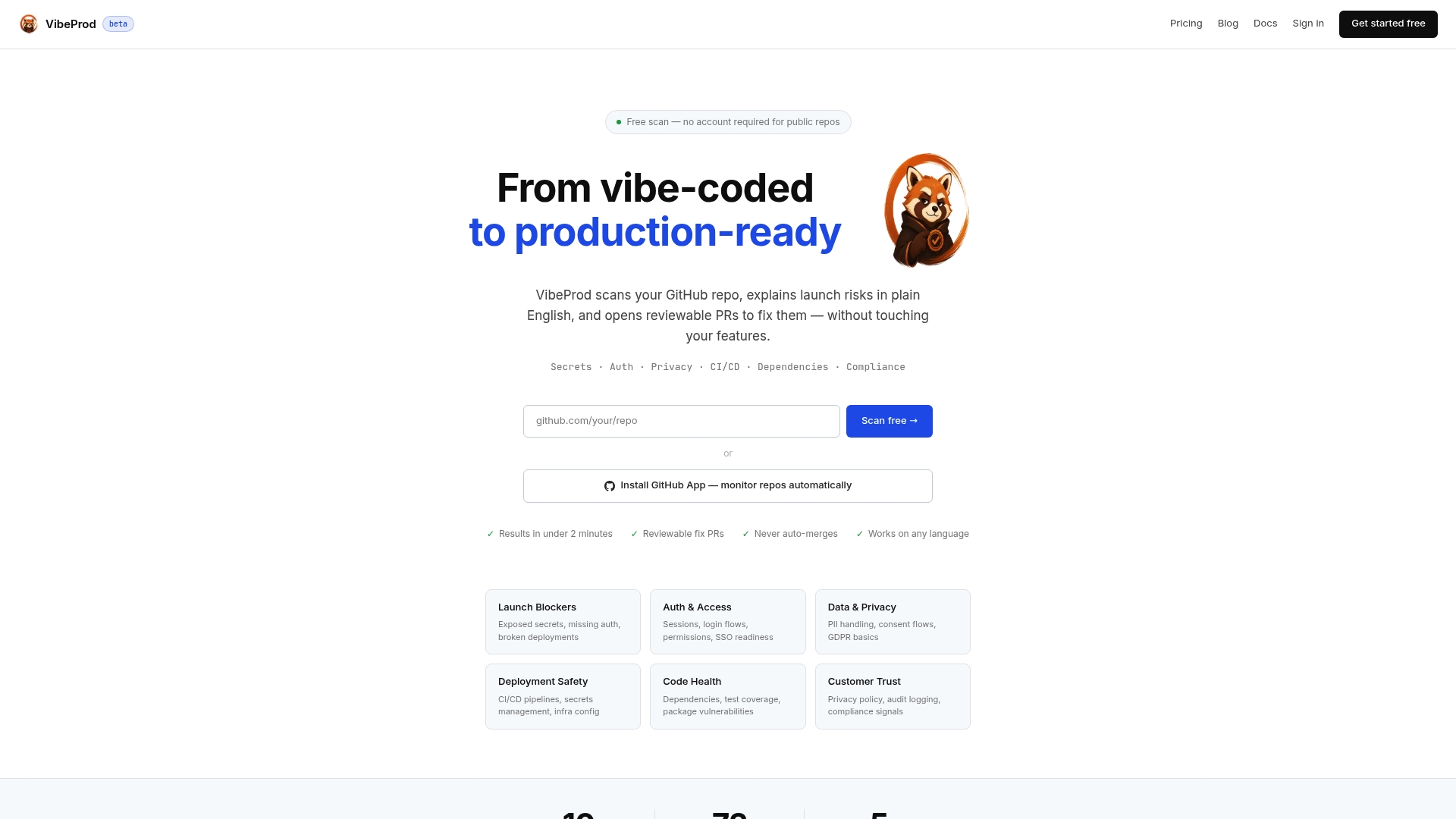
It is the no-ops-first security check built for indie developers and small teams who need to ship safe without hiring a security team. Start your free scan at Vibeprod and see what your repo is carrying before your first real user does.
Useful sources for deeper technical exploration
| Source | What it covers and why it matters |
|---|---|
| Palo Alto Networks Prisma AIRS | Product documentation for runtime guardrails, model governance, and AI lifecycle security architecture. |
| TrueFoundry: Best AI Security Tools | Technical breakdown of gateway-style AI security, VPC-native controls, and per-model RBAC patterns. |
| Pillar Security Platform | RedGraph attack-graph methodology, taint analysis, and multi-step agent attack simulation. |
| ZeroPath Agent Plugin (GitHub) | Plugin quickstart for local-diff scanning, explain-and-fix loops, and verified PR workflows in IDE/chat. |
| Gartner Peer Insights: AI Security and Anomaly Detection | Enterprise buyer reviews and vendor category definitions for AI security posture management. |
| Cycode: AI Cybersecurity Tools | Overview of supply-chain and SDLC security approaches for AI-generated code pipelines. |
| Endor Labs: Best Application Security Tools | Reachability-based SCA methodology and application security tool comparison. |
| Orca Security: Best AI Code Security Solutions | Cloud-native perspective on AI code security, covering posture management and runtime protection. |
| Schema Enforcement Approaches for AI: 2026 Developer Guide | Schema enforcement strategies for AI workflows and policy-as-code embedding in developer toolchains. |
| How Developer Sandboxes Work with AI Tools in 2026 | Sandboxing patterns for safe AI code experimentation and their interaction with no-ops security tooling. |
FAQ
Which AI security tool is best for coding and cybersecurity?
For most developers shipping AI-generated code, Vibeprod covers pre-launch GitHub risks (secrets, auth gaps, dependency CVEs) with the lowest setup friction. For broader cybersecurity coverage including runtime and model-layer protection, Semgrep, Snyk, and Prisma AIRS each address different layers of the stack.
What are the best no-ops security tools for AI coders?
The strongest no-ops options for AI coders are Vibeprod (pre-launch GitHub scanning with fix PRs), Semgrep (fast CI/IDE pattern scanning), Snyk (SCA and IaC with IDE integrations), ZeroPath (local-diff IDE scanning with verified fix PRs), and Aikido Security (all-in-one SaaS for small teams). Each runs checks automatically inside existing developer workflows without requiring manual triage.
Which AI tool has the best security for LLM and agent workflows?
For LLM and agent-specific security, Lakera Guard and Pillar Security are the strongest options: Lakera Guard provides runtime prompt-injection protection, while Pillar Security maps multi-step agent attack paths using RedGraph taint analysis. TrueFoundry and Prisma AIRS cover the infrastructure and governance layer for teams running model calls inside enterprise environments.
What is the best no-code or low-friction AI security tool?
Vibeprod is the lowest-friction option: connect your GitHub repo, and it returns a reviewable fix PR with plain-English explanations in under two minutes, with no security configuration required. Aikido Security is the next closest for teams that want broader coverage (SAST, SCA, IaC, containers) in a single SaaS setup that takes under 30 minutes to configure.