Automated PR Benefits for AI Code Projects in 2026

Automated pull requests (PRs) are the first line of defense between a prototype and a production-ready application. For AI code projects, the automated PR benefits are direct: faster review cycles, fewer security gaps, and less time spent on mechanical checks that slow your team down. AI tools like GitHub Actions and Claude have collapsed the time from idea to working code, but that speed creates a new problem. Code ships faster than humans can review it, and the gaps that slip through are rarely trivial.
1. How automated PR benefits AI code projects most
Automated PRs in AI-driven development do one thing exceptionally well: they catch what humans miss when volume is high and attention is stretched. The core benefit is not just speed. It is consistency. Every pull request gets the same level of scrutiny, whether it is the first of the day or the fiftieth.
Teams integrating AI-driven automated code review spend 40–60% less time on manual reviews, with cycles running up to 80% faster than traditional processes. That is not a marginal gain. It is the difference between shipping weekly and shipping daily.

AI-generated code has nearly doubled PR volumes in high-adoption teams since 2025. Manual human capacity has not kept pace. Automated PR workflows fill that gap without adding headcount.
2. How automated PRs improve code security in AI projects
Security is where automated PRs earn their place most clearly. AI code review tools scan every pull request for common vulnerabilities that developers under deadline pressure routinely miss.
The most common issues caught by automated PR scanners include:
- SQL injection in database query construction
- Hardcoded API keys and credentials embedded in source files
- Insecure data handling in auth flows and middleware
- Exposed environment variables in configuration files
- Missing input validation in API endpoints
AI reviewers process PRs in 10–60 seconds, handling the doubled PR volume that AI-assisted development has created. A human reviewer working through 30 PRs in a day cannot maintain that level of attention to each one. An automated scanner does not get tired.
Fail-closed systems are the most reliable safety net in this setup. When an automated reviewer encounters an error or an ambiguous result, a fail-closed configuration blocks the merge rather than allowing potentially insecure code through. That single design choice prevents a large category of production incidents.
Pro Tip: Before your AI reviewer processes any diff, redact secrets and trim unrelated code from the payload. Pre-processing diffs this way prevents credential leakage and keeps your review pipeline compliant with data handling policies.
3. Efficiency gains from automated PRs for AI codebases
Speed is the most visible benefit, but the real efficiency gain is what your senior developers stop doing. When automated tools handle style checks, syntax errors, and trivial bug detection, senior engineers focus on architecture, logic, and mentoring.
The efficiency gains stack up across several dimensions:
- Review time per developer: Industry averages show 4–6 hours per week spent on manual review. Automation cuts that significantly.
- Cycle time: Release cycles run up to 80% faster with AI-assisted review in place.
- PR volume handling: Teams absorbing doubled PR output from AI coding tools do so without proportional review cost increases.
- Consistency: Automated tools apply the same rules to every PR, eliminating the variance that comes from reviewer fatigue or differing standards.
AI provides the most value as a first-pass review layer that handles mechanical checks. Senior developers then review what actually requires judgment. That division of labor is where the real productivity gain lives.
Pro Tip: A basic automated PR review pipeline using GitHub Actions can be running in 30 minutes. Simple installs take as little as 5–15 minutes. You do not need a complex infrastructure investment to start capturing these benefits today.
4. Integration and scaling strategies for automated PR workflows
The right setup depends on your PR volume and team size. A solo developer or small team has different needs than an organization processing hundreds of PRs per month.
| Setup type | Best for | Trade-offs |
|---|---|---|
| GitHub Actions (basic) | Teams under 100 PRs/month | Fast to deploy, limited customization |
| Self-hosted runner | Teams needing data control | More control, requires maintenance |
| Claude-powered reviewer | Security-focused AI projects | Strong reasoning, API cost at scale |
| Multi-agent pipeline | 500+ PRs/month | Full automation, complex to configure |
For teams crossing 500 PRs per month, a multi-agent architecture becomes necessary. Single-model reviewers create bottlenecks at that volume. Systems like Genesis Factory manage autonomous development pipelines from design to deployment, including security review and auto-merge after all tests pass. That level of automation handles multiple projects simultaneously with safety classifiers and post-deploy monitoring.
The most important design principle at any scale is the hybrid human-AI review process. Automated tools handle the first pass. Humans handle the judgment calls. False positives are common in automated PR tools, and continuous calibration keeps AI feedback aligned with your project’s actual standards. Skipping human oversight entirely creates a different kind of risk.
Confidence gating is the mechanism that makes this hybrid approach work. High-confidence fixes apply automatically. Uncertain issues route to a human reviewer. That split prevents production errors without sacrificing the speed benefits of automation.
5. Key features of leading automated PR tools for AI-driven development
The best automated PR fix tools for AI codebases share a core set of capabilities, but each approaches the problem differently.
Fixi is an autonomous issue resolution agent that analyzes a problem, generates a fix, validates it, and opens a PR with the result. It operates with 13 enforced safety guardrails and supports optional human approval levels before any merge. That makes it well-suited for teams that want deep automation without losing oversight.
Claude-powered reviewers built on GitHub Actions offer strong natural language reasoning for security review. A Claude-based setup can explain why a piece of code is risky in plain English, not just flag a line number. The trade-off is API cost at scale and the need for careful diff pre-processing to avoid sending sensitive data to external models.
Genesis Factory takes the most complete approach. It manages the full development pipeline from design through deployment, including security review and auto-merge after passing all tests. It is the right fit for teams running multiple simultaneous projects with minimal manual intervention.
Key capabilities to evaluate when choosing a tool:
- Security scanning coverage (SQL injection, CVE detection, credential exposure)
- Auto-fix generation vs. flag-only behavior
- Auto-documentation of changes in plain English
- Confidence gating and human approval controls
- Integration depth with your existing CI/CD pipeline
No single tool wins across every dimension. Fixi excels at safe autonomous fixes. Claude-based setups excel at explainability. Genesis Factory excels at full pipeline coverage. Your choice depends on whether you prioritize depth of automation, clarity of output, or breadth of coverage.
Key takeaways
Automated PR workflows deliver the most value when they combine AI speed with human judgment at the right decision points.
| Point | Details |
|---|---|
| Security scanning is the top benefit | Automated tools catch SQL injection, hardcoded credentials, and insecure data handling on every PR. |
| Review time drops significantly | Teams report 40–60% less manual review time and release cycles up to 80% faster. |
| Volume scaling requires automation | AI-generated code has nearly doubled PR volumes, making manual-only review operationally unsustainable. |
| Hybrid review is the safest model | Confidence gating routes high-certainty fixes to auto-apply and uncertain issues to human reviewers. |
| Setup is faster than most teams expect | A basic GitHub Actions pipeline can be running in under 30 minutes with no complex infrastructure. |
Vibeprod’s take on trusting automated PR review
The conversation around automated PRs tends to split into two camps. One side treats full automation as the goal. The other treats any AI involvement in code review as a liability. Both positions miss the point.
The real question is not whether to automate. It is where to draw the confidence line. Automated tools are exceptionally good at catching the things humans consistently miss under pressure: a hardcoded key buried in a config file, an unvalidated input three layers deep in middleware, an environment variable that should never appear in a diff. These are not edge cases. They are the exact failure modes that show up in post-mortems.
What automation cannot do reliably is judge architectural intent. It cannot tell you whether a design decision is right for your product’s direction. That is where human review remains non-negotiable.
The teams that get this right treat their automated PR pipeline the way a good pilot treats autopilot. It handles the mechanical load. The human stays engaged for the decisions that require context. Pre-processing your diffs to redact secrets before AI processing is not optional hygiene. It is the baseline. Skipping it because setup feels complex is how compliance breaches happen.
Adopt the tooling. Calibrate it to your standards. Keep a human in the loop for the calls that matter. That is the approach that holds up.
— Vibeprod
What Vibeprod does for your automated PR workflow
Vibeprod scans your GitHub repository and identifies the launch risks that automated AI coding tools routinely leave behind: exposed secrets, compliance gaps, and security issues that sit between prototype and production.
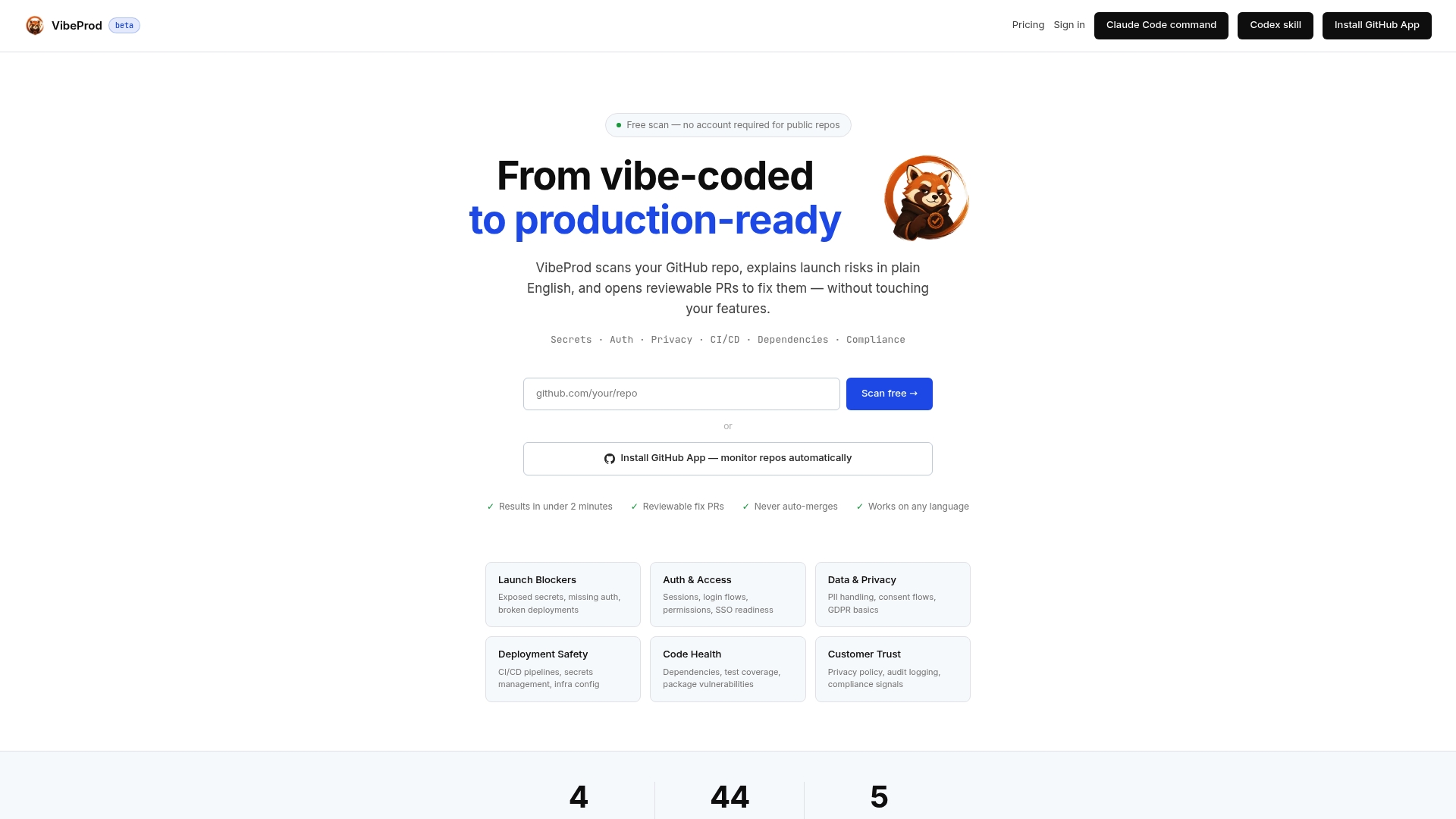
Every scan produces reviewable pull requests with plain-English explanations for each issue found, without touching your existing features. You get a clear picture of what needs fixing and why, in under two minutes. For solopreneurs and small teams shipping fast with AI assistance, that feedback loop is the difference between a prototype and a product you can put in front of real users. Vibeprod fits into your existing GitHub workflow without a complex setup or a dedicated security hire.
FAQ
What are the main automated PR benefits for AI code projects?
Automated PRs reduce manual review time by 40–60%, catch security vulnerabilities on every commit, and handle the doubled PR volumes that AI-generated code creates. They free senior developers to focus on architecture rather than mechanical checks.
How quickly can I set up an automated PR review pipeline?
A basic GitHub Actions pipeline can be running in 30 minutes, with simple installs taking as little as 5–15 minutes. Advanced multi-agent setups for high-volume teams require more configuration time.
What security vulnerabilities do automated PR tools detect?
Automated scanners flag SQL injection, hardcoded API keys, insecure data handling, exposed environment variables, and missing input validation. AI reviewers process each PR in 10–60 seconds, applying consistent checks regardless of volume.
Should automated PR tools fully replace human code review?
No. AI review should serve as the first-pass layer for mechanical and security checks, with human reviewers handling architectural decisions and judgment calls. Confidence gating routes high-certainty fixes to auto-apply while flagging uncertain issues for human review.
How do I prevent credential leakage in an AI PR review setup?
Pre-process your diffs before sending them to any AI model. Redact secrets and trim unrelated code from the payload. Fail-closed configurations add a second layer of protection by blocking merges when the reviewer encounters errors or ambiguous results.