AI Coding Workflow Security Best Practices in 2026
TL;DR:
- Securing AI coding workflows involves implementing controls like least-privilege access, input validation, and environment segmentation to prevent vulnerabilities. Teams must treat AI-generated code as third-party, review it carefully, and monitor AI tool configurations to avoid hidden risks. Adequate governance, audit trails, and sandboxing are essential to minimize advanced threats and ensure compliance.
AI coding workflow security is defined as the set of controls, protocols, and governance processes that protect AI-assisted development pipelines from code generation through production deployment. The gap between a working prototype and a production-ready application has never been more dangerous to ignore. AI tools have collapsed the time from idea to working code, but they have also introduced new attack surfaces that traditional security reviews were not built to catch. Applying ai coding workflow security best practices is no longer optional for teams that ship real software to real users. Frameworks like NIST AI Risk Management and OWASP’s guidance on AI systems now provide the baseline, and 2026 research shows that enforcing least-privilege access, input/output validation, and environment segmentation cuts breach risks by over 60%.

1. What are the foundational security principles for AI coding workflows?
Every secure AI coding workflow rests on four non-negotiable principles. Get these right first, and every layer you add on top becomes more effective.
- Least-privilege access at the agent level. AI agents should hold only scoped API permissions for defined time windows, not broad access. Least privilege enforced at the agent action level, not just the user role level, is what prevents privilege escalation when an agent is compromised.
- Input and output validation. Prompt injection is the most underestimated attack vector in AI workflows. Every input to an AI model and every output it produces should pass through a validation layer before any action is taken.
- Environment segmentation and sandboxing. Development, staging, and production environments must be isolated. An AI agent that can reach production secrets from a dev environment is a liability, not an asset.
- Automated audit logging and anomaly detection. Every agent action should be logged with enough context to reconstruct what happened, why, and who approved it. Anomaly detection on those logs catches drift before it becomes a breach.
Pro Tip: Set up your audit logging schema before you connect your first AI agent to any external API. Retrofitting logging into an existing workflow is significantly harder than building it in from the start.
2. How can developers implement secure AI code generation and review processes?
AI-generated code requires the same scrutiny as code from an unknown third-party library. The instinct to trust it because it looks correct is the exact instinct that gets teams into trouble.
- Treat AI-generated code as third-party code. Flag every file or function that an AI tool wrote or significantly modified. Require a human reviewer to sign off before it merges. This is not about distrust of the tool. It is about accountability.
- Run SAST and SCA on every AI-generated commit. Static application security testing (SAST) catches logic vulnerabilities and insecure patterns. Software composition analysis (SCA) identifies vulnerable dependencies. Both are necessary because AI models frequently suggest outdated or vulnerable packages.
- Adapt code review to AI-specific risks. Reviewers should specifically look for overly broad permissions in auth flows, missing input sanitization in middleware, and logic that assumes trusted input. These are the patterns AI models reproduce most often from training data.
- Track AI tool configurations as attack vectors. Your
.cursorrulesfile, your system prompts, and your session instructions are part of your attack surface. IDE configuration files with persistent AI instructions are trusted attack vectors that require monitoring, not just version control. - Scan for hallucinated dependencies. AI models hallucinate package names, and attackers preregister those names as malicious packages. This technique, called slopsquatting, can compromise your supply chain silently. Use a dependency scanner that flags packages with low download counts or suspicious registration dates.
Pro Tip: Add a CI/CD step that specifically checks for packages published within the last 30 days with fewer than 1,000 downloads. That pattern catches a disproportionate share of slopsquatting attempts.
3. What security controls should be applied to AI workflow integrations?
Environment controls are where workflow automation security gets concrete. Abstract principles become specific configurations here.
The most effective isolation approach uses sandboxing tools to contain AI agent processes. Tools like bubblewrap on Linux and seatbelt on macOS restrict what an agent process can read, write, and execute. Sandboxing in development environments reduces manual security permission prompts by 84%. That reduction matters because fewer prompts means fewer opportunities for a developer to click “allow” on something they should not.
Egress network controls are equally critical. An AI agent that can make arbitrary outbound connections can exfiltrate credentials even if it cannot write to disk. Apply strict egress filtering with allow-lists. Use mutual TLS for any service-to-service communication your AI agents initiate. Egress filtering is a critical defense against credential exfiltration even when the AI itself is compromised.
Never mount host secrets directly into an AI agent’s environment. Prefer short-lived tokens generated at runtime over long-lived credentials stored in environment variables. For sensitive operations, require per-action authorization. Human approval gates are mandatory for production infrastructure changes, deletions, and configuration updates. An AI agent should never be able to deploy to production without a human in the loop.
Pro Tip: Use the “Agent Action Bill of Materials” concept: for every action your AI agent can take, document the actor, the credentials used, and the intended outcome. This classification of AI actions reduces ambiguity during incident response and makes audits faster.
4. How to maintain governance, audit trails, and compliance in AI coding workflows?
Governance without structure is just good intentions. You need a defined model that tells every team member exactly what level of oversight applies to each type of AI operation.
The most practical governance model uses three risk zones:
- Green zone. Low-risk operations like code suggestions, documentation generation, and test scaffolding. AI can act autonomously. Logging is required but human review is asynchronous.
- Yellow zone. Medium-risk operations like database schema changes, dependency updates, and API integrations. AI proposes, a human approves before execution. Logs are reviewed on a scheduled cadence.
- Red zone. High-risk operations like production deployments, secret rotation, and permission changes. Human approval is mandatory before any action. Logs are immutable and reviewed immediately.
Categorizing AI operations into these risk zones is the most direct way to define control levels and human oversight without creating bottlenecks for low-risk work.
Audit logs must capture structured data, not just timestamps. A seven-field agent action log schema that records actor, action type, target resource, credentials used, input hash, output hash, and approval status satisfies GDPR and EU AI Act requirements. That specificity matters because regulators are increasingly asking for proof that AI actions were authorized, not just that they occurred.
Perform quarterly audits of your AI tool inventory. Review which tools have credentials, what permissions those credentials carry, and whether any tool has access it no longer needs. Align your audit process with NIST AI Risk Management Framework categories to ensure you are covering model governance, data provenance, and operational risk.
5. What common pitfalls and advanced threats should teams watch for?
The threats that cause the most damage are the ones teams do not think to look for. These are the ones worth knowing.
- Hidden instructions in IDE configuration files. Invisible Unicode characters in
.cursorrulesfiles can silently instruct AI agents to inject backdoors into every file they touch. Hidden characters in configuration files create persistent, project-wide attack vectors that survive code reviews because they are invisible in standard diff views. - Privilege escalation from broad agent tokens. An AI agent token with write access to your entire repository can be used to modify CI/CD pipeline definitions, which then run with elevated permissions. Scope every token to the minimum set of repositories and actions required.
- Prompt injection via external data. An AI agent that reads from external sources, like emails, tickets, or web pages, can be manipulated by malicious content in those sources. Runtime validation of all external inputs is the only reliable defense.
- Excessive agency in automated workflows. AI agents that can chain multiple actions without human checkpoints can cause cascading failures. Each action in a chain should be individually authorized for sensitive operations.
Prompt injection is not a theoretical risk. Any AI agent that reads from an external source and then takes an action is a potential execution path for an attacker who controls that source. The fix is not smarter AI. The fix is mandatory input validation layers and human approval gates at every consequential step.
Four critical remote code execution vulnerabilities were found in a popular automation platform in Q1 2026, with one scored at 10.0 CVSS. That score represents the maximum possible severity. Self-hosted AI workflow platforms carry the same class of risk if they are not patched and monitored continuously.
Key Takeaways
Securing AI coding workflows requires layered controls: least-privilege access, validated inputs and outputs, sandboxed environments, structured governance zones, and immutable audit logs that satisfy NIST and EU AI Act requirements.
| Point | Details |
|---|---|
| Least-privilege at agent level | Scope AI agent tokens to minimal API endpoints and defined time windows, not broad repository access. |
| Validate all inputs and outputs | Apply mandatory validation layers to prevent prompt injection from external data sources reaching agent actions. |
| Sandbox every AI agent process | Use tools like bubblewrap or seatbelt to isolate agent processes and apply strict egress network controls. |
| Govern with risk zones | Classify operations as Green, Yellow, or Red to define the right level of human oversight for each action type. |
| Audit logs must be structured | Capture a seven-field schema per agent action to satisfy GDPR, EU AI Act, and NIST audit requirements. |
The part of AI security most teams skip until it’s too late
Working with developers who ship fast using AI tools, the pattern that shows up repeatedly is this: teams invest heavily in the AI tooling itself and almost nothing in the controls around it. The assumption is that if the code works, it is safe. That assumption is wrong, and it is expensive to learn the hard way.
The most underrated practice in AI development safety measures is treating your AI tool’s configuration files with the same care as your production secrets. Your system prompts, your agent instructions, your .cursorrules files. These are not just settings. They are executable instructions that run with the trust level of your entire development environment. One malicious character in one configuration file can redirect every AI action in your project.
Extending CI/CD security practices to AI workflows is the most effective way to close AI-specific gaps without rebuilding your entire pipeline. You already have the infrastructure. Add AI-specific checks to the gates you already run. SAST, dependency scanning, and secret detection all apply directly to AI-generated code. The only addition is a step that validates AI tool configurations and flags new or modified agent instruction files for human review.
The teams that get this right do not slow down. They ship faster because they catch problems before they reach production, not after.
— Vibeprod
How Vibeprod fits into a secure AI coding workflow
Vibeprod addresses the exact gap where most AI-assisted projects get into trouble: the space between working code and production-ready code.
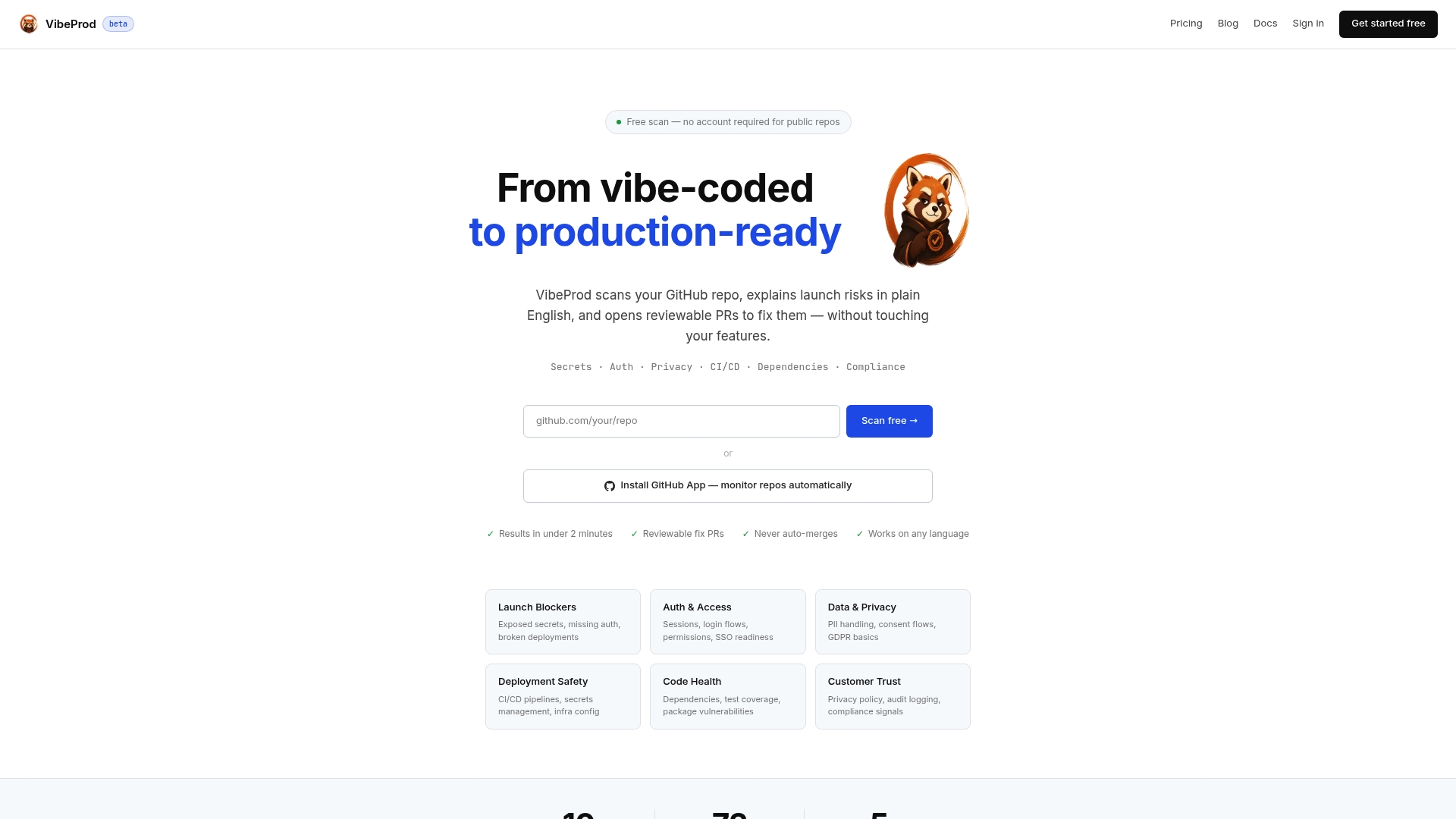
Vibeprod scans your GitHub repository and identifies launch risks including exposed secrets, missing compliance controls, and insecure patterns in AI-generated code. It then generates reviewable pull requests with plain-English explanations for each issue, so you understand what is wrong and why, not just that something needs to change. The entire process runs in under two minutes. For solo developers and small teams, that means you can ship production-ready code without dedicating a full sprint to security review. You stay focused on your core product while Vibeprod handles the audit layer that AI coding tools routinely skip.
FAQ
What is AI coding workflow security?
AI coding workflow security is the practice of applying access controls, validation, sandboxing, and governance to every stage of an AI-assisted development pipeline. The goal is to prevent AI-generated code and AI agent actions from introducing vulnerabilities or compliance failures into production systems.
How does least-privilege access apply to AI agents?
Least-privilege for AI agents means scoping each agent’s API permissions to the minimum endpoints and actions it needs for a specific task, within a defined time window. Broad, persistent access tokens are the primary cause of privilege escalation in AI workflow environments.
What is slopsquatting in AI code generation?
Slopsquatting is a supply chain attack where attackers preregister package names that AI models commonly hallucinate. When a developer installs the hallucinated package name, they install the attacker’s malicious version instead of a legitimate library.
How do you audit AI agent actions for compliance?
Log every agent action using a structured schema that captures the actor, action type, target resource, credentials used, input and output hashes, and approval status. This seven-field structure satisfies GDPR and EU AI Act audit requirements and supports anomaly detection.
What is the Green/Yellow/Red zone model for AI governance?
The risk zone model classifies AI operations by consequence level. Green zone actions run autonomously with async logging. Yellow zone actions require human approval before execution. Red zone actions, like production deployments, require mandatory human approval and immediate log review.