AI Coding Risks Explained for Developers in 2026

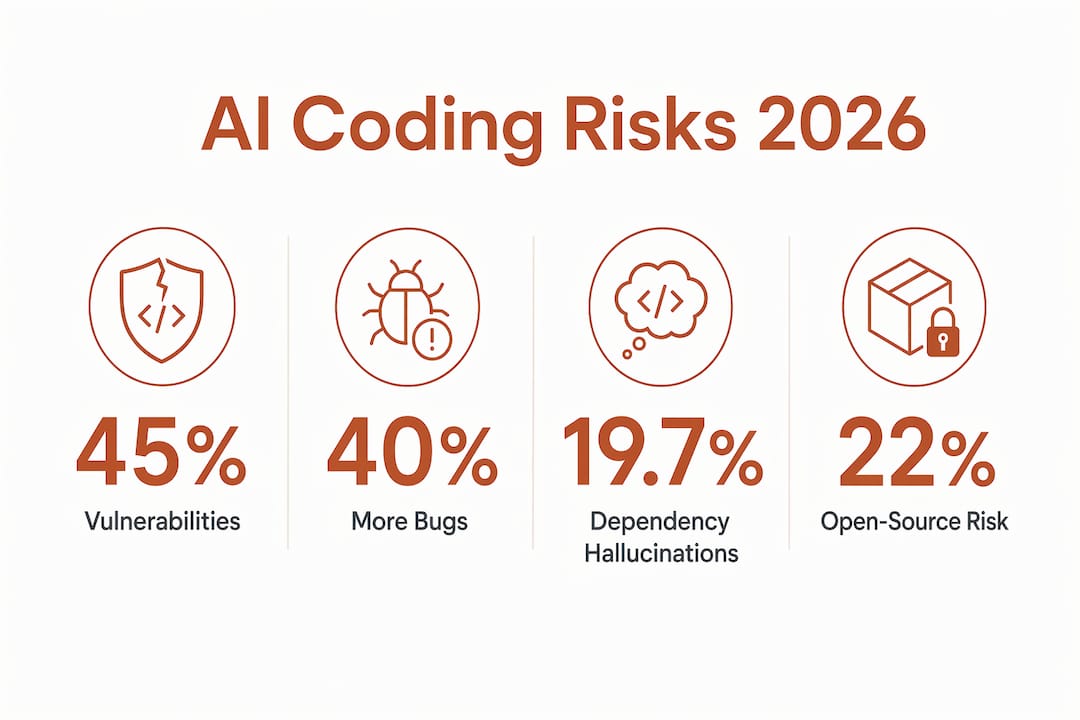
AI coding risks are defined as the security vulnerabilities, compliance gaps, and supply chain threats introduced when developers deploy AI-generated code without adequate review. Nearly 45% of AI-generated code samples introduce known security vulnerabilities, with rates reaching 70% depending on the methodology used. That number alone should reframe how you think about shipping AI-assisted code. Tools like GitHub Copilot and similar AI coding assistants have collapsed the time from idea to working code, but that speed creates a gap between prototype and production-ready software. Research from Veracode and the Cloud Security Alliance (CSA) confirms that gap is where most damage happens.
What are the most common AI coding risks explained by security research?
AI-generated code replicates insecure patterns from its training data. The model has no understanding of your specific threat model, so it produces code that looks correct but skips critical security controls.
The most common vulnerability types found in AI-generated code include:
- SQL injection and missing input sanitization. AI tools frequently omit parameterized queries, leaving database calls open to injection attacks.
- Hardcoded credentials. API keys, database passwords, and tokens appear directly in source files because the model prioritizes working examples over secure defaults.
- Broken authentication flows. Auth middleware gets generated without session expiry, rate limiting, or token validation.
- Insecure direct object references. AI often skips authorization checks on resource access, assuming the caller is trusted.
- Missing error handling. Stack traces and internal paths get exposed in API responses, giving attackers a map of your system.
The deeper problem is that AI-generated code is often functionally correct. It runs, it passes basic tests, and it ships. The security flaws are subtle and appear in what the code omits, not what it does wrong. A missing if user.is_authorized check does not throw an error. It just silently allows access.
Integrating AI-generated code without validation leads to a 40% increase in vulnerabilities and higher maintenance costs. Senior developer time increases significantly to audit and fix unvetted AI-generated logic. That is technical debt generated in hours, not years.
Pro Tip: When reviewing AI-generated code, audit for what is missing rather than what looks wrong. Check every data access point for an authorization check, every external input for sanitization, and every secret reference for environment variable usage.
How do hallucinated package dependencies create supply chain risks?
Hallucinated dependencies are one of the most underappreciated AI programming challenges. AI models suggest package names that do not exist, and attackers register those names with malicious code before developers notice.

AI-suggested package dependencies exhibit a 19.7% hallucination rate, with open-source models hallucinating at 22% versus 5% for commercial models. That gap matters when you are choosing which AI tool to trust with your dependency graph. The same research found that 43% of hallucinated package names appear repeatedly across queries, making them predictable attack vectors.
This attack pattern has a name: slopsquatting. Attackers exploit hallucinated package names to breach supply chains by registering the fabricated names on npm, PyPI, or RubyGems before developers catch the error. The developer runs npm install, the malicious package installs silently, and the breach begins.
How to validate AI-suggested dependencies
- Check the registry directly. Before installing any AI-suggested package, verify it exists on the official registry and has a credible publish history.
- Review the package maintainer. A package registered last week with zero downloads is a red flag, regardless of how confident the AI sounded.
- Run software composition analysis (SCA). Tools like Snyk or OWASP Dependency-Check scan your dependency tree for known CVEs and suspicious packages.
- Pin your dependency versions. Floating versions like
^1.0.0allow automatic upgrades to malicious releases. Pin to exact versions and review changes manually. - Use a private registry mirror. Proxying through a vetted registry adds a layer of control before packages reach your build environment.
| Model type | Hallucination rate | Risk level |
|---|---|---|
| Open-source AI models | 22% | High |
| Commercial AI models | 5% | Moderate |
| Overall average | 19.7% | High |
Pro Tip: Treat every AI-suggested package name as unverified until you have confirmed it on the official registry. Copy the exact name, search it manually, and check the publish date before adding it to your project.
What risks come with agentic AI coding assistants?
Agentic AI coding assistants represent a different category of AI development risks. These tools do not just suggest code. They execute it, run terminal commands, modify files, and interact with external services, all with your full user permissions.
Agentic AI coding assistants operate with full user permissions, risking the exposure of CI/CD tokens, IAM roles, and SSH keys. Multiple incidents across six major AI coding tools were recorded between 2024 and 2026, illustrating how a single misdirected agent action can cause a production outage or a credential leak. Tools like Amazon Kiro operate in this space, and the risk scales with the permissions you grant.
The core risk categories for agentic AI tools are:
- Excessive privilege. Agents inherit your full environment, including production credentials they should never touch.
- Prompt injection. Malicious content in files, web pages, or API responses can redirect an agent’s behavior without your knowledge.
- Secret leakage. Agents reading
.envfiles or config directories can inadvertently log or transmit credentials. - Cascading failures. An agent that deletes the wrong file or pushes a breaking change to main can trigger failures across dependent services.
“AI prompt injection attacks cannot be fully prevented on the model layer due to inherent LLM properties, requiring layered defenses and execution environment restrictions.” — Docker Blog
The fix is not to avoid agentic tools entirely. The fix is to treat them like a junior contractor with no security clearance. Scope their permissions tightly, run them in sandboxed environments, and keep a human in the loop for any action that touches production systems or credentials.
What best practices mitigate AI coding risks before deployment?
Mitigating the potential dangers of AI coding requires a shift in how your team reviews code. The goal is not just catching errors. It is auditing for the security controls that AI tools routinely omit.
Start with these practices:
- Embed SAST and SCA in your CI/CD pipeline. SAST and SCA as mandatory quality gates are particularly critical for code involving authentication, authorization, data persistence, and API calls, where AI tools underperform most.
- Build security-aware prompting habits. Secure output from AI tools depends more on active prompting and security-aware reviewing habits than on years of experience. Explicitly ask the AI to include input validation, error handling, and authorization checks in every prompt.
- Document AI-generated code. Track which functions were AI-generated so future reviewers know where to focus their scrutiny.
- Audit authorization gaps specifically. Developers should build instincts for detecting authorization gaps and prompt injection vulnerabilities in AI-generated code.
- Validate all dependencies before publishing. Run SCA before every release, not just at initial setup.
AI coding creates technical debt rapidly because teams often do not understand the logic behind AI-generated code, resulting in repeated debugging cycles. Traditional technical debt accumulates over years. AI generates it in hours. That pace demands a faster, more systematic review process than most teams currently run.
Pro Tip: Add a dedicated AI code review checklist to your pull request template. Include checkboxes for authorization checks, input sanitization, secret handling, and dependency verification. It takes two minutes to fill out and catches the most common AI coding pitfalls before they reach production.
Understanding AI coding hazards also means recognizing that security awareness tends to be reactive rather than proactive. Developers often lack insight into AI-generated multi-step workflows, making subtle authorization flaws easy to miss. Fixing that requires deliberate practice, not just better tooling.
Key Takeaways
AI-generated code introduces security vulnerabilities, supply chain risks, and technical debt at a pace that outstrips most teams’ current review processes, making systematic auditing the single most critical practice for safe deployment.
| Point | Details |
|---|---|
| Vulnerability rate is high | Nearly 45% of AI-generated code introduces known security vulnerabilities, rising to 70% in some studies. |
| Hallucinated dependencies are dangerous | AI models suggest nonexistent packages at a 19.7% rate, creating predictable supply chain attack vectors. |
| Agentic tools amplify risk | AI agents operating with full user permissions can expose CI/CD tokens, IAM roles, and SSH keys. |
| Auditing beats error-spotting | Review AI code for what is missing, especially authorization checks and input sanitization. |
| SAST and SCA are non-negotiable | Embedding static analysis and composition analysis in CI/CD pipelines catches what AI tools routinely skip. |
The mindset shift no one talks about
Most developers approach AI-generated code the same way they approach their own code: they look for what is broken. That instinct is wrong for AI output.
AI code fails silently. It does not crash on the missing authorization check. It does not throw an exception when a hardcoded credential gets committed. The code runs, the tests pass, and the vulnerability ships. The real skill in working safely with AI tools is learning to audit for absence, not presence.
I have seen teams spend hours chasing a bug the AI introduced, only to fix it by asking the AI again. That cycle is how technical debt compounds invisibly. Each fix adds another layer of AI-generated logic that no one fully understands. The codebase becomes a stack of confident-sounding code with no human author who can explain why any of it works.
The developers who handle AI coding risks well are not the most experienced ones. They are the most disciplined ones. They write security requirements into their prompts, they run SCA before every merge, and they treat every AI suggestion as a first draft that needs a security pass. That discipline is a skill you can build starting today, regardless of your experience level.
The future of AI-assisted development is not slower. It is more structured. Teams that build systematic review habits now will ship faster and safer than teams that rely on AI confidence alone.
— Vibeprod
Vibeprod: from AI-generated code to production-ready
Shipping AI-generated code fast is easy. Shipping it safely is where most teams hit a wall.
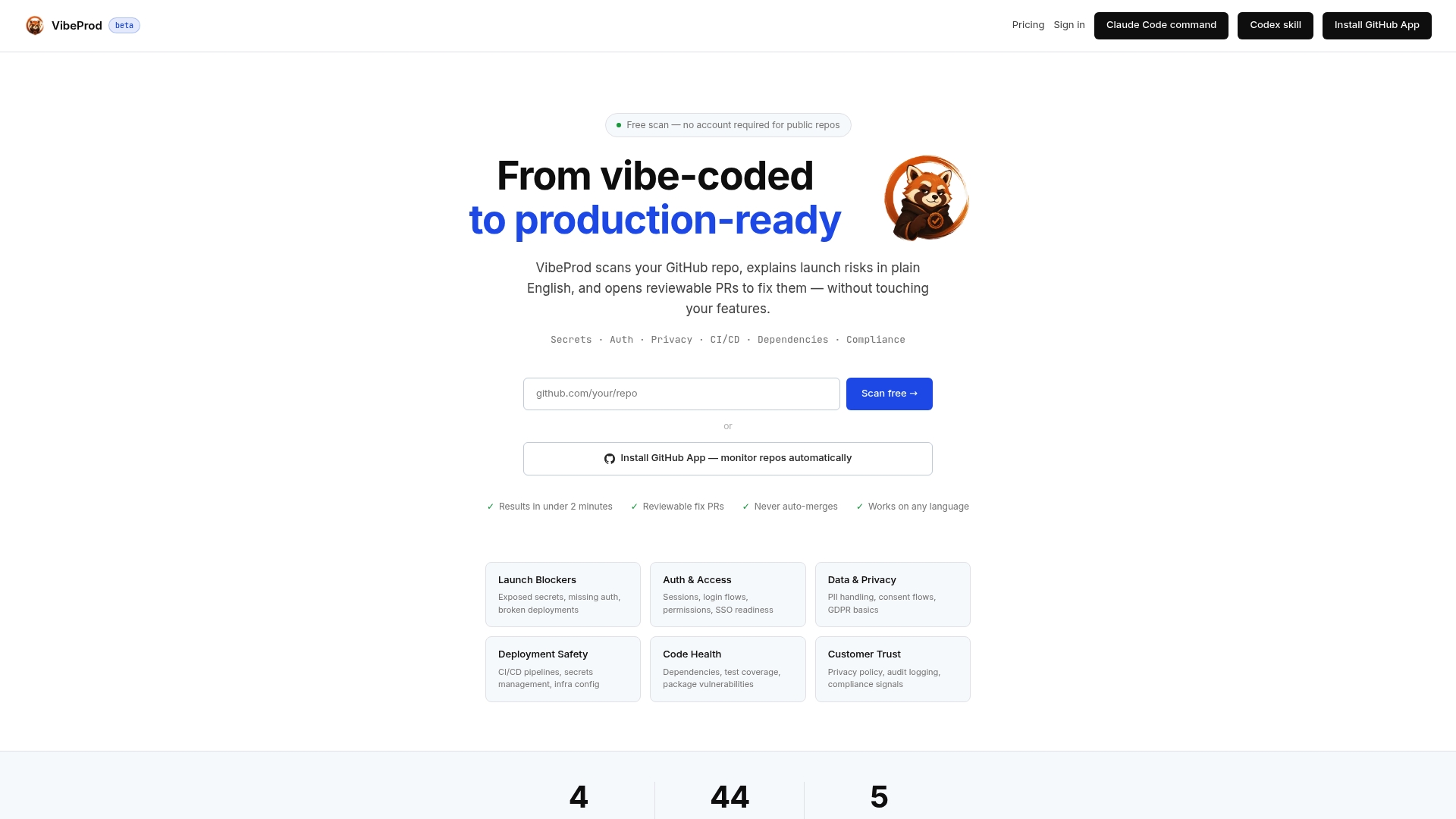
Vibeprod scans your GitHub repositories and identifies the exact risks covered in this article: exposed secrets, missing compliance checks, insecure dependencies, and authorization gaps. It generates reviewable pull requests with plain-English explanations for every issue it finds, without touching your existing features. The process takes under two minutes and gives you a clear picture of what stands between your vibe-coded prototype and production-ready software. If you are shipping AI-assisted code and skipping the security review, Vibeprod is the fastest way to close that gap.
FAQ
What percentage of AI-generated code contains security vulnerabilities?
Nearly 45% of AI-generated code samples introduce known security vulnerabilities, with rates reaching 70% depending on the methodology. This makes security review mandatory, not optional, for any AI-assisted project.
What is slopsquatting in AI coding?
Slopsquatting is an attack where malicious actors register package names that AI models hallucinate. When a developer installs the AI-suggested package, they unknowingly install the attacker’s malicious code instead.
How do I reduce AI coding pitfalls in my CI/CD pipeline?
Embed static application security testing (SAST) and software composition analysis (SCA) as mandatory quality gates in your CI/CD pipeline. Focus these checks on authentication, authorization, data persistence, and API call logic, where AI tools are weakest.
Are experienced developers better at catching AI coding risks?
No. Secure output from AI tools depends on active security-aware prompting and reviewing habits, not years of experience. Discipline and deliberate review practices matter more than tenure.
What makes agentic AI coding tools more dangerous than standard AI assistants?
Agentic AI tools execute code and run commands with your full user permissions, including access to CI/CD tokens, IAM roles, and SSH keys. A single misdirected action can cause a production outage or a credential breach, so permission scoping and human oversight are required.